Category
page 1Population ecology

population density
measurement of population per unit area or unit volume

population
ensemble of individuals of a species in an area, or their number
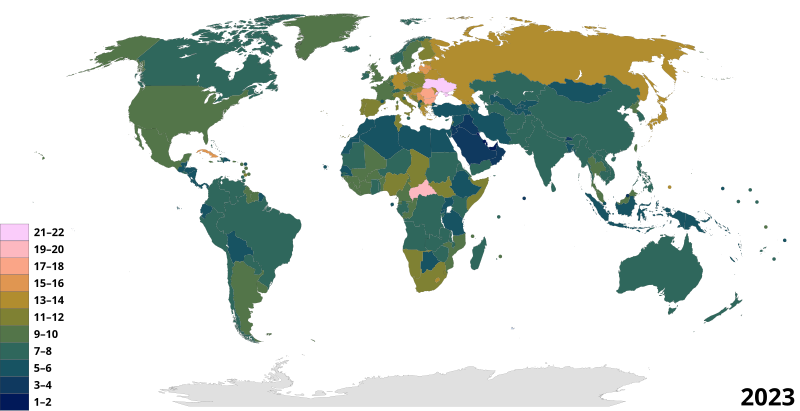
mortality rate
measure of the number of deaths in a population from a given cause, scaled by population, in a set period of time

one-child policy
population control policy which was used by the People's Republic of China

birth rate
total number of live births per 1,000 population divided by the length of a given period in years

population growth
increase in the number of individuals in a population

human overpopulation
undesirable condition where human numbers exceed the current carrying capacity of the environment
range
geographical area in which a taxon can be found

carrying capacity
maximum population size of the species that the environment can sustain indefinitely
reproductive rights
legal rights and freedoms relating to reproduction and reproductive health
colony collapse disorder
poorly-understood phenomenon causing decline in bee populations
logistic function
mathematical function
Lotka–Volterra equations
first-order nonlinear differential equations, frequently used to describe the dynamics of biological systems in which two species interact, one as a predator and the other as prey
r/K selection theory
ecological theory concerning the selection of life history traits
baby boom
period marked by a significant increase of birth rate
effective population size
ecological concept
.svg)
metapopulation
thumb|Metapopulations are important in fisheries. The local population (1.) serves as a source for hybridization with surrounding subspecies populations (1.a, 1.b, and 1.c).The populations are normally spatially separated and independent but spatial overlap between them during breeding times allows for gene flow between the populations.
A metapopulation consists of a group of spatially separated populations of the same species which interact at some level. The term metapopulation was coined by Richard Levins in 1969 to describe a model of population dynamics of insect pests in agricultural fie
Refugium
ecological concept
biological dispersal
movement of individuals (animals, plants, fungi, bacteria, etc.) from their birth site to their breeding site, as well as the movement from one breeding site to another
white-nose syndrome
disease affecting hibernating bats caused by a white fungus infecting the skin of the muzzle, ears, and wings
Behavioral sink
conceptual collapse in behavior which can result from overcrowding

overconsumption
thumb|Anti Shein protest, Grenoble, France
Overconsumption describes a situation where consumers overuse their available goods and services to where they cannot, or do not want to, replenish or reuse them. In microeconomics, this is the point where the marginal cost of a consumer is greater than their marginal utility. The term overconsumption is quite controversial and does not necessarily have a single unifying definition. When used to refer to natural resources to the point where the environment is negatively affected, it is synonymous with the term overexploitation. However, when used in t
Malthusian growth model
exponential growth based on a constant rate

Polyphenism
thumb|right|Biston betularia caterpillars on birch (left) and willow (right), demonstrating a color polyphenism.
A polyphenic trait is a trait for which multiple, discrete phenotypes can arise from a single genotype as a result of differing environmental conditions. It is therefore a special case of phenotypic plasticity.
decline in amphibian populations
ongoing mass extinction of amphibian species worldwide
decline in insect populations
ecological trend
Charles Sutherland Elton
British zoologist and ecologist (1900–1991)
life history theory
analytical framework designed to study the diversity of life history strategies used by different organisms throughout the world, as well as the causes and results of the variation in their life cycles
Mark and recapture
ecological sampling method

overpopulation
Overpopulation or overabundance is a state in which the population of a species is larger than the carrying capacity of its environment. This may be caused by increased birth rates, lowered mortality rates, reduced predation or large scale migration, leading to an overabundant species and other animals in the ecosystem competing for food, space, and resources. The animals in an overpopulated area may then be forced to migrate to areas not typically inhabited, or die off without access to necessary resources.
National Security Study Memorandum 200
1974 American memo on population control
net reproduction rate
average number of daughters per woman
biocapacity
The biocapacity or biological capacity of an ecosystem is an estimate of its production of certain biological materials such as natural resources, and its absorption and filtering of other materials such as carbon dioxide from the atmosphere.
two-child policy
government-imposed limit of two children per family
survivorship curve
shows the proportion of individuals surviving to each age for a given species or group
Fisher's equation
PDE named after statistician and biologist Ronald Fisher
doubling time
time required to double a quantity
world energy resources
estimated maximum capacity for energy production on Earth
zero population growth
condition of demographic balance where population remains constant over time
projections of population growth
world population growth projections
three-child policy
population control policy in China
relative species abundance
Concept in ecology
irruptive growth
population dynamics model characterized by sharp booms and busts
I = PAT
equates human impact on the environment
species discovery curve
Competitive Lotka–Volterra equations
model of multi-species population dynamics
predator satiation
anti-predator adaption
ecoauthoritarianism
Ecoauthoritarianism (also known as an eco-dictatorship or authoritarian environmentalism) is a political ideology which attempts to reconcile both environmentalist and authoritarian tendencies. It is justified by the belief of the inevitability and necessity of a strong central government to preserve the environment.
Leslie matrix
age-structured model of population growth
floating population
group of residents outside an official census count
hyperbolic growth
growth function exhibiting a singularity in a finite time
Population dynamics of fisheries