File:Mortality_Rate_Map_by_Country.svg · Wikimedia Commons · See Wikimedia Commons
mortality rate
Sign in to saveAlso known as death rate, mortality
measure of the number of deaths in a population from a given cause, scaled by population, in a set period of time
A mortality rate measures how many people die from a specific cause within a certain population over a set period of time, adjusted to account for the size of that population. It matters because it helps us understand how deadly a disease, condition, or cause is, and allows us to compare health risks fairly across different groups and places.
AI-generated from the Wikipedia summary — may contain errors.
Research
1,804,761 papers- Amniotic fluid embolism mortality rate.ReviewThe journal of obstetrics and gynaecology research · 2017Benson MDDOI: 10.1111/jog.13445
- A systematic review and meta-analysis on mortality rate following total pelvic exenteration in cancer patients.BMC cancer · 2024Esmailzadeh A, Fakhari MS, Saedi N et al.DOI: 10.1186/s12885-024-12377-5
- Mortality rate of end-stage kidney disease patients in Taiwan.Journal of the Formosan Medical Association = Taiwan yi zhi · 2022Wu BS, Wei CH, Yang CY et al.DOI: 10.1016/j.jfma.2021.12.015
- Is Neonatal Mortality Rate in Ethiopia Going from Bad to Worse?Ethiopian journal of health sciences · 2022Haileamlak ADOI: 10.4314/ejhs.v32i3.1
- COVID-19 mortality rate in children is U-shaped.Aging · 2021Khera N, Santesmasses D, Kerepesi C et al.DOI: 10.18632/aging.203442
- Trends in non-Hodgkin lymphoma mortality rate in Japan and the United States: A population-based study.Cancer science · 2023Usui Y, Ito H, Katanoda K et al.DOI: 10.1111/cas.15926
- In- and out-hospital mortality rate in surgical patients.Acta chirurgica Belgica · 2018Dony P, Pirson M, Boogaerts JGDOI: 10.1080/00015458.2017.1353236
- Dietary restriction of rodents decreases aging rate without affecting initial mortality rate -- a meta-analysis.Aging cell · 2013Simons MJ, Koch W, Verhulst SDOI: 10.1111/acel.12061
via PubMed
~15 min read
Encyclopedic overview
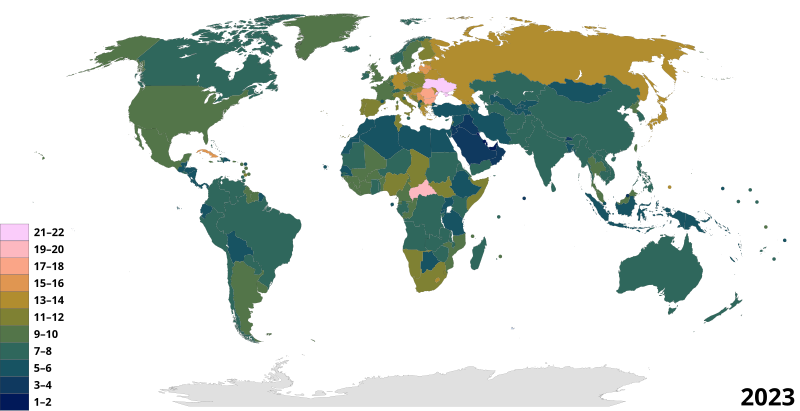
Mortality rate of countries, deaths per thousand
Mortality rate, or death rate, is a measure of the number of deaths (in general, or due to a specific cause) in a particular population, scaled to the size of that population, per unit of time. Mortality rate is typically expressed in units of deaths per 1,000 individuals per year; thus, a mortality rate of 9.5 (out of 1,000) in a population of 1,000 would mean 9.5 deaths per year in that entire population, or 0.95% out of the total. It is distinct from "morbidity", which is either the prevalence or incidence of a disease, and also from the incidence rate (the number of newly appearing cases of the disease per unit of time).
Excerpted from Wikipedia’s “mortality rate” article, available under the CC BY-SA 4.0 licence.
Gallery (2)
Available in 62 languages
- Español
- Français
- Deutsch
- 中文
- 日本語
- Русский
- Português
- Italiano
- العربية
- Albanian
- Bahasa Indonesia
- Basque
- Belarusian
- Bosnian
- Bulgarian
- Catalan
- Croatian
- Czech
Show 43 more
- Danish
- Esperanto
- Estonian
- Finnish
- Galician
- Greek
- Haitian Creole
- Hebrew
- Hungarian
- Kabyle
- Kazakh
- Kyrgyz
- Latvian
- Limburgish
- Lithuanian
- Macedonian
- Malay
- Nederlands
- Nepali
- Norwegian
- Norwegian Nynorsk
- Polski
- Romanian
- Serbian
- Serbian (Latin)
- simple
- Sinhala
- Slovak
- Slovenian
- Svenska
- Swahili
- Tamil
- Tiếng Việt
- Türkçe
- Ukrainian
- Urdu
- Walloon
- Welsh
- Wu Chinese
- zh_yue
- فارسی
- ไทย
- 한국어
via Wikidata sitelinks · CC0