Category
page 1Post-Soviet states
Ukraine
Ukraine is a country in Eastern Europe. It is the second-largest country in Europe after Russia, which borders it to the east and northeast. Ukraine also borders Belarus to the north; Poland and Slovakia to the west; Hungary, Romania and Moldova to the southwest; and the Black Sea and the Sea of Azov to the south and southeast. Kyiv is the nation's capital and largest city, followed by Kharkiv, Odesa, and Dnipro. The official language of Ukraine is Ukrainian.
Moldova
Moldova, officially the Republic of Moldova, is a landlocked country in Eastern Europe, with an area of and a population of 2.38 million. Moldova is bordered by Romania to the west and Ukraine to the north, east, and south. The unrecognised breakaway state of Transnistria lies across the Dniester river on the country's eastern border with Ukraine. Moldova is a unitary parliamentary representative democratic republic with its capital in Chișinău, the country's largest city and main cultural and commercial centre.
Republic of Abkhazia
Abkhazia, officially the Republic of Abkhazia, is a partially recognised state in the South Caucasus. It sits on the eastern coast of the Black Sea, at the intersection of Eastern Europe and West Asia. It covers and has a population of around 245,000. Its capital and largest city is Sukhumi.
South Ossetia
state in the South Caucasus
Transnistria
Transnistria, officially known as the Pridnestrovian Moldavian Republic (PMR) and locally as Pridnestrovie, is a landlocked breakaway state internationally recognised as part of Moldova. It controls most of the narrow strip of land between the Dniester river and the Moldova–Ukraine border, as well as some land on the other side of the river's bank. Its capital and largest city is Tiraspol. Transnistria is officially designated by the Republic of Moldova as the Administrative-Territorial Units of the Left Bank of the Dniester () or as ("Left (Bank) of the Dniester").
Commonwealth of Independent States
regional organisation whose participating countries are former Soviet Republics

Republic of Artsakh
former de-facto state in South Caucasus from 1992 to 2024

Eurasian Economic Union
economic organization of northern and central Asian and eastern European countries

Collective Security Treaty Organization
intergovernmental military alliance among post-Soviet states
Chechen Republic of Ichkeria
government in exile of Chechnya since 2000. Based in London
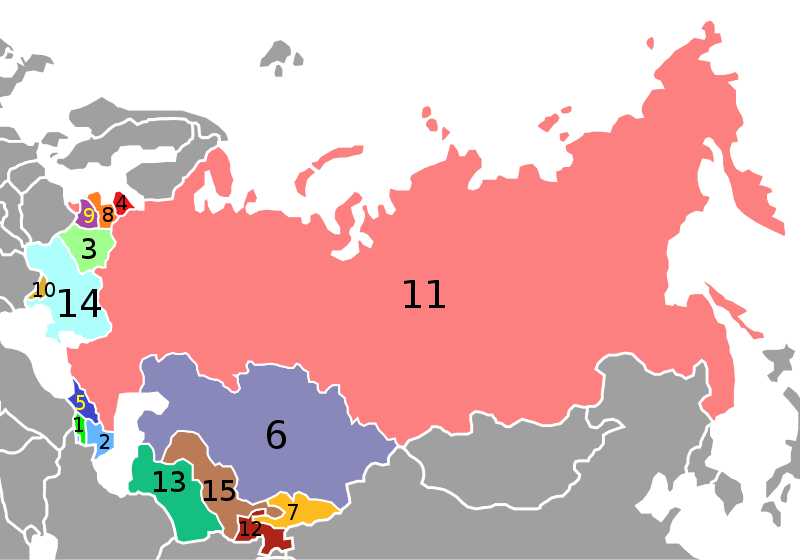
Post-Soviet states
states established following the disestablishment of the Soviet Union

Memorial
Russian historical and civil rights society

republic of the Soviet Union
top-level political division of the Soviet Union
satellite state

Soviet ruble
currency of the Union of Soviet Socialist Republics; briefly used by post-Soviet states after the dissolution of the Soviet Union
Gagauz Republic
1989–1995 self-proclaimed political entity in Eastern Europe
shock therapy
sudden release of price and currency controls
business oligarch
business magnate of great political influence
national delimitation in the Soviet Union
process of allocating national administrative-territorial units
Mir
TV channel in CIS and Baltic region
near abroad
states established following the dissolution of the Soviet Union, as seen from a Russian perspective
Kurdish Republic of Lachin
short-lived self-proclaimed political entity in the Caucasus
Operation Provide Hope
1992 US Navy humanitarian mission
state continuity of the Baltic states
legal continuity of Estonia, Latvia, and Lithuania under international law

Neo-Sovietism
thumb|Belarusian Honor Guard carrying the national flags of Belarus and the Soviet Union, as well as the Soviet victory banner, in Minsk, 2019.
CIS Interparliamentary Assembly
Consultative parliamentary body
Supreme Council of the Republic of Uzbekistan
legislature of Uzbekistan (1991–1994)
ethnic Russians in post-Soviet states
part of the Orthodox Slavic ethnic group in the territory of the former USSR