Moldova
Sign in to saveAlso known as Republic of Moldova, Moldavia, Republica Moldova
Moldova, officially the Republic of Moldova, is a landlocked country in Eastern Europe, with an area of and a population of 2.38 million. Moldova is bordered by Romania to the west and Ukraine to the north, east, and south. The unrecognised breakaway state of Transnistria lies across the Dniester river on the country's eastern border with Ukraine. Moldova is a unitary parliamentary representative democratic republic with its capital in Chișinău, the country's largest city and main cultural and commercial centre.
OverviewAI-generated
Moldova, officially the Republic of Moldova, is a landlocked sovereign state in Eastern Europe. It shares borders with Ukraine, Romania, Transnistria, and the European Union. The capital city is Chișinău. The country’s name derives from the Principality of Moldavia.
The population is recorded as 2,749,076 or 2,402,306 depending on the source. The area covers 33,847 square kilometers. Official languages are Moldovan and Romanian. The currency is the Moldovan leu. The national anthem is Limba noastră. The top-level Internet domain is .md.
Moldova is a member of the United Nations, Council of Europe, World Trade Organization, and Organization of the Black Sea Economic Cooperation. The head of state includes Igor Dodon, Nicolae Timofti, Maia Sandu, and Vladimir Voronin. The head of government includes Iurie Leancă, Valeriu Streleț, Chiril Gaburici, and Vlad Filat. The telephone country code is 373.
Synthesized by Vinony from 67 facts across 9 sources: Wikidata, REST Countries, Openweathermap, Open Meteo, World Bank, OpenStreetMap, PubMed, Vinony graph, Geo. Generated from structured data (not the Wikipedia text) and checked against those facts — may still contain errors.
In the Vinony graph
Moldova is indexed among the 215 entries in Vinony's Countries collection.
Within Vinony's link graph, Moldova is referenced by 17,879 other articles, and connects out to Dniester, Organization for Security and Co-operation in Europe and Parliament of the Republic of Moldova.
The entry is geolocated on the map in city, across 6 mapped points.
It sits within the topics 1991 establishments in Europe, Countries and territories where Romanian is an official language and Countries in Europe.
Weather now
cached 18h ago7-day forecast
via Open-Meteo
Country

- Capital
- Chișinău
- Population
- 2,749,076
- Region
- Europe · Eastern Europe
- Demonym
- Moldovan
- Currencies
- MDL (L)
- Languages
- Romanian
- Calling code
- +373
- Drives on
- Right
- Gini
- 25.7 (2018)
- FIFA code
- MDA
- TLD
- .md
- Timezones
- UTC+02:00
- Borders
- ROU, UKR
via REST Countries
Indicators · World Bank
- GDP
- $18.2B(2024)
- Population
- 2,402,306(2024)
- Life expectancy
- 71.3 yrs(2024)
- Unemployment
- 1.5 %(2025)
- Urban population
- 43.5 %(2024)
- Internet users
- 77.4 %(2024)
- Forest area
- 11.7 %(2023)
- Renewable energy
- 21.4 %(2021)
via World Bank Open Data · CC BY 4.0
Wikipedia views (30d)
145,498 totalvia Wikimedia Pageviews API
Key facts
- Country.area_rank
- 135th
- Country.conventional_long_name
- Republic of Moldova
- Country.common_name
- Moldova
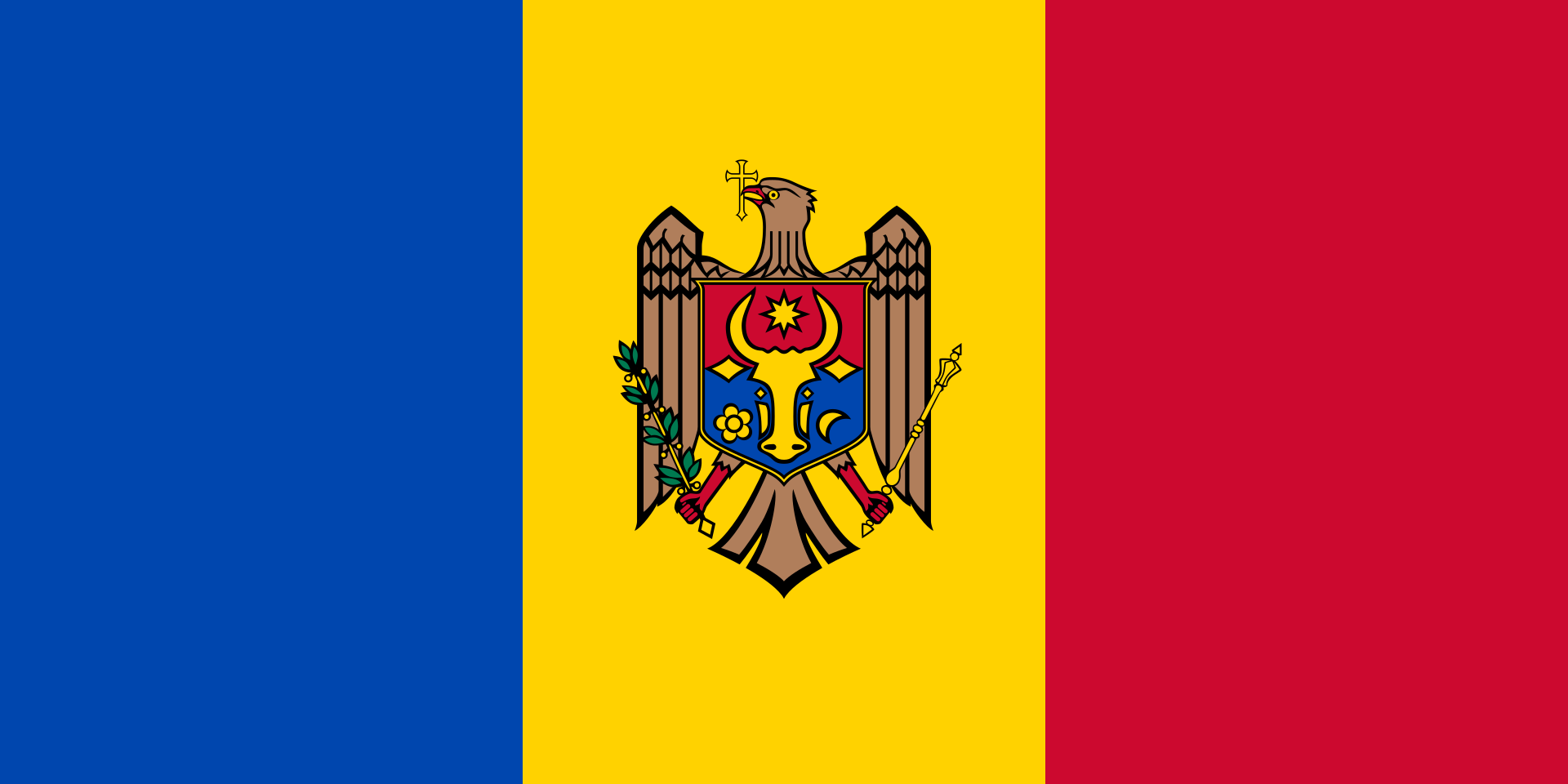
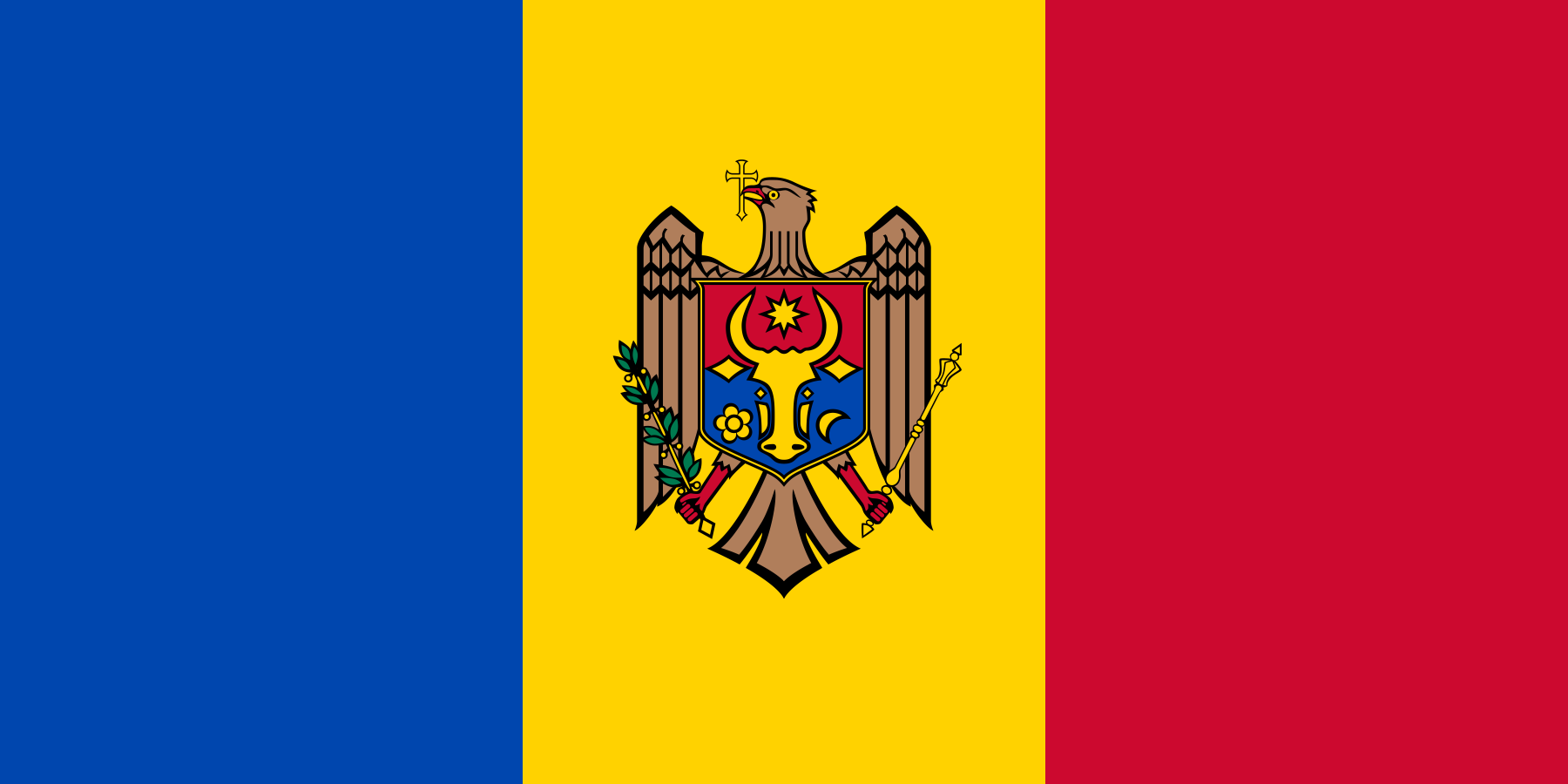
- Country.image_flag
- Flag of Moldova.svg
- Country.image_coat
- Coat of arms of Moldova.svg
- Country.national_anthem
- "Our language"
- Country.map_caption
- Location of Moldova in Europe (green)and its uncontrolled territory of Transnistria (light green)
- Country.capital
- Chișinău
- Country.largest_city
- capital
- Country.languages_type
- Official language
- Country.languages
- Romanian
- Country.languages2_type
- Recognised minoritylanguages
- Country.ethnic_groups_year
- 2024; excl. Transnistria
- Country.religion
- 97.4% Christianity 94.3% Eastern Orthodoxy 3.1% other Christian 0.3% other 1.5% no religion 0.8% unanswered
- Country.religion_year
- 2024; excl. Transnistria
- Country.demonym
- Moldovan
- Country.government_type
- Unitary parliamentary republic
- Country.leader_title1
- President
via Wikipedia infobox
Research
3,162 papers- The blood transfusion service in the Republic of Moldova.ReviewTransfusion and apheresis science : official journal of the World Apheresis Association : official journal of the European Society for Haemapheresis · 2023Cebotari SDOI: 10.1016/j.transci.2023.103808
- Hepatitis C Elimination in Moldova Is Feasible and Cost-Saving: A Modeling Study.The Journal of infectious diseases · 2023Aaron A, Zhong H, Hiebert L et al.DOI: 10.1093/infdis/jiad138
- MOLDOVA - SYSTEMATIC PREPAREDNESS FOR MEDICAL RESPONSE TO RADIATION EMERGENCIES.Problemy radiatsiinoi medytsyny ta radiobiolohii · 2024Stetsyk V, Tereshchenko H, Chumak AADOI: 10.33145/2304-8336-2024-29-489-492
- Limited Nosocomial Transmission of Drug-Resistant Tuberculosis, Moldova.Emerging infectious diseases · 2023Noroc E, Chesov D, Merker M et al.DOI: 10.3201/eid2905.230035
- The experience of the implementation of perinatal audit in Moldova.ReviewBJOG : an international journal of obstetrics and gynaecology · 2014Stratulat P, Curteanu A, Caraus T et al.DOI: 10.1111/1471-0528.12996
- Risk Factors for Cerebral Palsy in Moldova.Medicina (Kaunas, Lithuania) · 2021Bufteac Gincota E, Jahnsen R, Spinei L et al.DOI: 10.3390/medicina57060540
- Child safety restraint patterns in Moldova.Traffic injury prevention · 2022Cazacu-Stratu A, Varga NK, Cociu S et al.DOI: 10.1080/15389588.2022.2106476
- Republic of Moldova health system review.ReviewHealth systems in transition · 2012Turcanu G, Domente S, Buga M et al.
via PubMed
Wikidata facts
- Instance of
- country
- Part of
- Southeast Europe
- Named after
- Principality of Moldavia
- Official name
- Република Молдова
- Demonym
- Moldovaerinnen
- Country
- Moldova
- Contains
- Florești District
- Continent
- Europe
- Capital
- Chișinău
- Official language
- Romanian
- Currency
- Moldovan leu
- Population
- 2409207
- Area
- 33843.5
- Head of government
- Alexandru Munteanu
- Head of state
- Mircea Snegur
- Form of government
- parliamentary republic
- Legislature
- Parliament of the Republic of Moldova
- Anthem
- Limba noastră
- Shares border with
- European Union
- Highest point
- Bălănești Hill
- Official website
- www.moldova.md
- Image
- MoldRelief.jpg
- Life expectancy
- 69
Show 66 more facts
- Nominal GDP
- 14420947884
- Unemployment rate
- 3
- Calling code
- +373
- Licence plate code
- MD
- Electrical plug type
- Schuko
- Mains voltage
- 220
- Motto
- Dewch i Ddarganfod Taith Bywyd
- Flag
- flag of Moldova
- Coat of arms
- coat of arms of Moldova
- topic's main Wikimedia portal
- Portal:Moldova
- top-level Internet domain
- .md
- Commons category
- Moldova
- public holiday
- Independence Day
- topic's main category
- Category:Moldova
- category for people born here
- Category:Births in Moldova
- category for people who died here
- Category:Deaths in Moldova
- category of associated people
- Category:Moldovan people
- diplomatic relation
- China
- history of topic
- history of Moldova
- inception
- 1991-08-27
- Commons gallery
- Moldova
- lowest point
- Dniester
- mobile country code
- 259
- driving side
- right
- geography of topic
- Geography of Moldova
- emergency phone number
- 112
- age of majority
- 18
- trunk prefix
- 0
- native label
- Moldova
- office held by head of government
- Prime Minister of Moldova
- office held by head of state
- President of Moldova
- number of out-of-school children
- 119810
- total fertility rate
- 1.256
- maritime identification digits
- 214
- category for people buried here
- Category:Burials in Moldova
- railway traffic side
- right
- Unicode character
- 🇲🇩
- GS1 country code
- 484
- culture
- culture of Moldova
- VAT rate
- 20
- BTI Status Index
- 5.96
- BTI Governance Index
- 4.99
- replaces
- Soviet Union
- economy of topic
- economy of Moldova
- different from
- Moldavia
- demographics of topic
- demographics of Moldova
- Democracy Index
- 5.78
- Human Development Index
- 0.767
- P11012
- language
- hashtag
- Moldova
- on focus list of Wikimedia project
- Wikipedia:Vital articles/Level/4
- Happy Planet Index score
- 51
- Gini coefficient
- 26
- Inequality-adjusted Human Development Index
- 0.711
- P12749
- Hammerbrook
- birth rate
- 12.148
- male population
- 1137343
- death rate
- 16.609
- rural population
- 1442777
- female population
- 1271864
- urban population
- 1096117
- IPA transcription
- molˈdova
- P8168
- Williamson
- located in/on physical feature
- Eastern Europe
Sources (15)
via Wikidata · CC0
Travel guide
Understand
thumb|upright=0.8|A statue of Stephen the Great (1433–1504), the Prince of Moldavia, in Chișinău. One of the smallest states of the former USSR, Moldova has been part of two historical empires: the Ottoman Empire and the Russian Empire. For several centuries, the country was under Ottoman influence but that all changed during the 1800s when the Russians took control of it. In the years to follow, Moldova became a part of the Russian Empire and later on, the Soviet Union, before declaring independence in the 1990s. Its fertile soils led to Moldova being dubbed "the garden" of the Soviet Union.
Moldova is one of the least visited countries on the planet. You are likely to attract intrigued looks from locals curious of what you are doing in the country.
Since independence, Moldova has faced numerous difficulties, especially inter-ethnic conflict. Inter-ethnic tensions led to the creation of the proclaimed Transnistria Republic in eastern Moldova, which has its own government and currency but is not recognised by any UN member country. Economic links have been re-established between these two parts of Moldova despite the failure in political negotiations.
Similar to Switzerland, Moldova is committed to neutrality, and has decent relations with virtually every country in the world.
Despite Moldova's vast political and economic problems, Moldovans try to be happy and make the most of their situation.
Get in
thumb|375px|A map showing the visa requirements of Moldova.
Get around
thumb|300px|Trolleybus in Chișinău Moldova is small enough to be explored very quickly. For example, a long walk to Chișinău from Bolhrad − even though that sounds highly impractical − will take you about 34 hours.
The most reliable way of getting around the country is by bus. Buses can get you to most parts of the country. You can find information about long-distance bus services in Moldova on the Autogari website, for example. This site contains information on bus stations in Moldova, timetables and routes between cities.
Chișinău is the main transportation hub for the country. The three bus stations serve every city and town in Moldova. The fastest form of transport are small minibuses which seat around 15 people. Larger buses are also used and are marginally safer, because they travel at slower speeds.
thumb|Speed limits in Moldova
In Chișinău there is a state run trolleybus system which includes many new vehicles. Fare is 6 lei; a conductor collects fares and issues tickets. There is also a 'bus service which operates with fewer routes.
See
thumb|300px|Soroca fortress thumb|300px|Mileștii Mici
Eat
Chișinău is a good place for gourmands. There are a lot of good places to eat all over Chișinău.
Cheap, tasty food that is very popular with the locals is served in most places. For better service and more diverse food, there are a lot of small restaurants and cafés. Good restaurants have prices comparable to those elsewhere in Europe. For a quick lunch, fast food and pizza shops are recommended; these can be found at nearly every corner. For groceries, there are small shops all over. Some are even in front of apartment blocks just a few steps away from the entrances. For harder-to-find items, go to the supermarkets. For fresh fruits and vegetables, markets are a great place to shop. Most of the products are local, but there are a lot of sellers who to sell imported stuff, mostly oranges, bananas and other tropical fruits and vegetables. Meat and meat products are best purchased from supermarkets or shops. The quality is much better than from the market, and the prices aren't much higher.
While in Moldova, make sure you try at least some of the traditional dishes: Mămăligă, plăcintă and sarmale are essential for a complete experience during your visit to Moldova. For the full experience these should be accompanied by homemade wine.
Drink
thumb|300px|Wine fountain at Mileștii Mici Moldova has a long tradition of local wine. The reds are especially popular throughout the country. Most Moldovan villagers grow their own grapes and press their own wine, and many standard rural households will press thousands of litres per year.
The nightlife of Chișinău is also quite spectacular compared to what could be expected. It is the host of many clubs and bars that are equal in every aspect to many other places throughout Eastern Europe.
Sleep
Accommodation in Chișinău is surprisingly expensive and there is no shortage of €100 a night options. Most hotel prices are listed in euros but some are listed in US dollars.
Many smaller towns will have a Soviet relic hotel complete with service with a frown. Rates will be high for what you're getting. In many places it's possible to pay about €10 to stay in a local's house. This is an informal arrangement and can only be organized by talking to people upon arrival but it is well worth considering if you want to get out into the countryside.
Hostels. Hostelling is still in its infancy in Moldova, but there are a few nice hostels to be found in Chișinău. Amongst others Chișinău Hostel and Central Youth Hostel. Prices range from US$10–20.
Apartments. Many people in Chișinău rent out apartments. The location and quality can vary. Many are also not very modern. You may want to use a booking company as it may be hard to find people who speak English. Price €20–50.
Stay safe
thumb|300px|Mounted police in Chișinău Visitors to Moldova for business or romance should be aware of the potential risk of scams, particularly if first contact was made on the Internet. See International financial scams and Russian Internet dating schemes.
Corrupt police and border guards may try to extort bribe money but 'normal' crime rates are low. Locals are generally very friendly and will go to great lengths to provide hospitality to foreigners. You can expect a lengthy, and inevitably boozy, meal to be offered to you just in your honour.
Conservative dress must be worn at religious sites. Shorts are forbidden and women must cover their heads inside monasteries and churches.
While bribery and police corruption are still problems in Moldova, the situation is improving. It is still advised that tourists have the number of their embassy and the contact information of where they are staying. Foreigners are also required to have their passports on them at all times. There is however usually no one checking this in any normal setting.
Alcohol consumption can also be a problem. Running into drunks especially at night is common. Most are friendly; they often come off as aggressive and will invade your personal space. This can be scary the first couple of times. Politely walking away normally works. People coming from a country where less alcohol is consumed can find themselves becoming the drunks.
There are few natural hazards in the country. Landslides, mainly due to ero…
Stay healthy
Very few healthcare facilities are on par with Western standards, and accessibility may be hindered if you're not proficient in Romanian and/or Russian.
In the event of a serious medical emergency, it is strongly recommended that you make every effort to seek medical care elsewhere. Neighbouring Romania may have better healthcare facilities than neighbouring Ukraine.
The US Embassy in Moldova maintains a list of facilities that provide services in English. Refer to for more information.
The heavy use of agricultural chemicals, including banned pesticides such as DDT, has contaminated soil and groundwater. If you are concerned, water for drinking, cooking and oral hygiene should be taken from a known safe source, as ordinary water treatment, including boiling, does not remove such chemical contamination.
Respect
Tourists are likely to attract stares from the locals. Do not be alarmed or surprised; this doesn't indicate hostility, but rather, curiosity. This may cause some to treat you as a "walking wallet" or someone who is "wealthy". If you feel like you are about to be scammed by someone, simply ignore them or tell them to go away. Don't feel the need to be polite with scammers; nobody should put up with such behavior.
Travel guide from Wikivoyage (CC BY-SA 4.0)
~40 min read
Encyclopedic overview
39 sectionsContents
- Etymology
- History
- Geography
- Climate
- Biodiversity
- Government and politics
- Administrative divisions
- Foreign relations
- Russia
- European Union accession
- Military
- Security
- Law enforcement and emergency services
- Human rights
- Economy
- Energy
- Tourism
- Wine industry
- Agriculture
- Transport infrastructure
- Telecommunications
- Banking
- Demographics
- Diaspora and emigration
- Language
- Religion
- Education
- Health
- Regional differences and tensions
- Culture
- Holidays
- Music
- Media
- Cuisine
- Sports
- See also
- Notes
- References
- External links
Moldova, officially the Republic of Moldova, is a landlocked country in Eastern Europe, with an area of 33,843 km (13,067 sq mi) and a population of 2.38 million. Moldova is bordered by Romania to the west and Ukraine to the north, east, and south. The unrecognised breakaway state of Transnistria lies across the Dniester river on the country's eastern border with Ukraine. Moldova is a unitary parliamentary representative democratic republic with its capital in Chișinău, the country's largest city and main cultural and commercial centre.
Most of Moldovan territory was a part of the Principality of Moldavia from the 14th century until 1812, when it was ceded to the Russian Empire by the Ottoman Empire (to which Moldavia was a vassal state) and became known as Bessarabia. In 1856, southern Bessarabia was returned to Moldavia, which three years later united with Wallachia to form Romania. Still, Russian rule was restored over the entire region in 1878. During the 1917 Russian Revolution, Bessarabia briefly became an autonomous state within the Russian Republic. In February 1918, it declared independence and then integrated into Romania later that year following a vote of its assembly. The decision was disputed by Soviet Russia, which in 1924 established, within the Ukrainian SSR, a Moldavian autonomous republic on partially Moldovan-inhabited territories to the east of Bessarabia. In 1940, as a consequence of the Molotov–Ribbentrop Pact, Romania was compelled to cede Bessarabia and Northern Bukovina to the Soviet Union, leading to the creation of the Moldavian Soviet Socialist Republic (Moldavian SSR).
Excerpted from Wikipedia’s “Moldova” article, available under the CC BY-SA 4.0 licence.
Gallery (59)
On the map
6 mapped locations
Available in 270 languages
- Español
- Français
- Deutsch
- 中文
- 日本語
- Русский
- Português
- Italiano
- العربية
- हिन्दी
- Abkhazian
- Achinese
- Adyghe
- Afrikaans
- Albanian
- Albanian
- Amharic
- ami
Show 251 more
- Angika
- Aragonese
- Aramaic
- Armenian
- Arpitan
- Asturian
- Avaric
- Awadhi
- azb
- Azerbaijani
- Bahasa Indonesia
- Balinese
- Bangla
- Bashkir
- Basque
- bat_smg
- Bavarian
- be_x_old
- Belarusian
- Betawi
- Bhojpuri
- Bikol
- Bishnupriya
- Bislama
- blk
- Bosnian
- Breton
- Bulgarian
- Buriat
- Burmese
- Catalan
- cbk_zam
- cdo
- Cebuano
- Central Kurdish
- Chechen
- Cherokee
- Church Slavic
- Chuvash
- Cornish
- Corsican
- Crimean Tatar
- Croatian
- Czech
- Danish
- Divehi
- dty
- Dzongkha
- Egyptian Arabic
- eml
- Erzya
- Esperanto
- Estonian
- Ewe
- Extremaduran
- Faroese
- Fiji Hindi
- Filipino
- Finnish
- fiu_vro
- Friulian
- Fula
- Gagauz
- Galician
- Ganda
- gcr
- Georgian
- Gilaki
- Goan Konkani
- Gothic
- Greek
- Guarani
- Gujarati
- Haitian Creole
- Hakka Chinese
- Hausa
- Hawaiian
- Hebrew
- Hungarian
- hyw
- Icelandic
- Ido
- Igbo
- Iloko
- Inari Sami
- Interlingua
- Interlingue
- Irish
- Jamaican Creole English
- Javanese
- Kabardian
- Kabyle
- Kannada
- Kara-Kalpak
- Karachay-Balkar
- Kashubian
- Kazakh
- kbp
- Kinyarwanda
- Komi
- Komi-Permyak
- Kongo
- Kotava
- Kurdish
- Kyrgyz
- Ladino
- Lao
- Latgalian
- Latin
- Latvian
- Lezghian
- Ligurian
- Limburgish
- Lingala
- Lingua Franca Nova
- Lithuanian
- lld
- Lojban
- Lombard
- Low German
- Lower Sorbian
- Luxembourgish
- Macedonian
- Madurese
- Maithili
- Malagasy
- Malay
- Malayalam
- Maltese
- Manipuri
- Manx
- Māori
- map_bms
- Marathi
- Mari
- Mazanderani
- Minangkabau
- Mingrelian
- Mirandese
- Moksha
- Mongolian
- Moroccan Arabic
- Navajo
- nds_nl
- Nederlands
- Nepali
- Newari
- Northern Frisian
- Northern Sami
- Norwegian
- Norwegian Nynorsk
- Novial
- nrm
- Obolo
- Occitan
- Old English
- olo
- Oromo
- Ossetic
- Pampanga
- Pangasinan
- Papiamento
- Pashto
- Picard
- Piedmontese
- Polski
- Pontic
- Punjabi
- Quechua
- roa_rup
- roa_tara
- Romanian
- Romansh
- Romany
- Rusyn
- Samoan
- Sanskrit
- Santali
- Sardinian
- Saterland Frisian
- Scots
- Scottish Gaelic
- Serbian
- Serbian (Latin)
- Shan
- Shona
- Sicilian
- Silesian
- simple
- Sindhi
- Sinhala
- Slovak
- Slovenian
- Somali
- Southern Sotho
- Sranan Tongo
- Sundanese
- Svenska
- Swahili
- Swati
- szy
- Tachelhit
- Tajik
- Talysh
- Tamil
- Taroko
- Tatar
- tay
- Telugu
- Tetum
- Tibetan
- Tiếng Việt
- Tigrinya
- Toki Pona
- Tongan
- Tsonga
- Tumbuka
- Türkçe
- Turkmen
- Tyap
- Udmurt
- Ukrainian
- Upper Sorbian
- Urdu
- Uyghur
- Uzbek
- Venetian
- Veps
- Volapük
- Walloon
- Waray
- Welsh
- West Flemish
- Western Frisian
- Western Mari
- Western Panjabi
- Wolof
- Wu Chinese
- Yakut
- Yiddish
- Yoruba
- Zaza
- Zeelandic
- zh_classical
- zh_min_nan
- zh_yue
- Zhuang
- Zulu
- فارسی
- ไทย
- 한국어
via Wikidata sitelinks · CC0