File:USSR_Republics_numbered_by_alphabet.svg · Wikimedia Commons · See Wikimedia Commons
Post-Soviet states
Sign in to saveAlso known as New Independent States, Post-Soviet republics, former Soviet Union
states established following the disestablishment of the Soviet Union
Post-Soviet states are the countries that were formed after the Soviet Union dissolved in 1991. These states matter because they represent a major shift in global politics and international relations, as numerous formerly unified territories became independent nations navigating new political systems and relationships with each other and the rest of the world.
AI-generated from the Wikipedia summary — may contain errors.
Wikidata facts
- Country
- Latvia
- Follows
- Soviet Union
- Has parts of class
- sovereign state
Show 3 more facts
- Commons category
- Post-Soviet states
- topic's main category
- Q8784272
- start time
- 1992-02-00
via Wikidata · CC0
~40 min read
Encyclopedic overview
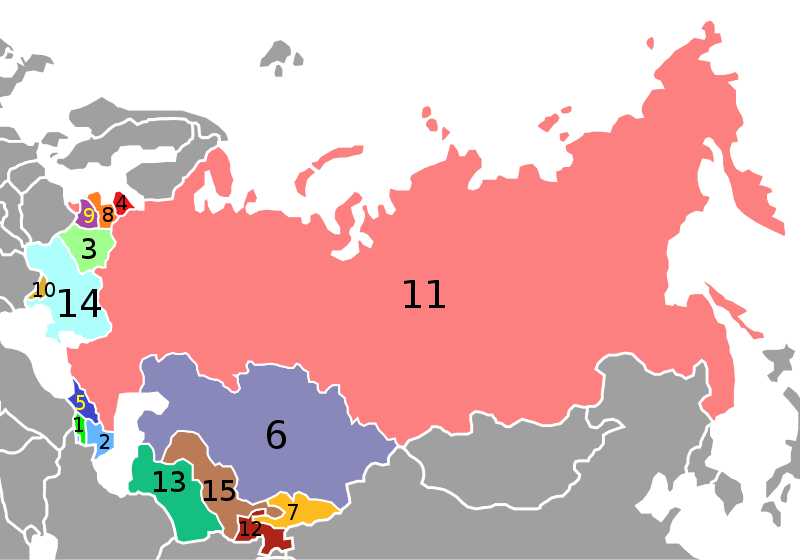
Post-Soviet states 1. Armenia • 2. Azerbaijan • 3. Belarus • 4. Estonia • 5. Georgia • 6. Kazakhstan • 7. Kyrgyzstan • 8. Latvia • 9. Lithuania • 10. Moldova • 11. Russia • 12. Tajikistan • 13. Turkmenistan • 14. Ukraine • 15. Uzbekistan
The post-Soviet states, also referred to as the former Soviet Union or the former Soviet republics, are the independent sovereign states that emerged/re-emerged from the dissolution of the Soviet Union in 1991. Prior to their independence, they existed as Union Republics, which were the top-level constituents of the Soviet Union. There are 15 post-Soviet states in total: Armenia, Azerbaijan, Belarus, Estonia, Georgia, Kazakhstan, Kyrgyzstan, Latvia, Lithuania, Moldova, Russia, Tajikistan, Turkmenistan, Ukraine, and Uzbekistan. Each of these countries succeeded their respective Union Republics: the Armenian SSR, the Azerbaijan SSR, the Byelorussian SSR, the Estonian SSR, the Georgian SSR, the Kazakh SSR, the Kirghiz SSR, the Latvian SSR, the Lithuanian SSR, the Moldavian SSR, the Russian SFSR, the Tajik SSR, the Turkmen SSR, the Ukrainian SSR, and the Uzbek SSR. In Russia, the term "near abroad" (Russian: ближнее зарубежье, romanized: bližneye zarubežye) is sometimes used to refer to the post-Soviet states other than Russia. In a broader sense, post-Soviet states may include all countries of the former Eastern Bloc.
Excerpted from Wikipedia’s “Post-Soviet states” article, available under the CC BY-SA 4.0 licence.
Gallery (12)
Available in 60 languages
- Español
- Français
- Deutsch
- 中文
- 日本語
- Русский
- Português
- Italiano
- العربية
- हिन्दी
- Afrikaans
- Albanian
- Asturian
- Azerbaijani
- Bahasa Indonesia
- Bangla
- Basque
- Belarusian
Show 41 more
- Bulgarian
- Catalan
- Central Kurdish
- Chechen
- Croatian
- Czech
- Esperanto
- Estonian
- Galician
- Georgian
- Greek
- Hausa
- Hebrew
- Hungarian
- Icelandic
- Kazakh
- Latin
- Latvian
- Malay
- Nederlands
- Pashto
- Polski
- Romanian
- Serbian
- Serbian (Latin)
- Sicilian
- simple
- Svenska
- Tajik
- Tiếng Việt
- Türkçe
- Ukrainian
- Urdu
- Uzbek
- Venetian
- Welsh
- Western Panjabi
- zh_min_nan
- فارسی
- ไทย
- 한국어
via Wikidata sitelinks · CC0