Category
page 1Potassium minerals

orthoclase
Orthoclase, or orthoclase feldspar (endmember formula KAlSi3O8), is an important tectosilicate mineral which forms igneous rock. The name is from the Ancient Greek for "straight fracture", because its two cleavage planes are at right angles to each other. It is a type of alkali feldspar, also known as potassium feldspar or K-spar. The gem known as moonstone (see below) is largely composed of orthoclase.
biotite series
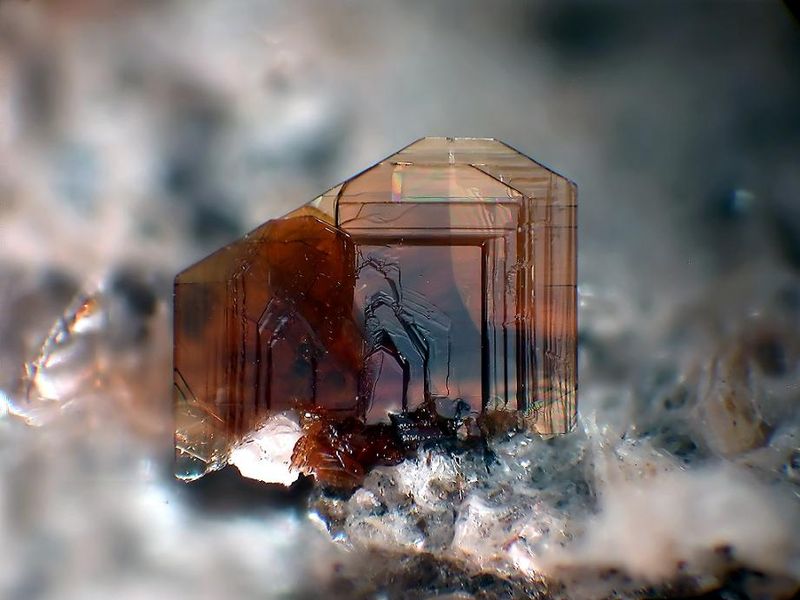
Biotite is a common group of phyllosilicate minerals within the mica group, with the approximate chemical formula . It is primarily a solid-solution series between the iron-endmember annite, and the magnesium-endmember phlogopite; more aluminous end-members include siderophyllite and eastonite. Biotite was regarded as a mineral species by the International Mineralogical Association until 1998, when its status was changed to a mineral group. The term biotite is still used to describe unanalysed dark micas in the field. Biotite was named by J.F.L. Hausmann in 1847 in honor of the French physicis

muscovite

nepheline
Nepheline (), also called nephelite, is a rock-forming mineral in the feldspathoid groupa silica-undersaturated aluminosilicate (Na3KAl4Si4O16) that occurs in intrusive and volcanic rocks with low silica, and in their associated pegmatites. It is used in glass and ceramic manufacturing and other industries, and has been investigated as an ore of aluminium.
lepidolite
Lepidolite is the common name for a lilac-gray or rose-colored series of minerals in the mica group. The mineralogical name for this series is the polylithionite-trilithionite series. Lepidolite has a chemical formula of . It is the most abundant lithium-bearing mineral and is a secondary source of this metal. It is also the major source of the alkali metal rubidium, which substitutes (as in all minerals) for potassium.

sylvite
Sylvite, or sylvine, is potassium chloride (KCl) in natural mineral form. It forms crystals in the isometric system very similar to normal rock salt, halite (NaCl). The two are, in fact, isomorphous. Sylvite is colorless to white with shades of yellow and red due to inclusions. It has a Mohs hardness of 2.5 and a specific gravity of 1.99. It has a refractive index of 1.4903. Sylvite has a salty taste with a distinct bitterness.

carnotite
thumb|Carnotite from the Happy Jack Mine, Moab, Utah
alunite
Alunite is a hydroxylated aluminium potassium sulfate mineral, formula KAl3(SO4)2(OH)6. It was first observed in the 15th century at Tolfa, near Rome, where it was mined for the manufacture of alum. First called aluminilite by J.C. Delamétherie in 1797, this name was contracted by François Beudant three decades later to alunite.
left|thumb|Alunite from Slovakia
Alunite crystals morphologically are rhombohedra with interfacial angles of 90° 50', causing them to resemble cubes. Crystal symmetry is trigonal. Minute glistening crystals have also been found loose in cavities in altered rhyolite. Al
glauconite
Glauconite is an iron potassium phyllosilicate (mica group) mineral of characteristic green color which is very friable and has very low weathering resistance.

carnallite
Carnallite (also carnalite) is an evaporite mineral, a hydrated potassium magnesium chloride with formula KCl.MgCl2·6(H2O). It is variably colored yellow to white, reddish, and sometimes colorless or blue. It is usually massive to fibrous with rare pseudohexagonal orthorhombic crystals. The mineral is deliquescent (absorbs moisture from the surrounding air to the point of forming an aqueous solution) and specimens must be stored in an airtight container.

microcline
Microcline (KAlSi3O8) is an important igneous rock-forming tectosilicate mineral. It is a potassium-rich alkali feldspar. It is common in granite and pegmatites. Microcline forms during slow cooling of orthoclase. Sanidine is a polymorph of alkali feldspar stable at yet higher temperature. Microcline has cross-hatch twinning that forms as a result of the transformation of monoclinic orthoclase into triclinic microcline.
leucite
Leucite (from the Greek word leukos meaning white) is a rock-forming mineral of the feldspathoid group, silica-undersaturated and composed of potassium and aluminium tectosilicate KAlSi2O6. Crystals have the form of cubic icositetrahedra but, as first observed by Sir David Brewster in 1821, they are not optically isotropic, and are therefore pseudo-cubic. Goniometric measurements made by Gerhard vom Rath in 1873 led him to refer the crystals to the tetragonal system. Optical investigations have since proved the crystals to be still more complex in character, and to consist of several orthorhom
sanidine
Sanidine is the high temperature form of potassium feldspar with a general formula K(AlSi3O8). Sanidine is found most typically in felsic volcanic rocks such as obsidian, rhyolite and trachyte. Sanidine crystallizes in the monoclinic crystal system. Orthoclase is a monoclinic polymorph stable at lower temperatures. At yet lower temperatures, microcline, a triclinic polymorph of potassium feldspar, is stable.

jarosite
Jarosite is a basic hydrous sulfate of potassium and ferric iron (Fe-III) with a chemical formula of KFe3(SO4)2(OH)6. This sulfate mineral is formed in ore deposits by the oxidation of iron sulfides. Jarosite is often produced as a byproduct during the purification and refining of zinc and is also commonly associated with acid mine drainage and acid sulfate soil environments.

illite
thumb|Structure of illite mica – USGS

phlogopite
Phlogopite is a yellow, greenish, or reddish-brown member of the mica family of phyllosilicates. It is also known as magnesium mica.

kainite
Kainite ( or ) (KMg(SO4)Cl·3H2O) is an evaporite mineral in the class of "Sulfates (selenates, etc.) with additional anions, with H2O" according to the Nickel–Strunz classification. It is a hydrated potassium-magnesium sulfate-chloride, naturally occurring in irregular granular masses or as crystalline coatings in cavities or fissures. This mineral is dull and soft, and is colored white, yellowish, grey, reddish, or blue to violet. Its name is derived from Greek [kainos] ("(hitherto) unknown"), as it was the first mineral discovered that contained both sulfate and chloride as anions. Kainite f
nitre
Niter or nitre is the mineral form of potassium nitrate, KNO3. It is a soft, white, highly soluble mineral found primarily in arid climates or cave deposits.
apophyllite
The name apophyllite refers to a specific group of phyllosilicates, a class of minerals. Originally, the group name referred to a specific mineral, but was redefined in 1978 to stand for a class of minerals of similar chemical makeup that comprise a solid solution series, and includes the members fluorapophyllite-(K), fluorapophyllite-(Na), hydroxyapophyllite-(K). The name apophyllite is derived from the Greek (), meaning 'it flakes off', a reference to this class's tendency to flake apart when heated, due to water loss. Exfoliation of apophyllite is also possible by treating it with acids or
chabazite
Chabazite () is a tectosilicate mineral series in the zeolite group, closely related to gmelinite, with the chemical formula , where M is one or more metal cations. Recognized minerals in the series include Chabazite-Ca, Chabazite-K, Chabazite-Na, and Chabazite-Sr, depending on the prominence of the indicated cation.
charoite
Charoite ( ) is a rare silicate mineral with the chemical composition , first described in 1978. It is named after the Chara River, despite its being away from the discovery place. When it was discovered, it was thought to be a fake, dyed purple to give it its striking appearance.
zinnwaldite
Zinnwaldite, KLiFeAl(AlSi3)O10(OH,F)2, potassium lithium iron aluminium silicate hydroxide fluoride, is a silicate mineral in the mica group. The IMA status is as a series between siderophyllite (KFe2Al(Al2Si2)O10(F,OH)2) and polylithionite (KLi2AlSi4O10(F,OH)2) and not considered a valid mineral species.
abernathyite
Abernathyite is a mineral with formula K(UO2)(AsO4)·3H2O. The mineral is named after Jesse Evrett Abernathy (1913–1963) who first noted it in 1953 in the U.S. State of Utah. It was described as a new mineral species in 1956. Abernathyite is yellow and occurs as small crystals.
afghanite
Afghanite, (Na,K)22Ca10[Si24Al24O96](SO4)6Cl6, is a hydrous sodium, calcium, potassium, sulfate, chloride, carbonate alumino-silicate mineral. Afghanite is a feldspathoid of the cancrinite group and typically occurs with sodalite group minerals. It forms blue to colorless, typically massive crystals in the trigonal crystal system. The lowering of the symmetry from typical (for cancrinite group) hexagonal one is due to ordering of Si and Al. It has a Mohs hardness of 5.5 to 6 and a specific gravity of 2.55 to 2.65. It has refractive index values of nω = 1.523 and nε = 1.529. It has one directio

polyhalite
Polyhalite is an evaporite mineral, a hydrated sulfate of potassium, calcium and magnesium with formula: . Polyhalite crystallizes in the triclinic system, although crystals are very rare. The normal habit is massive to fibrous. It is typically colorless, white to gray, although it may be brick red due to iron oxide inclusions. It has a Mohs hardness of 3.5 and a specific gravity of 2.8.
It is used as a valuable fertilizer.

sugilite
Sugilite ( ) is a relatively rare pink to purple cyclosilicate mineral with the complex chemical formula KNa2(Fe, Mn, Al)2Li3Si12O30. Sugilite crystallizes in the hexagonal system with prismatic crystals. The crystals are rarely found and the form is usually massive. It has a Mohs hardness of 5.5–6.5 and a specific gravity of 2.75–2.80. It is mostly translucent.
Sugilite was first described in 1944 by the Japanese petrologist Ken-ichi Sugi (1901–1948) for an occurrence on Iwagi Islet, Japan, where it is found in an aegirine syenite intrusive stock. It is found in a similar environment at
neptunite
Neptunite is a silicate mineral with the formula KNa2Li(Fe2+, Mn2+)2Ti2Si8O24. With increasing manganese it forms a series with mangan-neptunite. is the variety with vanadium replacing the titanium in the formula.
boleite
Boleite is a complex halide mineral with formula: KPb26Ag9Cu24(OH)48Cl62. It was first described in 1891 as an oxychloride mineral. It is an isometric mineral which forms in deep-blue cubes. There are numerous minerals related to boleite, such as pseudoboleite, cumengite, and diaboleite, and these all have the same complex crystal structure. They all contain bright-blue cubic forms and are formed in altered zones of lead and copper deposits, produced during the reaction of chloride bearing solutions with primary sulfide minerals.
phillipsite series
Phillipsite is a mineral series of the zeolite group; a hydrated potassium, calcium and aluminium silicate, approximating to . The members of the series are phillipsite-K, phillipsite-Na and phillipsite-Ca. The crystals are monoclinic, but only complex cruciform twins are known, these being exactly like twins of harmotome which also forms a series with phillipsite-Ca. Crystals of phillipsite are, however, usually smaller and more transparent and glassy than those of harmotome. Spherical groups with a radially fibrous structure and bristled with crystals on the surface are not uncommon. The Moh
clinoptilolite
Clinoptilolite is a natural zeolite composed of a microporous arrangement of silica and alumina tetrahedra. It has the complex formula . It forms as white, green to reddish tabular monoclinic tectosilicate crystals with a Mohs hardness of 3.5 to 4 and a specific gravity of 2.1 to 2.2. It commonly occurs as a devitrification product of volcanic glass shards in tuff and as vesicle fillings in basalts, andesites and rhyolites. It was described in 1969 from an occurrence in the Barstow Formation, San Bernardino County, California. Sodium levels in clinoptilolite are generally higher than potassium
celadonite
Celadonite is a mica group mineral, a phyllosilicate of potassium, iron in both oxidation states, aluminium and hydroxide with formula .

anorthoclase
The mineral anorthoclase ((Na,K)AlSi3O8) is a crystalline solid solution in the alkali feldspar series, in which the proportion of the sodium-aluminium silicate member exceeds the potassium-aluminium silicate member. It typically consists of between 64 and 90 percent of NaAlSi3O8 and between 10 and 36 percent of KAlSi3O8.
thumb|left|upright|An anorthoclase crystal from Mount Erebus, Antarctica

harmotome
Harmotome is a mineral, one of the rarer zeolites; a hydrated barium silicate with formula: . It forms vitreous white well defined monoclinic crystals, often associated with calcite and other zeolites. It has a Mohs hardness of 4 to 5 and a specific gravity of 2.44 to 2.5.

mordenite
Mordenite is a zeolite mineral with the chemical formula . and it is one of the six most abundant zeolites and is used commercially.
avogadrite
Avogadrite ((K,Cs)BF4) is a potassium-caesium tetrafluoroborate in the halide class. Avogadrite crystallizes in the orthorhombic system (space group Pnma) with cell parameters a 8.66 Å, b 5.48 Å and c Å 7.03.
pharmacosiderite
Pharmacosiderite is a hydrated basic ferric arsenate, with the chemical formula KFe4(AsO4)3(OH)4·(6-7)H2O and a molecular weight of 873.38 g/mol. It consists of the elements arsenic, iron, hydrogen, potassium, sodium and oxygen. It has a Mohs hardness of 2 to 3, about that of a finger nail. Its specific gravity is about 2.7 to 2.9, has indistinct cleavage, and is usually transparent or translucent. It has a yellow or white streak and a yellow, green, brown or red color. Its lustre is adamantine, vitreous and resinous, and it has conchoidal, brittle and sectile fracture.
langbeinite
Langbeinite is a potassium magnesium sulfate mineral with the chemical formula K2Mg2(SO4)3. Langbeinite crystallizes in the isometric-tetartoidal (cubic) system as transparent colorless or white with pale tints of yellow to green and violet crystalline masses. It has a vitreous luster. The Mohs hardness is 3.5 to 4 and the specific gravity is 2.83. The crystals are piezoelectric.
osumilite
Osumilite is a very rare potassium-sodium-iron-magnesium-aluminium silicate mineral. Osumilite is part of the milarite group (also known as the milarite-osumilite group) of cyclosilicates.
roscoelite
Roscoelite is a green mineral from the mica group that contains vanadium.
The chemical formula is K(V3+, Al, Mg)2AlSi3O10(OH)2.
Crystals of roscoelite take on the monoclinic form, and are from the 2/m point group.
The appearance is semi transparent to translucent coloured olive brown to green brown. The lustre is pearly. The mineral shows pleochroism with X showing green-brown, and Y and Z axes showing olive-green colour. The mineral was named after Henry Enfield Roscoe who first produced vanadium metal.
picromerite
Picromerite (synonyms: schoenite, schönite) is a mineral from the class of hydrous sulfates lacking additional anions, and containing medium to large cations according to the Nickel–Strunz classification.
hyalophane
Hyalophane or jaloallofane is a crystalline mineral, part of the feldspar group of tectosilicates. It is considered a barium-rich potassium feldspar. Its chemical formula is , and it has a hardness of 6 to . The name hyalophane comes from the Greek , meaning "glass", and meaning "to appear".
lópezite
Lópezite is a rare red chromate mineral with chemical formula: K2Cr2O7. It crystallizes in the triclinic crystal system.
margaritasite
Margaritasite is a yellow, caesium-bearing mineral in the carnotite group. Its chemical formula is (Cs, K, H3O)2(UO2)2V2O8·H2O and its crystal system is monoclinic (space group P21/a).
zippeite
Zippeite is a hydrous potassium uranium sulfate mineral with formula: K4(UO2)6(SO4)3(OH)10·4(H2O). It forms yellow to reddish brown monoclinic-prismatic crystals with perfect cleavage. The typical form is as encrustations and pulverulent earthy masses. It forms as efflorescent encrustations in underground uranium mines. It has a Mohs hardness of 2 and a specific gravity of 3.66. It is strongly fluorescent yellow under ultraviolet light and is moderately radioactive.

todorokite
thumb|Polyhedral representation of the todorokite structure.
hanksite
Hanksite is a sulfate mineral, distinguished as one of only a handful that contain both carbonate and sulfate ions (a sulfate carbonate). It has the chemical formula Na22K(SO4)9(CO3)2Cl.
phosphuranylite
Phosphuranylite is a uranyl phosphate mineral with formula KCa(H3O)3(UO2)7(PO4)4O4·8(H2O).
kalsilite
Kalsilite (KAlSiO4) is a vitreous white to grey feldspathoidal mineral that is found in some potassium-rich lavas, such as from Chamengo Crater in Uganda. It has a relative hardness of 5.5.
aphthitalite
Aphthitalite is a potassium sulfate mineral with the chemical formula: (K,Na)3Na(SO4)2.
annite
Annite is a phyllosilicate mineral in the mica family. It has a chemical formula of KFe32+AlSi3O10(OH)2. Annite is the iron end member of the biotite mica group, the iron rich analogue of magnesium rich phlogopite. Annite is monoclinic and contains tabular crystals and cleavage fragments with pseudohexagonal outlines. There are contact twins with composition surface {001} and twin axis {310}.
birnessite
Birnessite (nominally MnO2·nH2O), also known as δ-, is a hydrous manganese dioxide mineral with a chemical formula of Na0.7Ca0.3Mn7O14·2.8H2O. It is the main manganese mineral species at the Earth's surface, and commonly occurs as fine-grained, poorly crystallized aggregates in soils, sediments, grain and rock coatings (e.g., desert varnish), and marine ferromanganese nodules and crusts. It was discovered at Birness, Aberdeenshire, Scotland.
arcanite
Arcanite is a potassium sulfate mineral with formula K2SO4.
weeksite
Weeksite is a naturally occurring uranium silicate mineral with the chemical formula: K2(UO2)2Si6O15•4(H2O), potassium uranyl silicate. Weeksite has a Mohs hardness of 1–2. It was named for USGS mineralogist Alice Mary Dowse Weeks (1909–1988).

leonite
Leonite is a hydrated double sulfate of magnesium and potassium. It has the formula K2SO4·MgSO4·4H2O. The mineral was named after Leo Strippelmann, who was director of the salt works at Westeregeln in Germany. The mineral is part of the blodite group of hydrated double sulfate minerals.
poudretteite
Poudretteite is an extremely rare mineral and gemstone that was first discovered as minute crystals in Mont St. Hilaire, Quebec, Canada, during the 1960s. The mineral was named for the Poudrette family because they operated a quarry in the Mont St. Hilaire area where poudretteite was originally found, and the quarry is currently owned by the United Kingdom based Salmon Mining Industries Inc. Poudretteite has a barely detectable radioactivity.
aluminoceladonite
Aluminoceladonite is a low-temperature potassium dioctahedral mica mineral which is an end-member in the illite-aluminoceladonite solid solution series. The chemical formula for aluminoceladonite is K(Mg,Fe2+)Al(Si4O10)(OH)2.
tinaksite
Tinaksite (chemical formula ) is a mineral found in northern Russia. Tinaksite can be grayish-white, yellowish, orange, or brown, and it is often found in charoite. Its name is derived from its composition: titanium (Ti), sodium (Na) potassium (K) and silicon (Si). The International Mineralogical Association first recognized tinaksite as a mineral in 1965.
carobbiite
Carobbiite, chemical formula KF (potassium fluoride), is a rare, soft (Mohs 2 - 2.5), colourless cubic mineral. It is found at Monte Somma, Somma-Vesuvius Complex, Province of Naples, Campania, Italy. It was discovered in 1956 by Italian geologist Guido Carobbi (1900–1983). It has also been reported from Hokkaido, Japan.
challacolloite
Challacolloite, KPb2Cl5, is a rare halide mineral. It crystallizes in the monoclinic system (with space group P21/c) and occurs as white fumarolic encrustations on lava. It occurs as intergrowths with cotunnite.
yuksporite
Yuksporite is a rare inosilicate mineral with double width, unbranched chains, and the complicated chemical formula .
It contains the relatively rare elements strontium, titanium and niobium, as well as the commoner metallic elements potassium, calcium, sodium and manganese. As with all silicates, it contains groups of linked silicon and oxygen atoms, as well as some associated water molecules.