Category
page 1Provincial capitals in Angola

Luanda

Huambo
Huambo, formerly Nova Lisboa (English: New Lisbon), is the third-most populous city in Angola, after the capital city Luanda and Lubango, with a population of 595,304 (2014) in the city and a population of 836,293 in the municipality of Huambo (Census 2024). The city is the capital of the province of Huambo and is located about 220 km E from Benguela and 600 km SE from Luanda. Huambo is a main hub on the Caminho de Ferro de Benguela (CFB) (the Benguela Railway), which runs from the port of Lobito to the Democratic Republic of the Congo's southernmost province, Katanga. Huambo is serv

Cabinda
city in Cabinda Province, Angola

Benguela
Benguela (; Umbundu: Luombaka) is a city in western Angola, capital of Benguela Province. Benguela is one of Angola's most populous cities with a population of 555,124 in the city and 561,775 in the municipality, at the 2014 census.

Lubango
Lubango, formerly known as Sá da Bandeira, is a municipality in Angola, capital of the Huíla Province, with a population of 890,384 in 2024. The city center had a population of 600,751 in 2014 making it the second-most populous city in Angola after the capital city Luanda.

M'banza-Kongo
Mbanza Kongo (, , or , known as São Salvador in Portuguese from 1570 to 1976; ) is the capital of Angola's northwestern Zaire Province with a population of 221,141 in 2024. Mbanza Kongo was the capital of the Kingdom of Kongo since its foundation before the arrival of the Portuguese in 1483 until the abolition of the kingdom in 1915, aside from a brief period of abandonment during civil wars in the 17th century.
In 2017, Mbanza Kongo was declared a UNESCO World Heritage Site.

Moçâmedes
Moçâmedes is a city in southwestern Angola, and the capital of Namibe Province. The city's current population is 345,987 (2024 census). Founded in 1840 by the Portuguese colonial administration, the city was named Namibe between 1985 and 2016. Moçâmedes has a cool dry climate and desert vegetation, because it is near the Namib Desert.

Malanje
Malanje is the capital city of Malanje Province in Angola, with a population of 455,000 (2014 census), and a municipality, with a population of 506,847 (2014 census). Projected to be the thirteenth fastest growing city on the African continent between 2020 and 2025, with a 5.17% growth. It is located east of Angola's capital Luanda. Near it are the spectacular Calandula waterfalls, the rock formations of Pungo Andongo, and the Capanda Dam. The climate is mainly humid, with average temperatures between and rainfall in the rainy season (October to April).

Luena
town in Moxico Province, Angola

Uíge
Uíge (), formerly Carmona, is a provincial capital city in northwestern Angola, with a population of 322,531 (2014 census), and a municipality, with a population of 773,099 (2024 census), located in the province of the same name. It grew from a small market centre in 1945 to become a city in 1956. It is served by the Uíge Airport with daily flights to Luanda.
Kuito
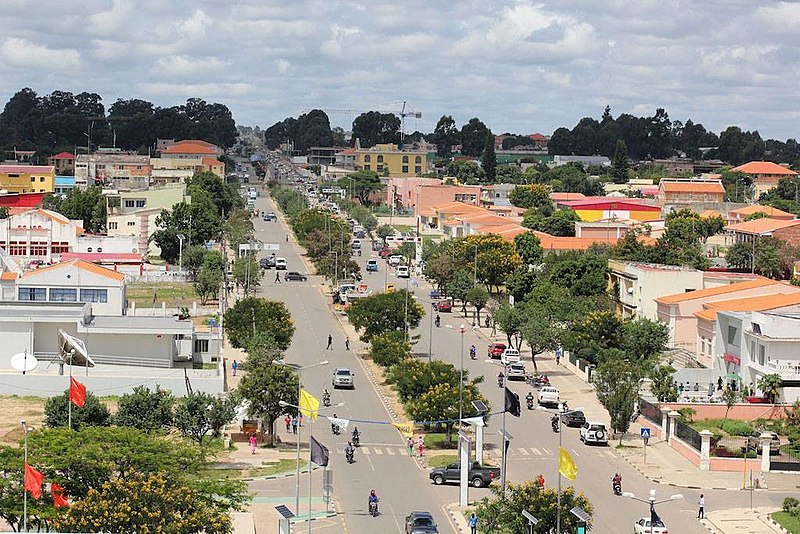
Cuíto, formerly known as Silva Porto, is a city and municipality in central Angola, capital of Bié Province. The municipality had a population of 450,881 in 2014. The city is projected to be the tenth fastest growing city on the African continent between 2020 and 2025, with a 5.56% growth rate.
Menongue
Menongue, formerly Serpa Pinto, is a municipality and the capital of Cubango Province in Angola. The municipality had a population of 320,914 in 2014. It is one of the four municipalities in Angola whose inhabitants are predominantly Mbunda.

Caxito
Caxito is a town, with a population of 55,000 (2014), and a commune in the municipality of Dande, province of Bengo, Angola. It is also the capital of the province.

Sumbe
Sumbe, formerly Novo Redondo, is a city located in west central Angola. It is the administrative capital of Cuanza Sul Province. In 2014 its population was 279,968.
Saurimo
Saurimo, formerly known as Henrique de Carvalho, is a city in Angola. It is the capital of Lunda Sul Province. As of 2014, Saurimo has a population of 393,000 people, which steadily grows as a result of migration.

Ondjiva
Ondjiva, formerly '''Vila Pereira d'Eça''', is a town, with a population of 121,537 (2014), and a commune in the municipality of Cuanhama, province of Cunene, Angola. It is also the administrative capital of Cunene Province and is located at the extreme south of the country, about from the border with Namibia. It was traditionally the seat of the Ovambo king of the Oukwanyama tribe. Ondjiva was greatly affected by the Angolan Civil War (1975-2002).
N'dalatando
'''N'dalatando, formerly Vila Salazar''', is a town, with a population of 161,584 (2014), and a commune in the municipality of Cazengo, province of Cuanza Norte, Angola.

Dundo
Dundo, or Dundo-Chitato, is a former mining town, with a population of 240,410 (2024 census), now a city and the provincial capital of Lunda Norte in Angola. Established in the early part of the 20th century as a planned diamond mining community, Dundo has continued to grow, has its own airport and is now being superseded by a new city, New Dundo.
Mavinga
Mavinga is a municipality in Angola, and the capital of Cuando Province since that province's creation in 2024. It is one of the three municipalities in Angola whose inhabitants are predominantly Mbunda. The municipality had a population of 27,196 in 2014. Previously Mavinga was part of Cuando Cubango Province, when it comprised the communes of Mavinga, Cunjamba/Dime, Cutuile and Luengue.

Catete
commune in the municipality of Ícolo e Bengo, Luanda Province, Angola
Cazombo
Cazombo is a municipality with a population of 100,313 (2024), and the capital of Moxico Leste Province in Angola since the province's establishment in 2024. Previously it was the seat of the municipality of Alto Zambeze. Cazombo is on the east bank of the Zambezi River. It is subdivided into the communes of Cazombo and Lumbala Caquengue.