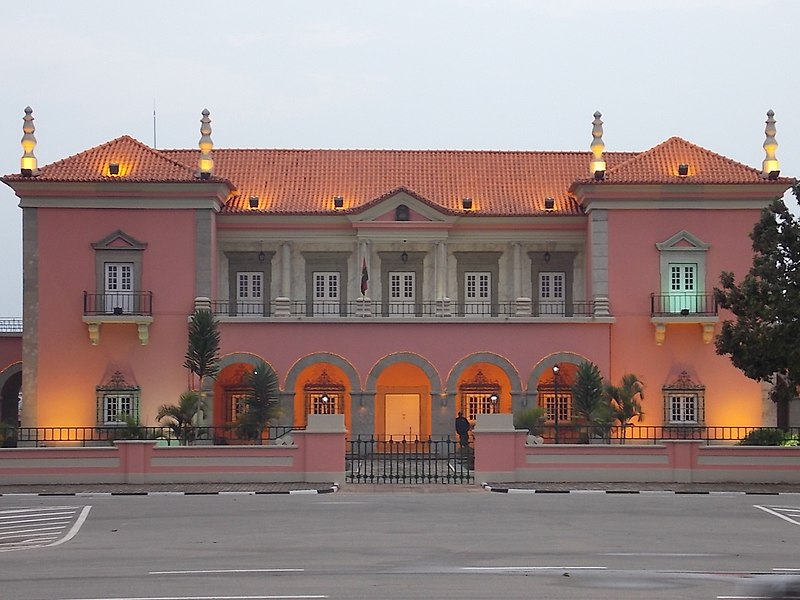
File:Huambo,_Palácio_do_Governador_(cropped2).jpg · Wikimedia Commons · See Wikimedia Commons
Huambo
Sign in to saveAlso known as Nova Lisboa
Huambo, formerly Nova Lisboa (English: New Lisbon), is the third-most populous city in Angola, after the capital city Luanda and Lubango, with a population of 595,304 (2014) in the city and a population of 836,293 in the municipality of Huambo (Census 2024). The city is the capital of the province of Huambo and is located about 220 km E from Benguela and 600 km SE from Luanda. Huambo is a main hub on the Caminho de Ferro de Benguela (CFB) (the Benguela Railway), which runs from the port of Lobito to the Democratic Republic of the Congo's southernmost province, Katanga. Huambo is serv
OverviewAI-generated
Huambo is a city in Angola that serves as the capital of Huambo Province. Established on August 8, 1912, the municipality covers an area of 2,609 square kilometers. It is situated at an elevation of 1,721 meters above sea level and falls within the Africa/Luanda timezone.
The city has a population of 844,000. While specific weather data indicates a current temperature of 16.64 degrees Celsius with 59 percent humidity, the urban area includes residential zones such as Cidade Baixa.
Synthesized by Vinony from 46 facts across 7 sources: Wikidata, Open Meteo, Openweathermap, OpenStreetMap, GeoNames, Vinony graph, Geo. Generated from structured data (not the Wikipedia text) and checked against those facts — may still contain errors.
Weather now
7-day forecast
via Open-Meteo
Place details
- Locality
- Huambo
- Region
- Huambo
- Country
- Angola
- Population
- 595,304
- Timezone
- Africa/Luanda
via OpenStreetMap · GeoNames
Key facts
- Settlement.name
- Huambo
- Settlement.other_name
- Nova Lisboa (New Lisbon)
- Settlement.settlement_type
- Municipality
- Settlement.pushpin_map
- Angola#Africa
- Settlement.pushpin_label_position
- right
- Settlement.pushpin_mapsize
- 300
- Settlement.pushpin_map_caption
- Location in Angola
- Settlement.pushpin_relief
- yes
- Settlement.subdivision_type
- Country
- Settlement.subdivision_type1
- Province
- Settlement.subdivision_name1
- Huambo
- Settlement.established_title
- Founded
- Settlement.unit_pref
- Metric
- Settlement.area_total_km2
- 2711
- Settlement.population_as_of
- 2024 Census
- Settlement.population_total
- 836,293
- Settlement.population_density_km2
- auto
- Settlement.population_metro
- 1,896,147
via Wikipedia infobox
Wikidata facts
- Instance of
- big city
- Official name
- Huambo
- Country
- Angola
- Located in
- Huambo Province
- Population
- 844000
- Area
- 2609
- Elevation
- 1721
- Capital of
- Huambo Province
- Image
- Huambo, Jardim da Cultura.jpg
Show 8 more facts
- Commons category
- Huambo
- topic's main category
- Category:Huambo
- category of associated people
- Category:People from Huambo
- category for people born here
- Q21092306
- inception
- 1912-08-08
- P8168
- E. W. Emo
- native label
- Huambo
- P12749
- Remscheid
via Wikidata · CC0
Travel guide
Understand
thumb|320px|The Governor's Palace
Huambo sits in the center of the traditional area of the Ovimbundu people (who speak Umbundu). During previous centuries the Ovimbundu were organized into several independent kingdoms. The Portuguese came into contact with these kingdoms in the 1500s, and the Ovimbundu soon proved themselves to be capable traders, creating trade networks from the Portuguese port town of Benguela all the way into modern-day Democratic Republic of Congo (Katanga province) and Zambia. At the beginning of the 1900s, the Portuguese turned from economic to military interests, and soon conquered the Central Highlands. It was in the immediate aftermath of this conquest that Huambo city was built.
Portuguese General Norton de Matos resided at the Quibala fortress while he laid plans for the new city of Huambo, established in 1912. The current layout of the city bears the marks of his Portuguese-style organization, with a monumental rotunda surrounded by government edifices, a beautiful central garden areas, and a commercial division with a clear grid street plan. These areas were devastated during the civil war, but the current government has rehabilitated the area very quickly, giving it an Angolan flair on top of the Portuguese design.
The old Portuguese center of the city is now surrounded by Angolan "bairros" which swelled during the war years with refugees from the surrounding countryside. The bairros are crowded and disorganized, and most roads are still pack…
Get around
The city center is small enough to be explored by foot.
Otherwise, the easiest way to get around Huambo is on motorcycle taxis. They wait at every corner, or you can flag one down as he drives by. Tell the driver where you want to go, and he'll tell you a price. Prices should be standard depending on the distance (usually 100, 200, or 300 kwanzas), but you, as a visitor, won't know what's fair. So try to bargain your way as low as they'll go, then you know you're getting a fair(er) price.
Be aware that motorcycle drivers are not necessarily safe. Many accidents occur. Ensure that the motorcycle you choose looks in decently good repair and has two good quality helmets. Don't climb on a motorcycle taxi without wearing a helmet.
Blue and white taxi vans are another option, useful if you need to cross from one side of the city to another. They run predetermined routes, and can sometimes be slow because they wait for the taxi to fill up. Listen for a taxi calling your destination. It should cost 100 kwanzas to get to that destination. You can get off earlier on the route, but you'll still pay 100 kwanzas.
Because of the dangers inherent in all forms of public transportation in Angola, it may be better to just plan to walk most of the places you're going. The center of the city is not large, and the climate is usually pleasant (except when it's raining). A 30-minute stroll will get you from the Cidade Alta (uptown) to the Cidade Baixa (downtown).
If driving, be very careful of…
See
thumb|300px|Former home of UNITA rebel leader Jonas Savimbi
Eat
If you're ready for a drink or a bite to eat, the immediate environs of the Jardim da Cultura provide several options. Otherwise, head eastward. First, you'll encounter several metals statues from the Portuguese era.
Travel guide from Wikivoyage (CC BY-SA 4.0)
~14 min read
Encyclopedic overview
10 sectionsContents
- History
- Early history
- Post-independence
- 21st century
- Geography
- Climate
- Education and science
- Notable residents
- References
- External links
Huambo, formerly Nova Lisboa (English: New Lisbon), is the third-most populous city in Angola, after the capital city Luanda and Lubango, with a population of 595,304 (2014) in the city and a population of 836,293 in the municipality of Huambo (Census 2024). The city is the capital of the province of Huambo and is located about 220 km E from Benguela and 600 km SE from Luanda. Huambo is a main hub on the Caminho de Ferro de Benguela (CFB) (the Benguela Railway), which runs from the port of Lobito to the Democratic Republic of the Congo's southernmost province, Katanga. Huambo is served by the Albano Machado Airport (formerly Nova Lisboa Airport).
== History ==
Excerpted from Wikipedia’s “Huambo” article, available under the CC BY-SA 4.0 licence.
Gallery (23)
On the map
3 mapped locations
Available in 66 languages
- Español
- Français
- Deutsch
- 中文
- 日本語
- Русский
- Português
- Italiano
- العربية
- Afrikaans
- Armenian
- azb
- Bahasa Indonesia
- Basque
- Belarusian
- Breton
- Bulgarian
- Catalan
Show 47 more
- Cebuano
- Croatian
- Czech
- Danish
- Egyptian Arabic
- Esperanto
- Estonian
- Filipino
- Finnish
- Georgian
- Greek
- Hausa
- Hebrew
- Hungarian
- Ido
- Lithuanian
- Luxembourgish
- Malagasy
- Malay
- Māori
- Nederlands
- Northern Frisian
- Norwegian
- Norwegian Nynorsk
- Occitan
- Polski
- Punjabi
- Romanian
- Scots
- Serbian
- Serbian (Latin)
- simple
- Svenska
- Swahili
- Tajik
- Tatar
- Tiếng Việt
- Ukrainian
- Urdu
- Uzbek
- Waray
- Western Panjabi
- Wu Chinese
- Zulu
- فارسی
- ไทย
- 한국어
via Wikidata sitelinks · CC0