Category
page 1Quantum chemistry

chemical bond
lasting attraction between atoms that enables the formation of chemical compounds
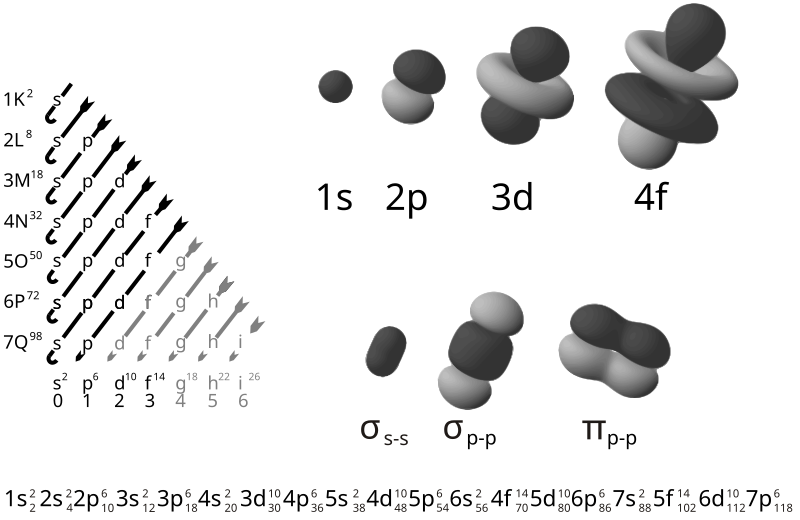
electron configuration
mode of arrangement of electrons in different shells of an atom

ionization
alt=The solar wind moving through the magnetosphere alters the movements of charged particles in the Earth's thermosphere or exosphere, and the resulting ionization of these particles causes them to emit light of varying colour, thus forming auroras near the polar regions.|thumb|201x201px|The solar wind moving through the [[magnetosphere alters the movements of charged particles in the Earth's thermosphere or exosphere, and the resulting ionization of these particles causes them to emit light of varying color, thus forming auroras near the polar regions.]]
Ionization or ionisation is the proce

ionization energy
minimum amount of energy required to remove an electron from an atom or molecule in the gaseous state

atomic orbital
mathematical function describing the location and behavior of an electron within an atom

quantum chemistry
field of chemistry

photovoltaics
thumb|The Solar Settlement, a sustainable housing community project in [[Freiburg, Germany|upright=1.2]]
thumb|Charging station in France that provides energy for electric cars using solar energy|upright=1.2
thumb|Solar panels on the International Space Station|upright=1.2Photovoltaics (PV) is the conversion of light into electricity using semiconducting materials that exhibit the photovoltaic effect, a phenomenon studied in physics, photochemistry, and electrochemistry. The photovoltaic effect is commercially used for electricity generation and as photosensors.

orbital hybridization
mixing (superposition) of atomic orbitals in chemistry

energy level
different states of quantum systems
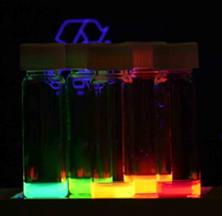
quantum dot
nano-scale semiconductor particle subject to quantum effects
Hamiltonian operator
quantum operator for the energy
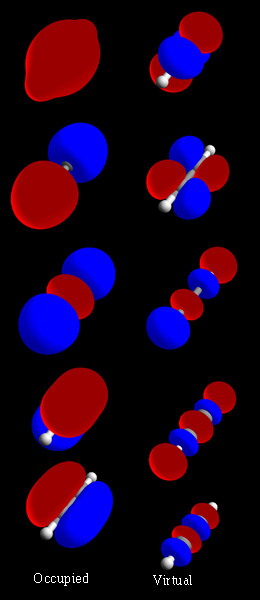
molecular orbital
wave-like behavior of an electron in a molecule
electron hole
conceptual and mathematical opposite of an electron

VSEPR theory
theoretical model used in chemistry

molecular orbital theory
method for describing the electronic structure of molecules using quantum mechanics
valence bond theory
one of two foundational theories of quantum chemistry
principal quantum number
one of four quantum numbers which are assigned to each electron in an atom to describe that electron's state
electron pair
two electrons that occupy the same orbital but have opposite spins
photovoltaic effect
electric current generation from light
Hund's rules
set of three rules proposed by physicist Friedrich Hund
HOMO/LUMO
type of molecular orbital in chemistry
Born-Oppenheimer approximation
The notion that the motion of atomic nuclei and electrons can be separated
protein-protein interaction
physical interactions and constructions between multiple proteins
Hartree–Fock method
method of approximation for the determination of the wave function and the energy of a quantum many-body system in a stationary state
relativistic quantum chemistry
Theories of quantum chemistry explained via relativistic mechanics
sonochemistry
In chemistry, the study of sonochemistry is concerned with understanding the effect of ultrasound in forming acoustic cavitation in liquids, resulting in the initiation or enhancement of the chemical activity in the solution. Therefore, the chemical effects of ultrasound do not come from a direct interaction of the ultrasonic sound wave with the molecules in the solution.
electron density
probability density of electrons being somewhere
exchange interaction of particles
quantum mechanical effect in which the expectation value of the distance when the wave functions of two or more indistinguishable particles overlap changes due to exchange symmetry of identical particles
shielding effect
decrease in attraction between an electron and the nucleus
reaction coordinate
abstract coordinate depicting chemical reaction progress
Slater determinant
expression that describes the wave function of a multi-fermionic system
forbidden mechanism
spectral line associated with absorption or emission of light by atomic nuclei, atoms, or molecules
Franck–Condon principle
quantum chemistry rule regarding vibronic transitions
Variational method
Method for the determination of the approximate ground state of a quantum mechanical system.
unpaired electron
electron occupying an orbital by itself rather than in a pair
potential energy surface
a mapping of possible energy states of a system
Morse potential
Interatomic interaction model
dihydrogen cation
molecular ion
superatom
In chemistry, a superatom is any cluster of atoms that seem to exhibit some of the properties of elemental atoms. One example of a superatom is the cluster .
inert pair effect
The reluctance of 'ns' pair of electrons to take part in bond formation
multiplicity
statistical weight of a quantum level
core electron
electrons in an atom's inner shells, which do not participate in chemical bonding
Hubbard model
in solid-state physics, a quantum lattice model of fermions with nearest-neighbor interactinos that describes the conductor-insulator transition
Slater's rules
semi-empirical rules for quantum chemistry
term symbol
in quantum physics, an abbreviated description of the total spin and orbital angular momentum quantum numbers of the electrons in a multi-electron atom
Kasha's rule
law of photochemistry
Hund's rule of maximum multiplicity
rule dealing with the filling of electrons into orbitals belonging to same shell

Koopmans' theorem
theorem in quantum mechanics that in closed-shell Hartree–Fock theory, the first ionization energy of a molecular system equals the negative of the orbital energy of the highest occupied molecular orbital
Basis set
chemical term
vibronic coupling
interaction between electronic and nuclear vibrational motion in a molecule
frontier molecular orbital theory
Chemical theory
Roothaan equations
International Academy of Quantum Molecular Science
organization devoted to applying quantum physics to chemistry
autoionization
Autoionization is a process by which an atom or a molecule in an excited state spontaneously emits one of the outer-shell electrons, thus going from a state with charge to a state with charge , for example from an electrically neutral state to a singly ionized state.
semiclassical physics
physical model treating some aspects in terms of quantum mechanics and others by classical physics
Electronic correlation
interaction between electrons, often complicating physical calculations
particle in a spherically symmetric potential
quantum mechanical model of a quantum nonrelativistic particle subject to a classical spherically symmetric potential well
RRKM theory
Microcanonic transition state theory of unimolecular reactions
Fermi resonance
shift of energy in physics
Coupled cluster
mathematical calculation method