Category
page 1Radioactivity

nuclear fission
nuclear reaction splitting an atom into multiple parts

Henri Becquerel
French physicist (1852–1908)

gamma ray
electromagnetic radiation of high frequency and high energy

half-life
{| class="wikitable" align=right
! Half-liveselapsed !! Fractionremaining !! colspan=2| Percentageremaining
|-
| 0 || ||align=right style="border-right-width: 0; padding-right:0"| 100||style="border-left-width: 0"|
|-
| 1 || ||align=right style="border-right-width: 0; padding-right:0"| 50||style="border-left-width: 0"|
|-
| 2 || ||align=right style="border-right-width: 0; padding-right:0"| 25||style="border-left-width: 0"|
|-
| 3 || ||align=right style="padding-right:0; border-right-width: 0"| 12||style="border-left-width: 0; padding-left:0"|.5
|-
| 4 || ||align=right style="border-right-width

alpha particle
particle of alpha radiation; helium-4 nucleus; particle of two protons and two neutrons

radiocarbon dating
technique based on carbon-14 decay to determine the age of organic materials

adaptive radiation therapy
therapy using ionizing radiation

ionizing radiation
radiation that carries enough energy to liberate electrons from atoms or molecules

nuclear reaction
process in which two nuclei collide to produce one or more nuclides
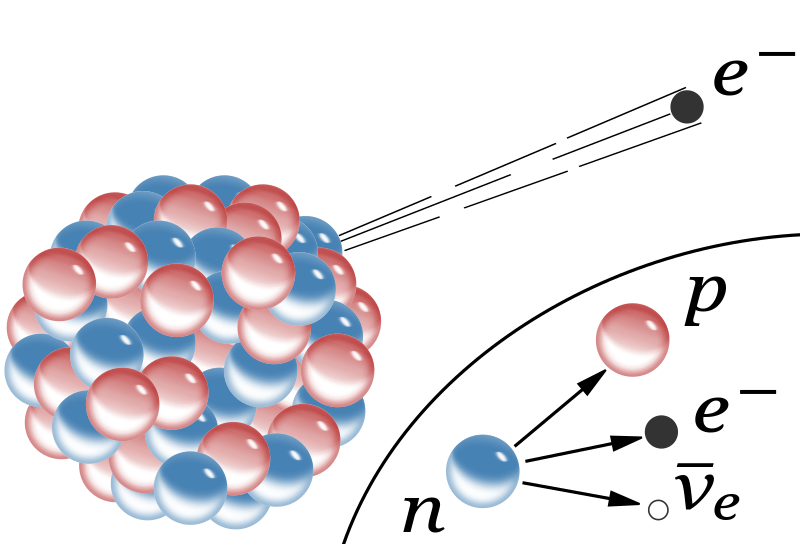
beta decay
emmision of beta particles by a decaying radioactive atom
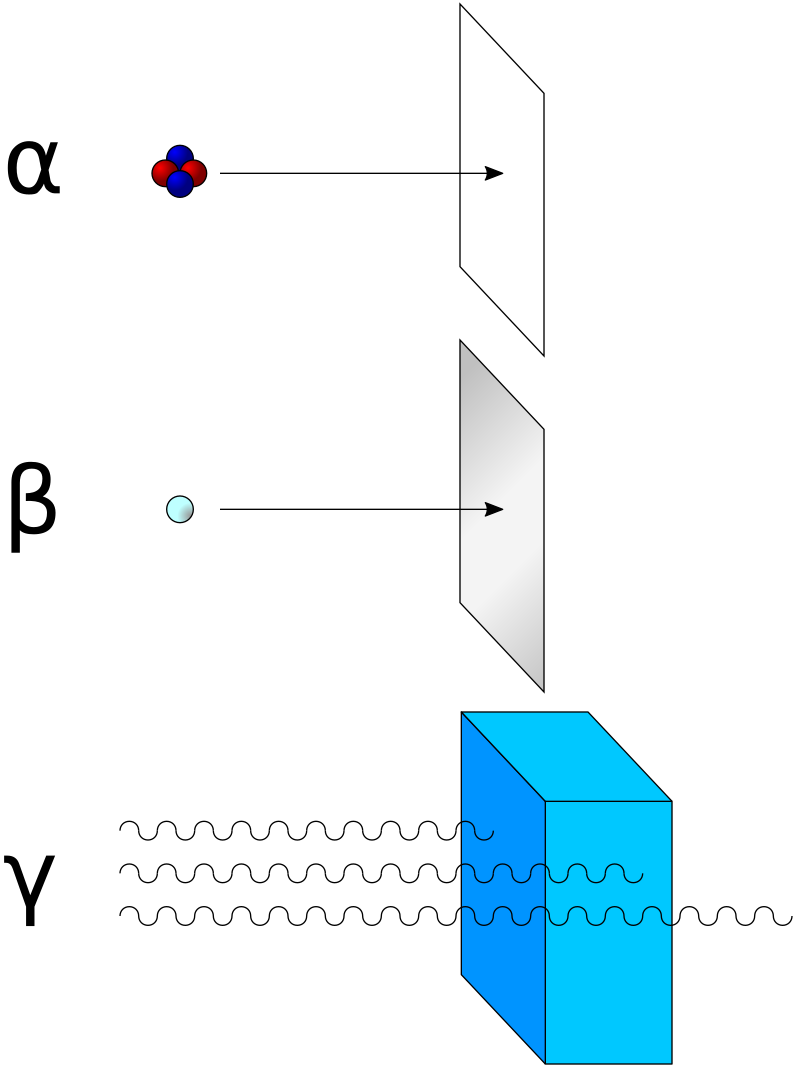
beta particle
high-energy, high-speed electron or positron emitted during beta decay

sievert
The sievert (symbol: Sv) is a derived unit in the International System of Units (SI) intended to represent the stochastic health risk of ionizing radiation, which is defined as the probability of causing radiation-induced cancer and genetic damage. The sievert is important in dosimetry and radiation protection. It is named after Rolf Maximilian Sievert, a Swedish medical physicist renowned for work on radiation dose measurement and research into the biological effects of radiation.

radionuclide
thumb|Chart of known nuclides . The vast majority are radionuclides.

gray
SI unit of absorbed dose of ionizing radiation
alpha decay
emission of alpha particles by a decaying radioactive atom
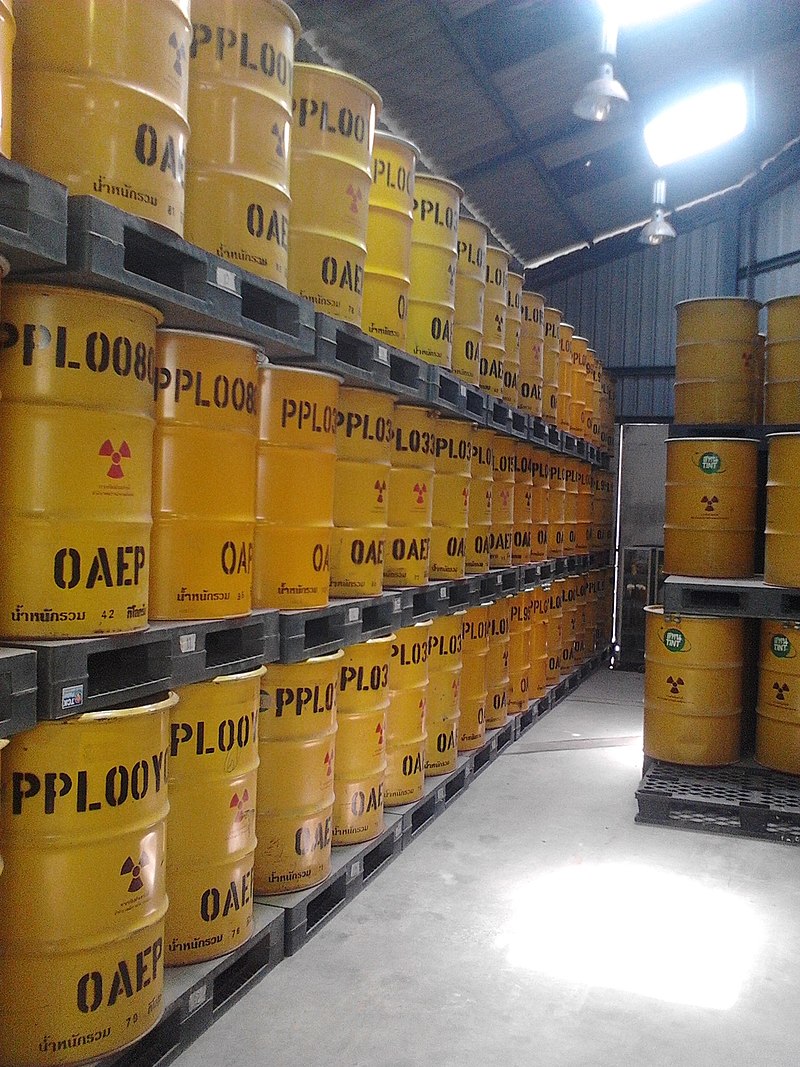
radioactive waste
waste containing radioactive material and emitting ionizing radiation

curie
non-SI unit of radioactivity

cloud chamber
scientific device

electron capture
process in which a proton-rich nuclide absorbs an inner atomic electron

critical mass
smallest amount of fissile material needed for a sustained nuclear chain reaction

mutagen
thumb|The Globally Harmonized System of Classification and Labeling of Chemicals|international pictogram for chemicals that are sensitising, mutagenic, [[carcinogenic or toxic to reproduction]]

radioactive decay
emission of subatomic particles by the decay of an atomic nucleus

radiochemistry
thumb|Glovebox

nuclear transmutation
conversion of one chemical element or an isotope into another chemical element
decay chain
series of elements in radioactive decay
magic number
number of protons or neutrons that make a nucleus particularly stable
island of stability
region of the chart of the nuclides containing isotopes of super-heavy elements theorized to be much more stable than others
spontaneous fission
form of radioactive decay found in very heavy chemical elements
background radiation
level of ionizing radiation present in the natural environment
synthetic radioisotope
radioisotope that is man-made and is not found in nature
neutron emission
decay where a neutron is ejected from the nucleus
positron emission
radioactive decay in which a proton is converted into a neutron while releasing a positron and a neutrino
particle radiation
fast-moving particles with energy
internal conversion
radioactive decay process wherein an excited nucleus interacts electromagnetically with one of its electrons, causing it to be ejected from the atom
fallout shelter
enclosed space specially designed to protect occupants from radioactive debris or fallout
proton emission
radioactive decay where a proton is ejected from the nucleus
radioactive tracer
chemical compound
double beta decay
decay mode
neutron source
device that emits neutrons
delta ray
secondary electron with enough energy to escape a significant distance away from the primary radiation beam and produce further ionization
trace radioisotope
element that is found in small quantities because it undergoes radioactive decay

spinthariscope
thumb|200px|right|A low quality toy spinthariscope taken from a 1950s Chemcraft brand "Atomic energy" chemistry experimentation set
thumb|A spinthariscope crafted by Robert Drosten in Belgium in 1905 and used in the University of Mons Faculty of Engineering ("Polytech Mons") at the beginning of the 20th century.
A spinthariscope () is a device for observing individual nuclear disintegrations caused by the interaction of ionizing radiation with a phosphor (see radioluminescence) or scintillator.
gamma spectroscopy
quantitative study of the energy spectra of gamma-ray sources
double electron capture
decay mode
kerma
kinetic energy released per mass
cluster decay
nuclear decay in which an atomic nucleus emits a small cluster of neutrons and protons
criticality
state of a nuclear reactor where the nuclear chain reaction is precisely self-sustaining
cosmogenic nuclide
isotopes that are produced by interaction of cosmic rays with the nucleus of the atom
tritium illumination
use of gaseous tritium to create visible light
secular equilibrium
branching fraction
proportion of a nuclear or particle decay going to a given decay mode
radiogenic nuclide
nuclide produced by radioactive conversion from other nuclide
discovery of nuclear fission
1938 achievement in physics
United States Radium Corporation
US company
four factor formula
formula used to calculate nuclear chain reaction growth rate
Branca Edmée Marques
Portuguese writer (1899-1986)
diamond battery
nuclear battery concept
radioactive source
radionuclide which emits ionizing radiation
Elizaveta Karamihailova
Bulgarian physicist (1897–1968)
decay scheme
a graphical presentation of all the transitions occurring in a decay of a radioactive substance