Category
page 1Reasoning

Age of Enlightenment
period of European history and cultural movement of the 17th and 18th centuries

reason
Reason is the capacity to consciously apply logic by drawing valid conclusions from new or existing information, with the aim of seeking truth. It is associated with activities considered characteristic of humans, including philosophy, religion, science, language, and mathematics, and is generally considered a distinguishing ability possessed by humans. The term "reason" is sometimes used to refer to rationality, although the latter is more about its application.

rationalism
In philosophy, rationalism is the epistemological view that "regards reason as the chief source and test of knowledge" or "the position that reason has precedence over other ways of acquiring knowledge", often in contrast to other possible sources of knowledge such as faith, tradition, or sensory experience. More formally, rationalism is defined as a methodology or a theory "in which the criterion of truth is not sensory but intellectual and deductive".
.svg)
argument
An argument is one or more premises—sentences, statements, or propositions—directed towards arriving at a logical conclusion. The purpose of an argument is to give reasons for one's thinking and understanding via justification, explanation, or persuasion. As a series of logical steps, arguments are intended to determine or show the degree of truth or acceptability of a logical conclusion.

critical thinking
analysis of facts, with certain levels of rigor and problem-solving abilities, to form a judgment
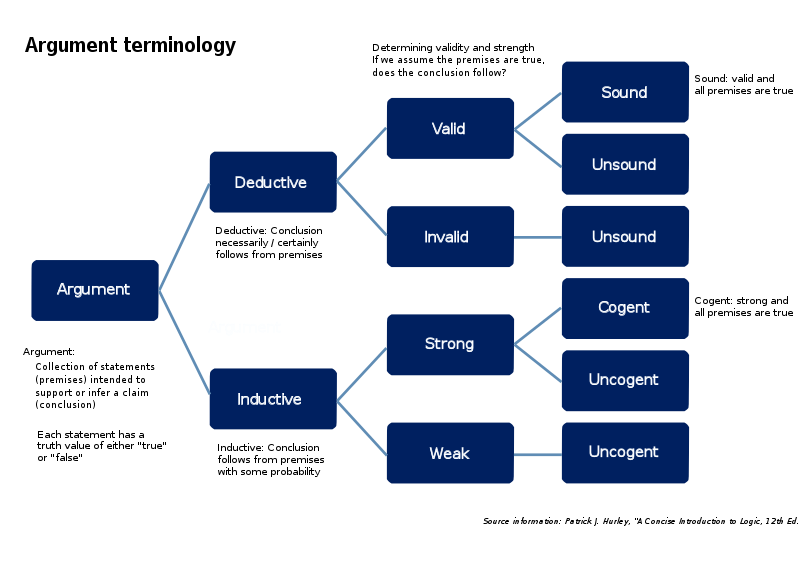
inductive reasoning
method of reasoning in which a body of observations is synthesized to hypothesize a general principle
deductive reasoning
method of reasoning by which premises understood to be true produce logically certain conclusions
inference
Inferences are steps in logical reasoning, moving from premises to logical consequences; etymologically, the word infer means to "carry forward". Inference is theoretically traditionally divided into deduction and induction, a distinction that dates at least to Aristotle (300s BC). Deduction is inference deriving logical conclusions from premises known or assumed to be true, with the laws of valid inference being studied in logic. Induction is inference from particular evidence to a universal conclusion. A third type of inference is sometimes distinguished, notably by Charles Sanders Peirce, c

analysis
thumb|Adriaen van Ostade, "Analysis" (1666)

problem solving
using generic or ad hoc methods in an orderly manner to find solutions to problems
introspection
Introspection is the examination of one's own conscious thoughts and feelings. In psychology, the process of introspection relies on the observation of one's mental state, while in a spiritual context it may refer to the examination of one's soul. Introspection is closely related to human self-reflection and self-discovery and is contrasted with external observation.

rationality
Rationality is the quality of being guided by or based on reason. In this regard, a person acts rationally if they have a good reason for what they do, or a belief is rational if it is based on strong evidence. This quality can apply to an ability, as in a rational animal, to a psychological process, like reasoning, to mental states, such as beliefs and intentions, or to persons who possess these other forms of rationality. A thing that lacks rationality is either arational, if it is outside the domain of rational evaluation, or irrational, if it belongs to this domain but does not fulfill its
abductive reasoning
form of logical inference that seeks the best conclusion that explains a set of given observations

Nous
thumb|right|upright=1.2|This diagram shows the medieval understanding of celestial spheres|spheres of the [[cosmos, derived from Aristotle, and as per the standard explanation by Ptolemy. It came to be understood that at least the outermost sphere (marked "Primũ Mobile") has its own intellect, intelligence or nous – a cosmic equivalent to the human mind.]]
paradigm shift
fundamental change in the basic concepts and experimental practices of a scientific discipline.
lateral thinking
manner of solving problems using an indirect and creative approach via reasoning that is not immediately obvious or attainable using only traditional step-by-step logic
burden of proof
the obligation on a party in a dispute to provide sufficient warrant for their position
case-based reasoning
approach to solve new case on solution of similar previous case
reason
consideration which justifies or explains
irrationality
Irrationality is cognition, thinking, talking, or acting without rationality.

akrasia
Akrasia refers to the phenomenon of acting against one's better judgment—the state in which one intentionally performs an action while simultaneously believing that a different course of action would be better. Sometimes translated as "weakness of will" or "incontinence," akrasia describes the paradoxical human experience of knowingly choosing what one judges to be the inferior option. This concept raises philosophical questions regarding the connection between reason, desire, and action by challenging the intuitive assumption that rational judgment governs an agent's behavior. Altogether, akr
logical reasoning
Wikimedia list article
sensemaking
Sensemaking or sense-making is the process by which people give meaning to their collective experiences. It has been defined as "the ongoing retrospective development of plausible images that rationalize what people are doing" (Weick, Sutcliffe, & Obstfeld, 2005, p. 409). The concept was introduced to organizational studies by Karl E. Weick in the late 1960's and has affected both theory and practice. Weick intended to encourage a shift away from the traditional focus of organization theorists on decision-making and towards the processes that constitute the meaning of the decisions that are en
circumstantial evidence
evidence that indirectly supports a conclusion, but allows for multiple explanations
non-monotonic logic
formal logic whose conclusion relation is not monotonic
rational agent
entity that always performs optimal actions from given information
doxastic logic
modal logic concerned with reasoning about beliefs
backward chaining
method of forming inferences
Synderesis
In scholastic moral philosophy, synderesis () or synteresis is habitual knowledge of the universal practical principles of moral action. The reasoning process in the field of speculative science presupposes certain fundamental axioms on which all science rests. Such are the principle of contradiction, "a thing cannot be and not be at the same time," and self-evident truths like "the whole is greater than its part". These are the first principles of the speculative intellect. In the field of moral conduct there are similar first principles of action, such as: "evil must be avoided, good done";
legal syllogism
form of argument to test if an act is lawful
motivated reasoning
form of cognitive bias in which a decision is based upon supporting a desired outcome rather than the preponderance of evidence
practical reason
the use of reason to decide how to act
analytic reasoning
ability to look at information and discern patterns
emotional reasoning
a cognitive process by which one's own emotional reaction is used to prove something is true
commonsense reasoning
branch of artificial intelligence aiming to create AI systems with "common sense"
Spatial–temporal reasoning
area of artificial intelligence
indicative conditional
special kind of sentence in liguistics
Defeasible reasoning
Reasoning that is rationally compelling, though not deductively valid
Humeanism
Humeanism refers to the philosophy of David Hume and to the tradition of thought inspired by him. Hume was an influential eighteenth century Scottish philosopher well known for his empirical approach, which he applied to various fields in philosophy. In the philosophy of science, he is notable for developing the regularity theory of causation, which in its strongest form states that causation is nothing but constant conjunction of certain types of events without any underlying forces responsible for this regularity of conjunction. This is closely connected to his metaphysical thesis that there
moral reasoning
study in psychology that overlaps with moral philosophy
Dysrationalia
Dysrationalia is defined as the inability to think and behave rationally despite adequate intelligence. It is a concept in educational psychology and is not a clinical disorder such as a thought disorder. Dysrationalia can be a resource to help explain why smart people fall for Ponzi schemes and other fraudulent encounters.
psychology of reasoning
study of how people reason

Rationality
2021 non-fiction work by Steven Pinker
verbal reasoning
understanding and reasoning using concepts framed in words