Category
page 1Renaissance art

Mannerism
thumb|upright=1.2|In Parmigianino's [[Madonna with the Long Neck (1534–1540), Mannerism makes itself known by elongated proportions, highly stylized poses, and lack of clear perspective.]]
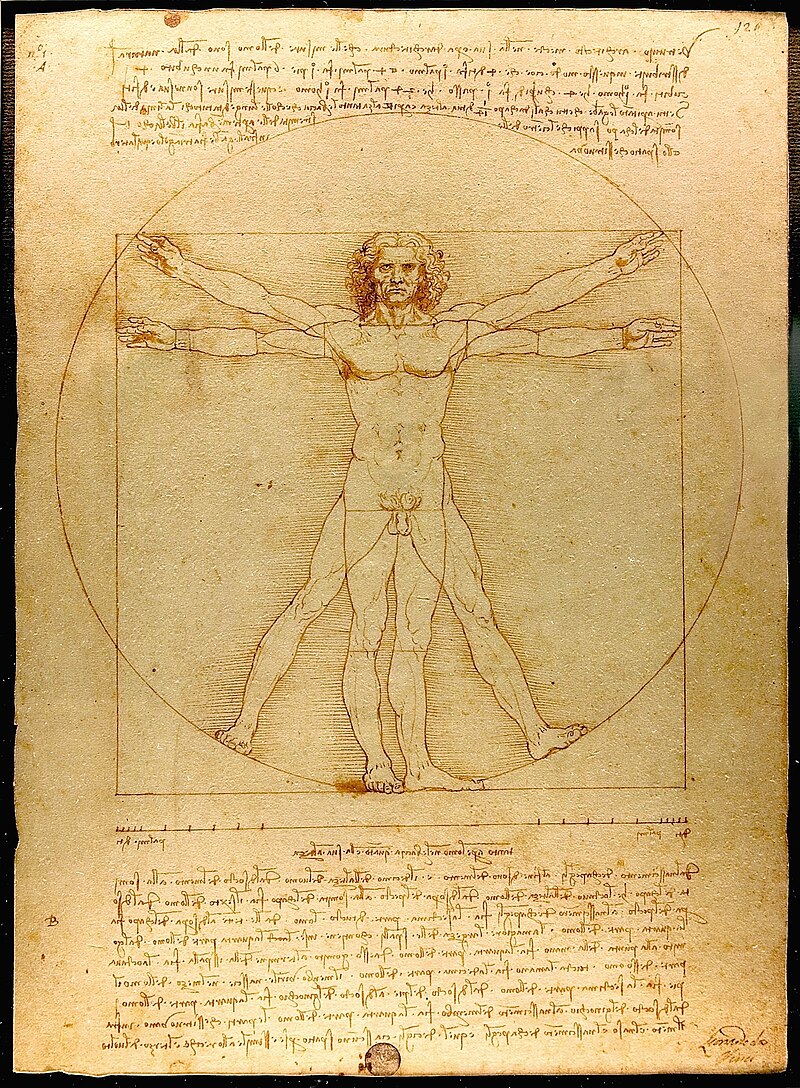
Vitruvian Man
drawing by Leonardo da Vinci

Renaissance architecture
architectural style

Italian Renaissance
cultural movement from the 14th to 17th century

Renaissance art
painting, sculpture and decorative arts of that period of European history known as the Renaissance
Quattrocento
The cultural and artistic events of Italy during the period 1400 to 1499 are collectively referred to as the Quattrocento ( , , ), from the Italian word for the number '400', in turn from , '1400'. The Quattrocento encompasses the artistic styles of the late Middle Ages (most notably International Gothic), the early Renaissance (beginning around 1425), and the start of the High Renaissance, generally asserted to begin between 1495 and 1500.

maiolica
thumb|Istoriato decoration on a plate from Castel Durante, 1550–1570 ([[Musée des Beaux-Arts de Lille)]]

Spanish Golden Age
16th- and 17th-century period of cultural and literary flourishing coinciding with the rise of the Spanish Empire

putto
thumb|Renaissance art|Renaissance putti, detail from the [[Camera degli Sposi, by Andrea Mantegna, 1465–1474, fresco, Ducal Palace, Mantua, Italy]]
A putto (; plural putti ) is a figure in a work of art depicted as a chubby male child, usually naked and very often winged. Originally limited to profane passions in symbolism, the putto came to represent a sort of baby angel in religious art, often called a cherub (plural cherubim), though in traditional Christian theology, a cherub is actually one of the most senior types of angel.
thumb|Three Putti Next to a cartouche (design)|Cartouche, after

grisaille
thumb|270px|Christ and the Woman Taken in Adultery (Bruegel)|Christ and the Woman Taken in Adultery, [[Pieter Bruegel the Elder, 1565, ]]
thumb|270px|Battesimo della gente, one of Andrea del Sarto's gray and brown grisaille [[frescoes in the Chiostro dello Scalzo, Florence (1511-26)]]
Grisaille ( or ; , from gris 'grey') is a painting executed entirely in shades of black and grey or of another neutral greyish colour. It is particularly used in large decorative schemes in imitation of sculpture. Many grisailles include a slightly wider colour range.
Northern Renaissance
Renaissance that occurred in the European countries north of the Alps
Raphael Rooms
suite of reception rooms in the Palace of the Vatican painted by Raphael and his workshop between 1509 and 1524
Trecento
The Trecento ( , , ; short for , "1300") refers to the 14th century in Italian cultural history. The Trecento is considered to be the beginning of the Italian Renaissance or at least the Proto-Renaissance in art history. The Trecento was also famous as a time of heightened literary activity, with writers working in the vernacular instead of Latin. In music, the Trecento was a time of vigorous activity in Italy, as it was in France, with which there was a frequent interchange of musicians and influences.
High Renaissance
short period of the most exceptional artistic production during the Italian Renaissance
Cinquecento
The cultural and artistic events of Italy during the period 1500 to 1599 are collectively referred to as the Cinquecento ( , ), from the Italian for the number '500', in turn from , '1500'. Cinquecento encompasses the styles and events of the High Italian Renaissance, and Mannerism.
Danube school
art movement
Brancacci Chapel
chapel in the Church of Santa Maria del Carmine in Florence, Italy
Arcadia
utopian ideal
A Treatise on Painting
collection of Leonardo da Vinci's writings
Cappella Paolina
chapel in the Apostolic Palace, Vatican City
Palazzo Schifanoia
palace and museum in Ferrara, Italy

Sgabello
thumb|upright|A 16th-century French walnut sgabello (Walters Art Museum)
Dutch and Flemish Renaissance painting
Power of Women
Medieval artistic and literary topos
Studiolo of Francesco I
room in the Palazzo Vecchio, Florence
Villa del Principe
palace in Genoa, Italy
Zuccone
(; ) is the popular name given to a marble statue by Donatello. It was commissioned for the bell tower of the Cathedral of Florence, Italy and completed between 1423 and 1425. It is also known as the Statue of the Prophet Habakkuk (), as many believe it depicts the Old Testament prophet Habakkuk, though Vasari says that it is a portrait (in Biblical garb) of Giovanni di Barduccio Cherichini.
Battle of Orsha
painting from the circle of Lucas Cranach the Elder
puer mingens
artistic motif of a urinating boy
Death and the Maiden
art motif
Labours of the Months
artistic theme representing the twelve months by iconographic scenes showing human activities, usually in a landscape
Christ taking leave of his Mother
theme in Christian art
Florentine Renaissance art
Renaissance art in Florence
Oriental carpets in Renaissance painting
aspect of art history
Waddesdon Bequest
collection of Renaissance art in the British Museum
desco da parto
symbolic gift after a successful birth in medieval Italy
Portraiture of Elizabeth I of England
portraits of the English queen
Artists of the Tudor court
painters and limners engaged by the Tudor dynasty between 1485 and 1603
The Reformation and art
protestant Reformation: 16th century, Europe
Triumphal Procession
series of woodcut prints commissioned by Emperor Maximilian I
Renaissance in Urbino
aspects of Renaissance art and culture in Urbino
Studiolo di Belfiore
historic principal study of Lionello d'Este in 1447
Sine Cerere et Baccho friget Venus
Latin phrase and artistic theme
Kronkåsa
thumb|right|A kronkåsa that belonged to Gustaf Banér and Christina Sture (1589)|241x241pxA kronkåsa (, plural kronkåsor) is a form of elaborate drinking cup that was used during the Renaissance in Sweden.
thumb|227x227px|Depiction of drinking using kronkåsor, from the Historia de Gentibus Septentrionalibus by [[Olaus Magnus]]
Goldener Saal