Category
page 1Rheingau
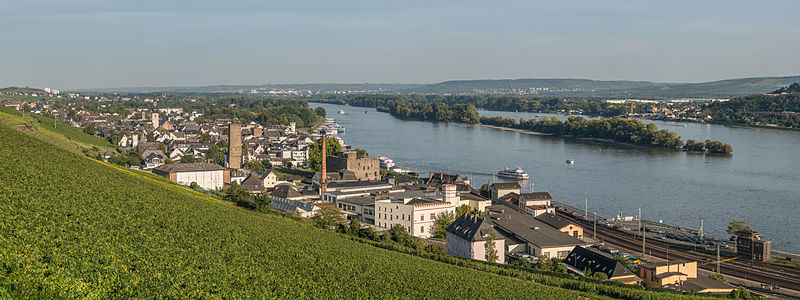
Rüdesheim am Rhein
town in Rheingau-Taunus-Kreis in Hesse, Germany

Oestrich-Winkel
Oestrich-Winkel () is a town with roughly 12,000 inhabitants in the Rheingau-Taunus-Kreis in the Regierungsbezirk of Darmstadt in Hesse, Germany.

Rheingau-Taunus-Kreis
Rheingau-Taunus is a Kreis (district) in the west of Hesse, Germany. Rheingau-Taunus-Kreis is part of the Darmstadt region; its main administrative seat is Bad Schwalbach. Outposted sections of the local administration are located in Idstein and Rüdesheim am Rhein.

Eltville am Rhein
Eltville am Rhein (; from Alta Villa, Latin for "high estate, high town", corrupted to Eldeville, Elfeld and later Eltville ) is a town in the Rheingau-Taunus-Kreis in the Regierungsbezirk of Darmstadt in Hesse, Germany. It lies on the German Timber-Frame Road ('''').

Geisenheim
Geisenheim () is a town in the Rheingau-Taunus-Kreis in the Regierungsbezirk of Darmstadt in Hessen, Germany, and is known as Weinstadt (“Wine Town”), Schulstadt (“School Town”), Domstadt (“Cathedral Town”) and Lindenstadt (“Linden Tree Town”).

Hochheim am Main
town in Main-Taunus-Kreis in Hesse, Germany

Flörsheim am Main
town in Hesse, Germany
Lorch
town in Rheingau-Taunus-Kreis in Hesse, Germany

Kiedrich
Kiedrich is a municipality in the Rheingau-Taunus-Kreis in the Regierungsbezirk of Darmstadt in Hesse, Germany.

Walluf
Walluf is a municipality in the Rheingau-Taunus-Kreis in the Regierungsbezirk of Darmstadt in Hesse, Germany. With 5,581 residents in its 6.74 square kilometer area, it is the most densely populated community in the Rheingau-Taunus-Kreis.
Welterod
Welterod is a municipality in the district of Rhein-Lahn, in Rhineland-Palatinate, in western Germany.

Sauerthal
thumb|Sauerthal (Rhein-Lahn district
Sauerthal () is a municipality in the district of Rhein-Lahn, in Rhineland-Palatinate, in western Germany.

Müller-Thurgau
Müller-Thurgau ( , ) is a white grape variety (sp. Vitis vinifera) which was created by Hermann Müller from the Swiss Canton of Thurgau in 1882 at the Geisenheim Grape Breeding Institute in Germany. It is a crossing of Riesling with Madeleine Royale. It is used to make white wine in Germany, Austria, Northern Italy, Hungary, England, Australia, the Czech Republic, Slovakia, Slovenia, New Zealand, Canada, the United States, Belgium and Japan. There are around ) cultivated worldwide, which makes Müller-Thurgau the most widely planted of the so-called "new breeds" of grape varieties created since
Strüth
Strüth is a municipality in the district of Rhein-Lahn, in Rhineland-Palatinate, in western Germany.

Rheingau
The Rheingau (; ) is a region on the northern side of the Rhine between the German towns of Wiesbaden and Lorch near Frankfurt, reaching from the Western Taunus to the Rhine. It is situated in the German state of Hesse and is part of the Rheingau-Taunus-Kreis administrative district. It is famous for Rheingau wines, especially the "Rheingauer Riesling," and its many taverns.
Eberbach Abbey
former monastery in the Rheingau
Niederwalddenkmal
monument commemorating the founding of Germany
Free State Bottleneck
former quasi-state in western Germany
Rheingau
German wine region

Wisper
The Wisper is a river in Hesse, Germany, right tributary of the Rhine. Its source is in the western Taunus, Rheingau-Taunus-Kreis district, near a small village named Wisper (municipality Heidenrod). It flows southwest through a densely forested valley with some medieval castle ruins surrounded by a popular hiking area. A man-made lake, the Wispersee, is stocked with trout and is a popular fishing destination. The Wisper flows into the Rhine at Lorch.
Assmannshausen
Assmannshausen () is, since its incorporation in 1977, a quarter of Rüdesheim am Rhein in the Rheingau, located on the Rhine in the state of Hesse, Germany. The village has a lithium spring, spa and a Kurhaus, and is famed for its red wine (Assmannshäuser) made from Pinot noir (German: Spätburgunder), which resembles red Burgundy wine. The Hessische Staatsweingüter Kloster Eberbach are running their VDP red wine estate (Einzellage: Höllenberg, 23.1 ha under vine) in the village.
Dotzheim
Dotzheim is a western borough of Wiesbaden, capital of the state of Hesse, Germany. It is the second largest borough of the city by area and, with over 27,000 inhabitants the second-most populated of Wiesbaden's suburban boroughs. It was the largest village in the former Duchy of Nassau. The formerly independent village was incorporated into Wiesbaden in 1928.
Hock
general term for white wine from Rhine region
Spätlese
right|thumb|A Spätlese level wine from the Mosel
Schloss Johannisberg
château
Rhein in Flammen
firework in Germany
Frauenstein
Frauenstein () is the westernmost borough of the city of Wiesbaden, located in the Rhine Main Area near Frankfurt and capital of the federal state of Hesse, Germany. The borough has a population of approximately 2,400. The formerly independent village was incorporated into Wiesbaden in 1928.
Rheinsteig
The Rheinsteig is a hiking trail following a mainly elevated path along the east bank of the Rhine River in Germany. Its route stretches from Wiesbaden to Bonn, running parallel to the Rheinhöhenweg Trail and Rheinburgenweg Trail.
Hallgarten
municipal district of Oestrich-Winkel in Rheingau-Taunus-Kreis, Germany
East Rhine Railway
railway line in Germany
Rheingauer Dom
Catholic parish church in Geisenheim, Germany
Aulhausen
Aulhausen was first mentioned in 1108 as Aulhausen im Rheingau. It lies in Hesse and has about 1200 Inhabitants (2018). From 1970 to 1977 Aulhausen was a district in Assmannshausen. The wine and air recreation town lies in a valley above Assmannshausen. It is separated from Rüdesheim by Niederwald.

EBS Universität für Wirtschaft und Recht
German private university
Schierstein
Schierstein () is a southwestern borough of Wiesbaden, capital of state of Hesse, Germany. First mentioned in historical records in 860, Schierstein was incorporated into Wiesbaden in 1926. Today the borough has about 10,000 residents. Situated on the Rhine River, Schierstein is known as the "Gateway to the Rheingau."
Mainz-Kostheim
thumb|Location of Mainz-Kostheim
Walluf
river in Germany
Erbacher Kopf
Taunus mountain in Germany

Eibingen
Eibingen (), now a part of Rüdesheim am Rhein, Hesse, Germany is the location of Eibingen Abbey, the Benedictine monastery founded by Hildegard of Bingen in 1165 (replacing an Augustine foundation of 1148).
Hallgarter Zange
Taunus mountain in Germany
Kalte Herberge
Taunus mountain in Germany
Ehrenfels Castle
ruined castle near Rüdesheim am Rhein in Hesse, Germany
Erbach
municipal district of Eltville am Rhein, Germany
Brömserburg
thumb|The Brömserburg from the north. Above left: the base of the bergfried
The Brömserburg (also called the Niederburg) is a castle located near the banks of the Rhine in the town of Rüdesheim am Rhein in Rheingau-Taunus-Kreis in the German state of Hesse. Its original structure was probably one of the first stone castles in the Rhine Gorge, now a UNESCO World Heritage Site.
Ernstbach
Ernstbach is a river of Hesse, Germany. It is a left tributary of the Wisper River in the Taunus mountains, part of the Rhine River system.
Presberg
Presberg was first mentioned in 1391 as Brensbur and, since 1977, is part of the town of Rüdesheim am Rhein. It lies in Hessen and has about 860 inhabitants as of 2007. The air recreation village is situated on top of Rheingau mountains, 8 km north of the center of Rüdesheim.
Rhine-Taunus Nature Park
nature park in Hesse, Germany
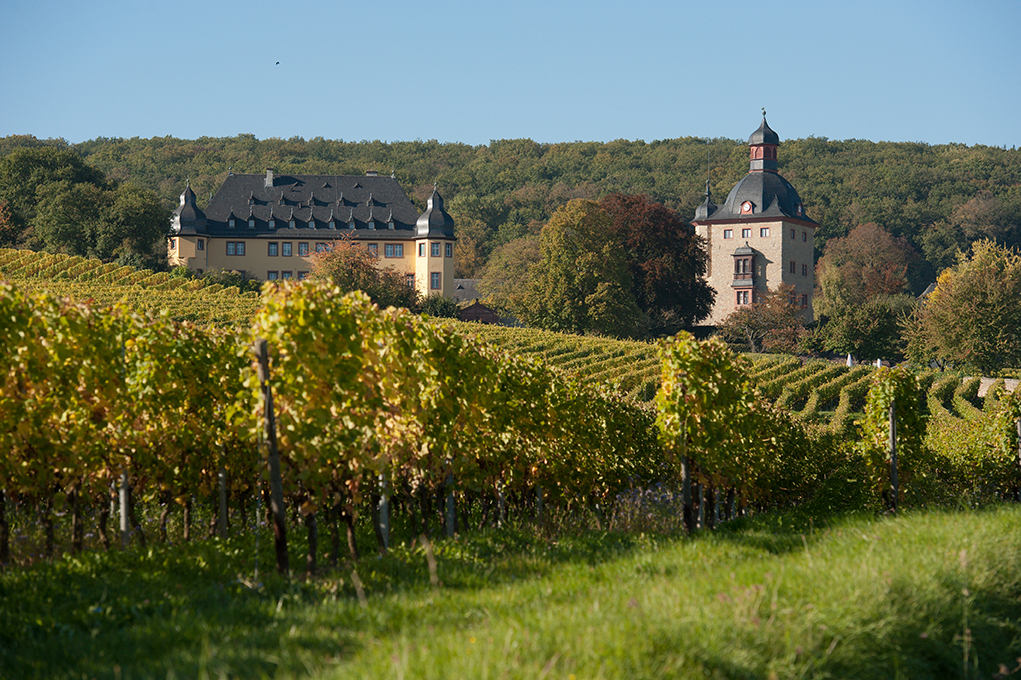
Schloss Vollrads
château
Geisenheim Grape Breeding Institute
German research institute
Ehrenfelser
Ehrenfelser is a white wine grape variety of German origin. It was created by Dr. Heinrich Birk (1898-1973) at the Geisenheim Grape Breeding Institute in 1929, by crossing Riesling with what was thought at the time to be Silvaner, but DNA markers have since indicated it was the Alsace variety Knipperlé.