Category
page 1Roman-era Greeks

Plotinus
Plotinus (; , Plōtînos; – 270 CE) was a Hellenistic Greek philosopher, born and raised in Roman Egypt. Plotinus is regarded by modern scholarship as the founder of Neoplatonism.

Origen
Origen of Alexandria (), also known as Origen Adamantius, was an early Christian scholar, ascetic, and theologian who was born and spent the first half of his career in Alexandria. He was a prolific writer who wrote roughly 2,000 treatises in multiple branches of theology, including textual criticism, biblical exegesis and hermeneutics, homiletics, and spirituality. He was one of the most influential and controversial figures in early Christian theology, apologetics, and asceticism. He has been described by John Anthony McGuckin as "the greatest genius the early church ever produced".

Ammianus Marcellinus
4th-century Roman historian and soldier
Arrian
Arrian of Nicomedia (; Greek: Arrianós; ; )

Ausonius
Decimus Magnus Ausonius (; ) was a Roman poet and teacher of rhetoric from Burdigala, Aquitaine (now Bordeaux, France). For a time, he was tutor to the future Emperor Gratian, who afterwards bestowed the consulship on him. His best-known poems are Mosella, a description of the River Moselle, and Ephemeris, an account of a typical day in his life. His many other verses show his concern for his family, friends, teachers and circle of well-to-do acquaintances and his delight in the technical handling of meter.
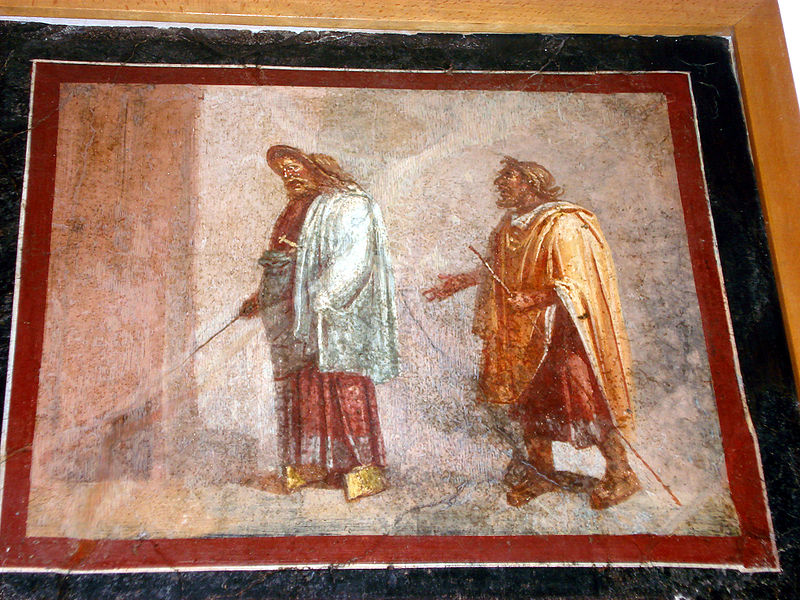
Livius Andronicus
3rd-century BC Greco-Roman dramatist and epic poet

Tiberius II Constantine
Byzantine Emperor (520-582)

Nonnus of Panopolis
Nonnus of Panopolis (, Nónnos ho Panopolítēs, 5th century AD) was the most notable Greek epic poet of the Imperial Roman era. He was a native of Panopolis (Akhmim) in the Egyptian Thebaid and probably lived in the 5th century AD. He is known as the composer of the Dionysiaca, an epic tale of the god Dionysus, and of the Metabole, a paraphrase of the Gospel of John. The epic Dionysiaca describes the life of Dionysus, his expedition to India, and his triumphant return. It was written in Homeric Greek and in dactylic hexameter, and it consists of 48 books at 20,426 lines.
Libanius
Libanius (; ) was a teacher of rhetoric of the Sophist school in the Eastern Roman Empire. His prolific writings make him one of the best documented teachers of higher education in the ancient world and a critical source of history of the Greek East during the 4th century AD. During the rise of Christian hegemony in the later Roman Empire, he remained unconverted and in religious matters was a pagan Hellene.
Meleager of Gadara
1st-century BC Greek poet
Quintus Smyrnaeus
4th-century Greek poet
Artemidorus
Greek professional diviner (2nd century)
Cleomedes
Cleomedes () was a Greek astronomer who is known chiefly for his book On the Circular Motions of the Celestial Bodies (Κυκλικὴ θεωρία μετεώρων), also known as The Heavens ().
Cassius Longinus
Syrian/Egyptian Neoplatonist philosopher (c.213–273)
Aelianus Tacticus
2nd-century Greek military writer
Alexander of Abonoteichus
Greek mystic and oracle (c. 105 – c. 170)
Memnon of Heraclea
1st century Greek historian
Gaius Julius Quadratus Bassus
Roman senator, general and governor (70 – 117)
Aristides Quintilianus
ancient Greek musicologist
Caecilius of Calacte
Greek critic and rhetorician during the reign of Augustus
Himerius
Himerius (; c. 315 – c. 386) was a Greek sophist and rhetorician. 24 of his orations have reached us complete, and fragments of 12 others survive.
Aspasius
Aspasius (; ; c. 80 – c. 150 AD) was a Peripatetic philosopher. Boethius, who frequently referred to his works, said he wrote commentaries on most of the works of Aristotle.
Gaius Antius Aulus Julius Quadratus
Roman consul in 105 AD
Melankomas
Melankomas, or Melancomas (), meaning 'One with the Black Hair,' was an Ancient Greek boxer from Caria and victor in the 207th Olympiad (49 AD.).
Antonia Tryphaena
Roman Client Queen of Thrace (10 BC - AD 55)
Sosigenes the Peripatetic
Late 2nd century Roman philosopher and astronomer
Serenus of Antinouplis
ancient Greek mathematician
Tiberius Julius Celsus Polemaeanus
1st/2nd century Roman senator and suffect consul
Apsyrtus
Ancient veterinary surgeon from Bithynia
Bianor
ancient Greek poet
Ptolemy
tetrarch, son of Mennaeus
Rufinus
Roman poet
Agasias
son of Menophilus, Ephesian sculptor
Theodorus of Gadara
ancient Greek rhetorician
Boios
Boios (Βοῖος), Latinized Boeus, was a Greek grammarian and mythographer, remembered chiefly as the author of a lost work on the transformations of mythic figures into birds, his Ornithogonia. Ornithogonia was translated into Latin by Aemilius Macer, a friend of Ovid, who was the author of the most familiar such collections of metamorphoses. In the 2nd century CE, Antoninus Liberalis gave extremely brief summaries of the contents of some of the myths collected in Ornithogonia.

Alpheus of Mytilene
ancient Greek epigrammatist
Fronto of Emesa
3rd-century Greek rhetorician