Category
page 1Rules of chess
castling
Castling is a move in chess. It consists of moving the king two squares toward a rook on the same and then moving the rook to the square that the king passed over. Castling is permitted only if neither the king nor the rook has previously moved; the squares between the king and the rook are vacant; and the king does not leave, cross over, or finish on a square attacked by an enemy piece. Castling is the only move in chess in which two pieces are moved at once.

checkmate
right|thumb|upright=1.35|White and Black in chess|Black is checkmated and loses the game.
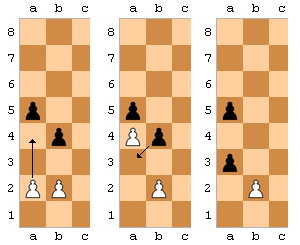
en passant
special move in chess where, immediately after a pawn makes a 2-step move, if it could have been captured by an opposing pawn had it advanced only 1 step, then the opponent can capture the just-moved pawn “as it passes” through the 1st square
stalemate
Stalemate is a situation in chess where the player whose turn it is to move is not in check but has no legal move. Stalemate results in a draw. During the endgame, stalemate is a resource that can enable the player with the inferior position to draw the game rather than lose. In more complex positions, stalemate is much rarer, usually the result of a swindle that succeeds only if the superior side is inattentive. Stalemate is also a common theme in endgame studies and other chess problems.

rules of chess
rules of play for the game of chess
check
chess condition

promotion
in chess, the mandatory immediate replacement of a pawn reaching its 8th rank by the player's choice of a queen, knight, rook, or bishop of the same color
draw
result of a chess game ending in a tie
perpetual check
situation in the game of chess
fifty-move rule
chess rule that a player can claim a draw if no capture has been made and no pawn has been moved in the last 50 moves
time control
Mechanism used in chess
time trouble
concept in chess
threefold repetition
in chess and some other abstract strategy games, the rule that a player can claim a draw if the same position occurs three times, with the same player to move
touch-move rule
chess rule that, if a player deliberately touches a piece on their turn, then they must move (if own) or capture (if opponent’s) that piece if legal; if a player wishes to adjust a piece, they must announce “j’adoube” or similar
adjournment
in board games, mechanism to suspend a game, so it can be continued at another time
cheating in chess
unfair behavior in chess

White and Black in chess
chess convention of colors used to indicate the first- and second-moving players
tie-breaking in Swiss-system tournaments
systems to break ties between players with the same number of points in chess Swiss system tournaments
draw by agreement
chess game outcome when one player accepts the other's offer to draw