File:Ajedrez_captura_al_paso_del_peon.png · Wikimedia Commons · See Wikimedia Commons
en passant
Sign in to saveAlso known as e.p.
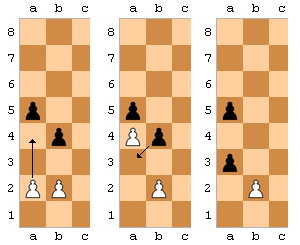
special move in chess where, immediately after a pawn makes a 2-step move, if it could have been captured by an opposing pawn had it advanced only 1 step, then the opponent can capture the just-moved pawn “as it passes” through the 1st square
En passant is a special chess move that allows a pawn to capture an opponent's pawn that has just moved two squares forward, by taking it as if it had only advanced one square. This rule matters because it prevents a pawn from safely bypassing an opponent's pawn by moving two squares instead of one, preserving the tactical balance of pawn play in chess.
AI-generated from the Wikipedia summary — may contain errors.
Wikidata facts
- Instance of
- rules of chess
- Subclass of
- capture in chess
- Sport
- chess
Show 3 more facts
- short name
- a.p.
- Commons category
- En passant
- Stack Exchange tag
- chess.stackexchange.com/tags/en-passant
Sources (2)
via Wikidata · CC0
~9 min read
Encyclopedic overview
Example of en passant
In chess, en passant (French for 'in passing') describes the capture by a pawn of an enemy pawn on the same rank and an adjacent file that has just made an initial two-square advance. This is a special case in the rules of chess. The capturing pawn moves to the square that the enemy pawn passed over, as if the enemy pawn had advanced only one square. The rule ensures that a pawn cannot use its two-square move to safely skip past an enemy pawn.
Excerpted from Wikipedia’s “en passant” article, available under the CC BY-SA 4.0 licence.