Category
page 1Schisms in Christianity

Protestant Reformation
The Reformation, also known as the Protestant Reformation or the European Reformation, was a time of major theological movement in Western Christianity in 16th-century Europe that posed a religious and political challenge to the papacy and the authority of the Catholic Church hierarchy. Towards the end of the Renaissance, the Reformation marked the beginning of Protestantism. It is considered one of the events that signified the end of the Middle Ages and the beginning of the early modern period in Europe.

East-West Schism
division of Christianity into two large parts in 1054

Council of Chalcedon
synod

Monophysitism
thumb|'Spectrum' of Christology, with monophysitism at far right.
Monophysitism ( ) or monophysism ( ; from Greek , "solitary" and , "nature") is a Christological doctrine that states that there was only one nature—the divine—in the person of Jesus Christ, who was the incarnated Word. It is rejected as heretical by the Catholic Church, Eastern Orthodox Church, Anglicanism, Lutheranism, Reformed Christianity (Calvinist), and all mainstream Protestant denominations, which hold to the dyophysitism of the 451 Council of Chalcedon—as well by Oriental Orthodoxy, which holds to miaphysitism.

First Council of Ephesus
ecumenical council in Ephesus in June–July 431, convened by Emperor Theodosius II
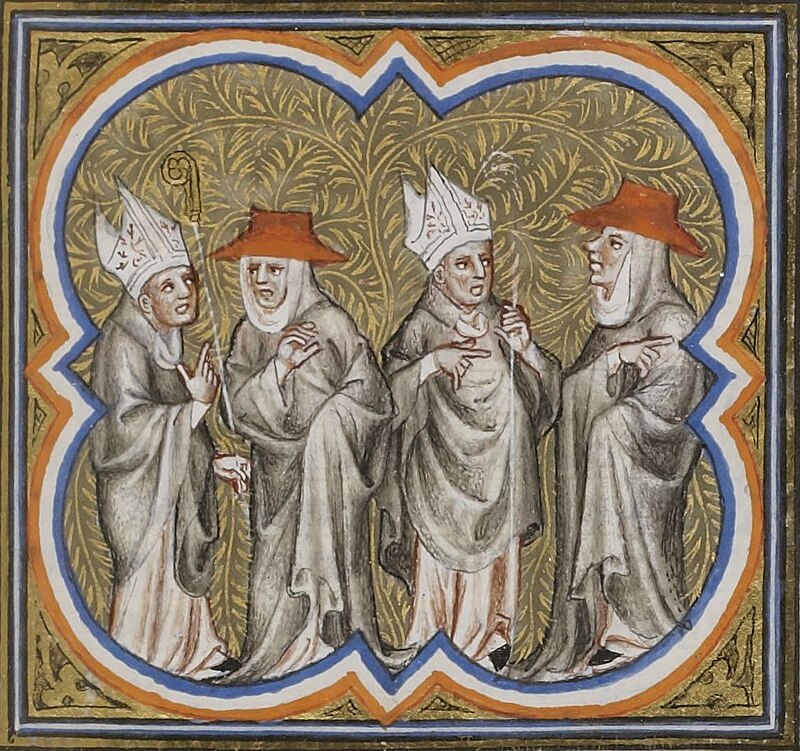
Western Schism
split within the Catholic Church from 1378 to 1417, in which bishops in Rome and Avignon both claimed to be the pope, joined by a third line of Pisan popes in 1409

jansenism
upright=1.3|thumb| ('The Conversion of St. Augustine', c. 1650) by French [[Baroque painter and Jansenist Philippe de Champaigne]]

Donatism
thumb|alt=Painting of Augustine of Hippo arguing with a man before an audience|Charles-André van Loo's 18th-century Augustine arguing with Donatists
Donatism was a schism from the Catholic Church in the Archdiocese of Carthage from the fourth to the sixth centuries. Donatists argued that Christian clergy must be faultless for their ministry to be effective and their prayers and sacraments to be valid. Donatism had its roots in the long-established Christian community of the Roman province Africa Proconsularis (present-day Tunisia, the northeast of Algeria, and the western coast of Libya) and M

monothelitism
Monothelitism, or monotheletism, is a theological doctrine in Christianity that was proposed in the 7th century, but was ultimately rejected by the sixth ecumenical council. It held Christ as having only one will and was thus contrary to dyothelitism, the Christological doctrine accepted by most Christian denominations, which holds Christ as having two wills (divine and human). Historically, monothelitism was closely related to monoenergism, a theological doctrine that holds Jesus Christ as having only one energy. Both doctrines were at the center of Christological disputes during the 7th cent

nontrinitarianism
Nontrinitarianism is a form of Christianity that rejects the Christian theology of the Trinity—the belief that God is three distinct hypostases or persons who are coeternal, coequal, and indivisibly united in one being, or essence (from the Ancient Greek ). Certain religious groups that emerged during the Protestant Reformation have historically been known as antitrinitarian.

Marcionism
Marcionism was an early Christian dualistic belief system originating with the teachings of Marcion of Sinope in Rome around 144. Marcion was an early Christian theologian, evangelist, and an important figure in early Christianity. He was the son of a bishop of Sinope in Pontus. About the middle of the 2nd century (140–155) he traveled to Rome, where he joined the Syrian gnostic Cerdo.
dyophysite
Dyophysitism (; from Greek δύο dyo, "two" and φύσις physis, "nature") is the Christological position that Jesus Christ is in two distinct, inseparable natures: divine and human. It is accepted by the majority of Christian denominations, including the Catholic Church, Eastern Orthodox Church, Church of the East, Anglicanism, Methodism, Reformed Christianity and Lutheranism. It is rejected by the Oriental Orthodox churches, who hold to Miaphysitism—that Jesus Christ is of two natures united into one composite nature—while rejecting Monophysitism as heresy along with other extant denominations.
Miaphysitism
Miaphysitism () is the Christological doctrine that holds Jesus, the Incarnate Word, is fully divine and fully human, in one nature or physis (). It is the position held by the Oriental Orthodox Churches. It differs from the dyophysitism of the Catholic Church, Eastern Orthodox Church, the Church of the East and major Protestant denominations, which holds that Jesus is one person with two natures (divine and human) as defined by the Council of Chalcedon in 451.
Raskol
1650s–1660s Russian Orthodox schism creating the Old Believers
Meletius of Antioch
Christian bishop of Antioch from 360 to 381
Nazarene
sect of 4th-century Christianity described by Epiphanius of Salamis
Fourth Council of Constantinople (Eastern Orthodox)
synoz convoked by Byzantine Emperor Basil I and held in 879–880
schism in Christianity
division between people belonging to a Christian organization
Acacian schism
schism (484–519) between the Pope and the Patriarch of Constantinople
2018 Moscow–Constantinople schism
ongoing split between the Eastern Orthodox patriarchates of Moscow and Constantinople
Three-Chapter Controversy
a phase in the Chalcedonian controversy
Photian schism
9th-century schism between Rome and Constantinople

Novatianism
Novatianism or Novationism was an early Christian sect devoted to the theologian Novatian () that held a strict view that refused readmission to communion of lapsi (those baptized Christians who had denied their faith or performed the formalities of a ritual sacrifice to the pagan gods under the pressures of the persecution sanctioned by Emperor Decius in AD 250). The Church of Rome declared the Novatianists heretical following the letters of Saint Cyprian of Carthage and Ambrose wrote against them. Novatianism survived until the 8th century.
Lapsi
Christians who bowed to external pressure

Quartodecimanism
Quartodecimanism (from the Vulgate Latin quarta decima in Leviticus 23:5, meaning fourteenth) is the name given to the practice of commemorating the death of Christ on the day of Passover, the 14th of Nisan according to biblical dating, on whatever day of the week it occurs. The Quartodeciman controversy in the Church was the question of whether to celebrate Easter on Sunday (the first day of the week), or at the time of sacrifice of the Passover lamb.

Alogi
thumb|right
The Alogi (), also called Alogoi or Alogians, were a group of heterodox Christians in Asia Minor that flourished c. 200 AD, and taught that the Gospel of John and the Apocalypse of John were not the work of the Apostle, but his adversary Cerinthus. What we know of them is derived from their doctrinal opponents, whose literature is extant, particularly Epiphanius of Salamis. It was Epiphanius who coined the name "Alogi" as a word play suggesting that they were both illogical and they were against the Christian doctrine of the Logos. While Epiphanius does not specifically indicate th

Judaizers
The Judaizers were a faction of the Jewish Christians, both of Jewish and non-Jewish origins, who regarded the Levitical laws of the Old Testament as still binding on all Christians. They tried to enforce Jewish circumcision upon the Gentile converts to early Christianity and were strenuously opposed and criticized for their behavior by the Apostle Paul, who employed many of his epistles to refute their doctrinal positions.
1159 papal election
1159 election of the Catholic pope
1130 papal election
1130 election of the Catholic pope
Melitius of Lycopolis
bishop of Lycopolis
Council of Rimini
synod held in 359
circumcision controversy in early Christianity
Meletians
thumb | right | Melitian manuscript from 1524.
The Melitians, sometimes called the Church of the Martyrs, were an early Christian sect in Egypt. They were founded about 306 by Bishop Melitius of Lycopolis and survived as a small group into the eighth century. The point on which they broke with the larger catholic church was the same as that of the contemporary Donatists in the province of Africa: the ease with which lapsed Christians were received back into communion. The resultant division in the church of Egypt is known as the Melitian schism.
LDS succession crisis
event in Latter Day Saint history after the death of Joseph Smith in 1844
Proto-Protestantism
Nestorian Schism
schism between the Christian churches of Sassanid Persia affiliated with Nestorius and churches that rejected him, arising out of a Christological dispute, caused by the Council of Ephesus (431)
Secession of 1834
Primitive Baptists
Christian denomination in the United States
Schism of 1552
Church of the East divided into one faction in communion with Rome and the other remaining independent until the 19th century
Council of Seleucia
synod held in 359
Disruption of 1843
divergence of the Free Church of Scotland from the Church of Scotland
Global Fellowship of Confessing Anglicans
global Christian denomination, 2008-
Jehovah's Witnesses splinter groups
splinter groups of the Jehovah's Witnesses