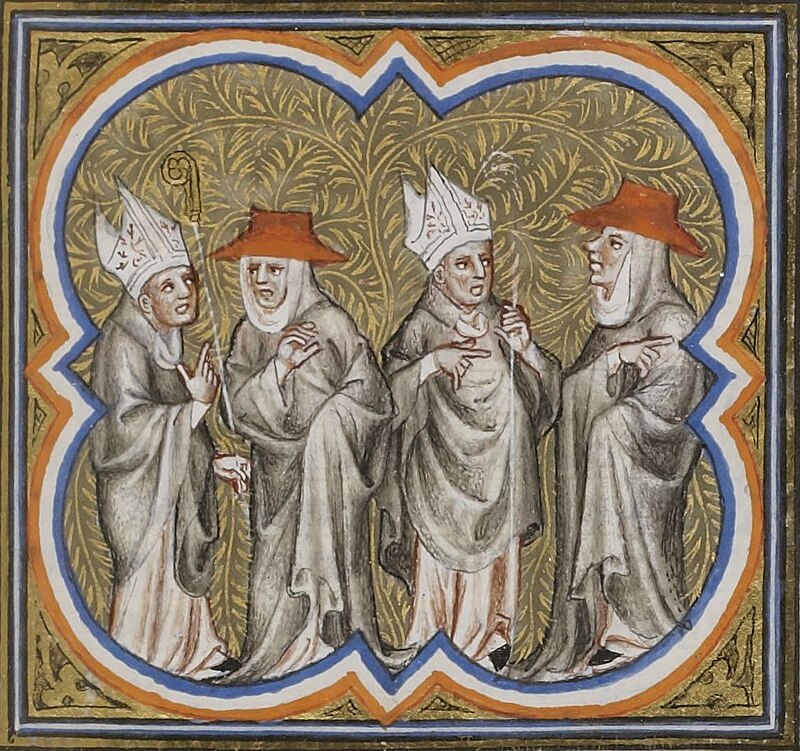
File:Grandes_Chroniques_de_Frances_de_Charles_V_-_BNF_fr2813_f208_(Clercs_se_disputant).jpg · Wikimedia Commons · See Wikimedia Commons
Western Schism
Sign in to saveAlso known as Papal Schism, Great Occidental Schism, Schism of 1378, Vatican Standoff
split within the Catholic Church from 1378 to 1417, in which bishops in Rome and Avignon both claimed to be the pope, joined by a third line of Pisan popes in 1409
The Western Schism was a period from 1378 to 1417 when the Catholic Church was divided because competing groups of bishops in Rome, Avignon, and later Pisa each claimed their own leader was the true pope. This split weakened the Church's authority and required a major church council to finally resolve which pope was legitimate and reunify the institution.
AI-generated from the Wikipedia summary — may contain errors.
In the Vinony graph
Vinony's link graph records 2,104 inbound references to Western Schism, and connects out to Protestant Reformation, Society of Jesus and Clement I.
It is catalogued under topics including 1370s in Europe, 1370s in religion and 1378 in Europe.
Vinony links it to 60 Wikipedia language editions.
Wikidata facts
- Instance of
- schism in Christianity
- Follows
- East-West Schism
- Image
- Enguerrand Quarton, La vierge de miséricorde de la famille Cadard (1452).jpg
Show 6 more facts
- topic's main category
- Category:Western Schism
- start time
- 1378-00-00
- Commons category
- Western Schism
- end time
- 1417-00-00
- P8168
- 2010 Veikkausliiga
- described by source
- Wikitólica
Sources (3)
via Wikidata · CC0
~26 min read
Encyclopedic overview
The Western Schism, also known as the Great Divide, the Great Occidental Schism, the Schism of 1378, or the Great Western Schism (Latin: Magnum schisma occidentale, Ecclesiae occidentalis schisma), was a split within the Catholic Church lasting from 20 September 1378 to 11 November 1417, in which bishops residing in Rome and Avignon simultaneously claimed to be the true pope, and were eventually joined by a line of Pisan claimants in 1409. The event was driven by international rivalries, personalities and political allegiances, with the Avignon Papacy in particular being closely tied to the French monarchy.
The papacy had resided in Avignon since 1309, but Pope Gregory XI returned to Rome in 1377. The Catholic Church split in September 1378, when, following Gregory XI's death and Urban VI's subsequent election, a group of French cardinals declared his election invalid due to intimidation and violence and, in the presence of three Italian cardinals, elected Clement VII, who claimed to be the true pope. As Roman claimant, Urban VI was succeeded by Boniface IX, Innocent VII and Gregory XII. Clement VII was succeeded as Avignon claimant by Benedict XIII.
Excerpted from Wikipedia’s “Western Schism” article, available under the CC BY-SA 4.0 licence.
Gallery (4)
Available in 60 languages
- Español
- Français
- Deutsch
- 中文
- 日本語
- Русский
- Português
- Italiano
- العربية
- Afrikaans
- Albanian
- Aragonese
- Asturian
- Bahasa Indonesia
- Bangla
- Basque
- Belarusian
- Bosnian
Show 41 more
- Bulgarian
- Catalan
- Croatian
- Czech
- Egyptian Arabic
- Esperanto
- Estonian
- Filipino
- Finnish
- Galician
- Georgian
- Hebrew
- Hungarian
- Icelandic
- Interlingue
- Irish
- Latin
- Low German
- Macedonian
- Malay
- Malayalam
- Nederlands
- Norwegian
- Polski
- Romanian
- Serbian
- Serbian (Latin)
- simple
- Slovenian
- Svenska
- Swahili
- Tamil
- Tiếng Việt
- Türkçe
- Ukrainian
- Venetian
- Welsh
- zh_yue
- فارسی
- ไทย
- 한국어
via Wikidata sitelinks · CC0