Category
page 1Seabirds

penguin
Penguins are a group of flightless semi-aquatic sea birds which live almost exclusively in the Southern Hemisphere. Only one species, the Galapagos penguin, lives at, and slightly north of, the equator. Highly adapted for life in the ocean water, penguins have countershaded dark and white plumage and flippers for swimming. Most penguins feed on krill, fish, squid and other forms of sea life which they catch with their bills and swallow whole while swimming. A penguin has a spiny tongue and powerful jaws to grip slippery prey.

Laridae
Laridae is a family of seabirds in the order Charadriiformes that includes the gulls, terns (including white terns), noddies, and skimmers. It includes 105 species arranged into 23 genera. They are an adaptable group of mostly aerial birds found worldwide.

albatross
Albatrosses, of the biological family Diomedeidae, are large seabirds related to the procellariids, storm petrels, and diving petrels in the order Procellariiformes (the tubenoses). They range widely in the Southern Ocean and the North Pacific. They are absent from the North Atlantic, although fossil remains of short-tailed albatross show they lived there up to the Pleistocene, and occasional vagrants are found. Great albatrosses are among the largest of flying birds, with wingspans reaching up to and bodies over in length. The albatrosses are usually regarded as falling into four genera, but

Charadriiformes
Charadriiformes (, from Charadrius, the type genus of family Charadriidae) is a diverse order of small to medium-large birds. It includes about 390 species and has members in all parts of the world. Most charadriiform birds live near water and eat invertebrates or other small animals; however, some are pelagic (seabirds), others frequent deserts, and a few are found in dense forest. Members of this group can also collectively be referred to as shorebirds.

Pelecaniformes
The Pelecaniformes are an order of medium-sized and large waterbirds found worldwide. As traditionally (but erroneously) defined, they encompass all birds that have feet with all four toes webbed. Hence, they were formerly also known by such names as totipalmates or steganopods. Under this obsolete definition, the Fregatidae (frigatebirds), Sulidae (gannets and boobies), Phalacrocoracidae (cormorants and shags), Anhingidae (darters), and Phaethontidae (tropicbirds) were included in the Pelecaniformes. Subsequent molecular and morphological studies indicate they are in fact not close relatives

Phalacrocoracidae
Phalacrocoracidae is a family of approximately 40 species of aquatic birds found worldwide and commonly known as cormorants and shags. Several different classifications of the family have been proposed, but in 2021 the International Ornithologists' Union (IOU) adopted a consensus taxonomy of seven genera.

Procellariiformes
Procellariiformes is an order of seabirds that comprises four families; the albatrosses, the petrels and shearwaters, and two families of storm petrels. Formerly called Tubinares and still called tubenoses in English, Procellariiformes are often referred to collectively as the petrels, a term that has been applied to all members of the order, or more commonly all the families except the albatrosses. They are almost exclusively pelagic (feeding in the open ocean), and have a cosmopolitan distribution across the world's oceans, with the highest diversity being the seas around New Zealand.

Stercorariidae
The skuas () are a group of predatory and kleptoparasitic seabirds with seven species forming the genus Stercorarius, the only genus in the family Stercorariidae. The three smaller skuas, the Arctic skua, the long-tailed skua, and the pomarine skua, are called jaegers in North American English.

Procellariidae
The family Procellariidae is a group of seabirds that comprises the fulmarine petrels, the gadfly petrels, the diving petrels, the prions, and the shearwaters. This family is part of the bird order Procellariiformes (or tubenoses), which also includes the albatrosses and the storm petrels.

Fregata
Frigatebirds are a family of seabirds called Fregatidae which are found across all tropical and subtropical oceans. The five extant species are classified in a single genus, Fregata. All have predominantly black plumage, long, deeply forked tails and long hooked bills. Females have white underbellies and males have a distinctive red gular pouch which they inflate during the breeding season to attract females. Their wings are long and pointed and can span up to , the largest wing area to body mass ratio of any bird.
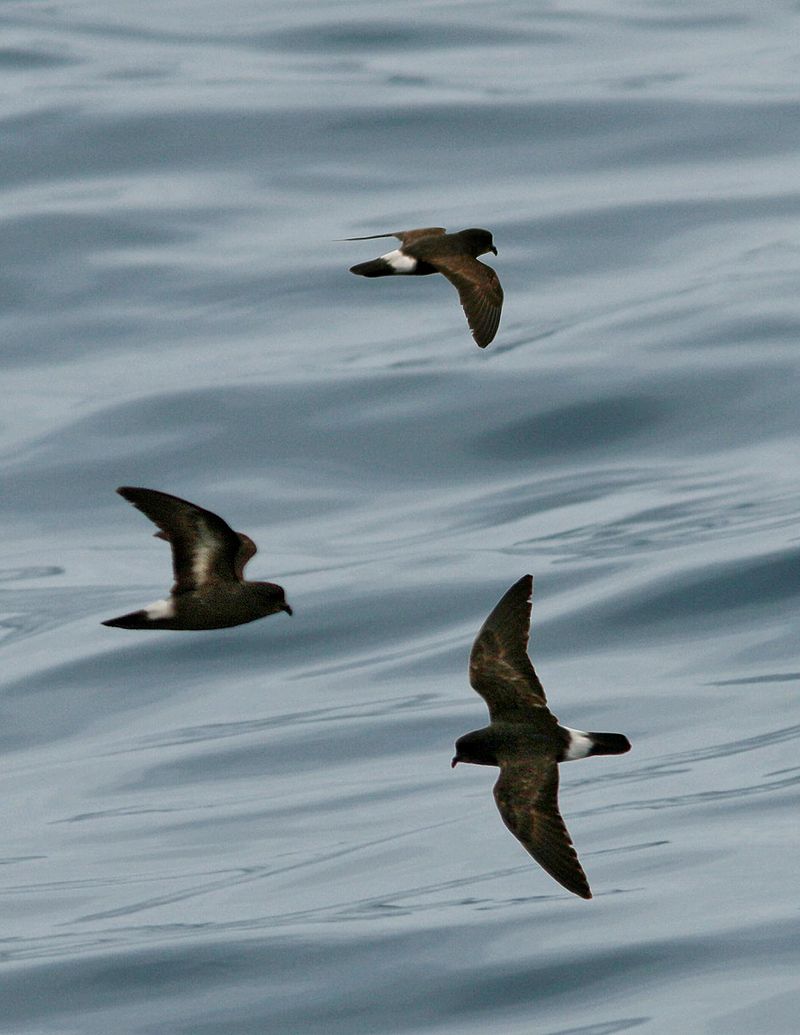
Hydrobatidae
family of birds
.jpg)
seabird
thumb|350px|alt=black seabird flying against blue sky|right|The sooty tern is highly aerial and marine and spends months flying at sea, returning to land only for breeding.
thumb|350px|Raft of coastal seabirds Gulf of St. Lawrence, [[Quebec, Canada]]

Larinae
thumb|right|Immature (probably 2nd year) Armenian gull in flight, flying over [[Lake Sevan]]
Gulls or seagulls are seabirds of the subfamily Larinae. They are most closely related to terns and skimmers, and are placed with them in the family Laridae. They are also related, more distantly, to auks and skuas, and more distantly still to waders. Until the 21st century, most gulls were placed in the genus Larus, but that arrangement is now considered polyphyletic, leading to the readoption and revision of several genera.

Suliformes
The order Suliformes (, dubbed "Phalacrocoraciformes" by Christidis & Boles 2008) is an order of birds that includes gannets, boobies, frigatebirds, cormorants and darters. The order is recognised by the International Ornithologist's Union. Regarding the recent evidence that the traditional Pelecaniformes is polyphyletic, it has been suggested that the group be divided to reflect the true evolutionary relationships; a 2017 study indicated that they are most closely related to Otidiformes (bustards) and Ciconiiformes (storks).

Morus
Gannets are seabirds comprising the genus Morus in the family Sulidae, closely related to boobies. They are known as 'solan' or 'solan goose' in Scotland. A common misconception is that the Scottish name is 'guga' but this is the Gaelic name referring to the chicks only.
Fulmar
The fulmars are tube-nosed seabirds in the family Procellariidae. The family includes two extant species, and two extinct fossil species from the Miocene.

Phaethon
Tropicbirds are a family, Phaethontidae, of tropical pelagic seabirds. They are the sole living representatives of the order Phaethontiformes. For many years, they were considered part of the Pelecaniformes, but genetics indicate they are most closely related to the Eurypygiformes. There are three species in one genus, Phaethon. The scientific names are derived from Ancient Greek phaethon, "sun". They have predominantly white plumage with elongated tail feathers and small feeble legs and feet.

Phaethontiformes
The Phaethontiformes are an order of birds. They contain one extant family, the tropicbirds (Phaethontidae), and one extinct family Prophaethontidae from the early Cenozoic. Several fossil genera have been described, with well-preserved fossils known as early as the Paleocene. The group's origins may lie even earlier if the enigmatic waterbird Novacaesareala from the latest Cretaceous or earliest Paleocene of New Jersey is considered a tropicbird.
Oceanitidae
family of birds
shearwater
Shearwaters are medium-sized long-winged seabirds in the petrel family Procellariidae. They have a global marine distribution, but are most common in temperate and cold waters, and are pelagic outside the breeding season.

petrel
REDIRECT Procellariiformes
Storm petrel
Wikimedia disambiguation page
Southern African Foundation for the Conservation of Coastal Birds
thumb|SANCCOB at Cape Recife
thumb|SANCCOB at Cape Recife
seawatching
thumb|Seawatchers in Gambell, Alaska
thumb|Flamborough Head in northern England is a good place for seawatching
Seawatching is a type of birdwatching where participants observe seabirds from a fixed point on the mainland. They may do this from a coastal location, usually a headland, looking out to sea, or from a boat or ship.
Fulmarine petrel
group of birds