Category
page 1Sex organs

vagina
The vagina (: vaginas or vaginae) is the elastic, muscular reproductive organ of the female genital tract through which mammals copulate and give birth. In humans, it extends from the vulval vestibule to the cervix (neck of the uterus). The vaginal introitus is normally partly covered by a thin layer of mucosal tissue called the hymen. The vagina also channels menstrual flow, which occurs in humans and closely related primates as part of the menstrual cycle.
.jpg)
penis

testicle
thumb|right|202px| Animation of the migration of spermatozoa from their origin as germ cells to their exit from the vas deferens. A) Blood vessels; B) Head of [[epididymis; C) Efferent ductules; D) Seminiferous tubules; E) Parietal lamina of tunica vaginalis; F) Visceral lamina of tunica vaginalis; G) Cavity of tunica vaginalis; H) Tunica albuginea; I) Lobule of testis; J) Tail of epididymis; K) Body of epididymis; L) Mediastinum testis; M) Vas deferens.]]
A testicle, also called testis ( testes) is the male gonad in all gonochoric animals, including humans, and is homologous to the ovary, whi

uterus
The uterus (from Latin uterus, : uteri or uteruses) or womb () is the organ in the reproductive system of most female mammals, including humans, that accommodates the embryonic and fetal development of one or more fertilized eggs until birth. The uterus is a hormone-responsive sex organ that contains glands in its lining that secrete uterine milk for embryonic nourishment. (The term uterus is also applied to analogous structures in some non-mammalian animals.)

clitoris
In amniotes, the clitoris ( or ; : clitorises or clitorides) is a female sex organ. In humans, it is the vulva's most erogenous area and generally the primary anatomical source of female sexual pleasure. The clitoris is a complex structure, and its size and sensitivity can vary. The visible portion, the glans, of the clitoris is typically roughly the size and shape of a pea and is estimated to have more than 10,000 nerve endings. Sometimes in common speech, clitoris or clit is used to solely reference the glans.

Vulva
In mammals, the vulva (: vulvas or vulvae) comprises mostly external, visible structures of the female genitalia leading into the interior of the female reproductive tract. For humans, it includes the mons pubis, labia majora, labia minora, clitoris, vestibule, urinary meatus, vaginal introitus, hymen, and openings of the vestibular glands (Bartholin's and Skene's). The folds of the outer and inner labia provide a double layer of protection for the vagina (which leads to the uterus). While the vagina is a separate part of the anatomy, colloquially the term has often been used synonymously with
.jpg)
ovary
The ovary () is a gonad in the female reproductive system that produces ova; when released, an ovum travels through the fallopian tube/oviduct into the uterus. There is an ovary on the left and the right side of the body. The ovaries are endocrine glands, secreting various hormones that play a role in the menstrual cycle and fertility. The ovary progresses through many stages beginning in the prenatal period through menopause.

scrotum
In most terrestrial mammals, the scrotum (: scrotums or scrota; possibly from Latin scortum, meaning "hide" or "skin") or scrotal sac is a part of the external male genitalia located at the base of the penis. It consists of a sac of skin containing the external spermatic fascia, testicles, epididymides, and vasa deferentia. The scrotum will usually tighten when exposed to cold temperatures.

prostate
The prostate is an accessory gland of the male reproductive system and a muscle-driven mechanical switch between urination and ejaculation. It is found in all male mammals. It differs between species anatomically, chemically, and physiologically. Anatomically, the prostate is found below the bladder, with the urethra passing through it. It is described in gross anatomy as consisting of lobes and in microanatomy by zone. It is surrounded by an elastic, fibromuscular capsule and contains glandular and connective tissue.

sex organ
biological part involved in sexual reproduction

Human penis
In human anatomy, the penis is an external sex organ through which males ejaculate and urinate. Together with the testes and surrounding structures, the penis functions as part of the male reproductive system.
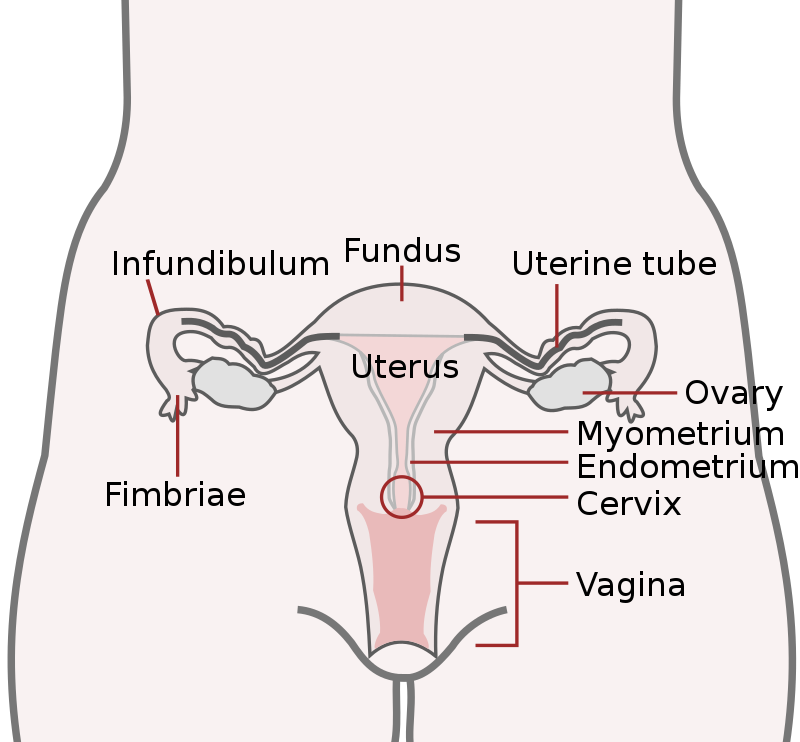
fallopian tube
part of the female reproductive organs

cervix
The cervix (: cervices) or uterine cervix () is a dynamic fibromuscular sexual organ of the female reproductive system that connects the vagina with the uterine cavity. The human female cervix has been documented anatomically since at least the time of Hippocrates, over 2,000 years ago. The cervix is approximately long with a diameter of approximately and tends to be described as a cylindrical shape, although the front and back walls of the cervix are contiguous. The size of the cervix changes throughout a female's life cycle. For example, females in the fertile years of their reproductive cyc

vas deferens
part of the male reproductive system of many vertebrates

cloaca
thumb|Cloaca of a red-tailed hawk

epididymis
The epididymis (; : epididymides or ) is an elongated tubular genital organ attached to the posterior side of each one of the two male reproductive glands, the testicles. It is a single, narrow, tightly coiled tube in adult humans, in length; uncoiled, the tube would be approximately 6 m (20 feet) long. It connects the testicle to the vas deferens in the male reproductive system. The epididymis serves as an interconnection between the multiple efferent ducts at the rear of a testicle (proximally), and the vas deferens (distally). Its primary function is the storage, maturation and transport of

gonad
A gonad, sex gland, or reproductive gland is a mixed gland and sex organ that produces the gametes and sex hormones of an organism. Female reproductive cells are egg cells, and male reproductive cells are sperm. The male gonad, the testicle, produces sperm in the form of spermatozoa. The female gonad, the ovary, produces egg cells. Both of these gametes are haploid cells. Some hermaphroditic animals (and some humanssee Ovotesticular syndrome) have a type of gonad called an ovotestis.

bulbourethral gland
small exocrine gland in the reproductive system of many male mammals

seminal vesicula
pair of simple tubular glands posteroinferior to the urinary bladder of male mammals

Bartholin's gland
two glands located slightly posterior and to the left and right of the opening of the vagina

gynoecium
thumb|Flower of Magnolia × wieseneri|Magnolia × wieseneri showing the many pistils making up the gynoecium in the middle of the flower
thumb|Hippeastrum flowers showing stamens, style and stigma
thumb|right|Hippeastrum stigmas and style
thumb|right|Moss plants with gynoecia, clusters of archegonia at the apex of each shoot.
Skene's gland
glands located on the anterior wall of the vagina

spermatophore
thumb|Spermatophores of a mole salamander

pedipalp
thumb|right|Green-shaded pedipalps in an illustrated dorsal view of a Uropygi|whip scorpion

hemipenis
thumb|An everted hemipenis of a North American rattlesnake (Crotalus adamanteus).
thumb|Common house geckos, mating, ventral view with hemipenis inserted in the [[cloaca]]

gametangium
thumb|Light micrograph of a whole-mount slide of gametangia of [[Equisetum]]
A gametangium (: gametangia) is a sex organ or cell in which gametes are produced that is found in many multicellular protists, algae, fungi, and the gametophytes of plants. In contrast to gametogenesis in animals, a gametangium is a haploid structure and formation of gametes does not involve meiosis.

Hectocotylus
thumb|160px|Georges Cuvier's original illustration of an octopus hectocotylus. Mistaking it for its own separate organism, he named it Hectocotyle octopodis.

gonopore
thumb|The ventral side (underside) of a female American lobster, a member of the class [[Malacostraca. The gonopores are at the bases of the third walking leg, pointing towards the animal's tail.]]
A gonopore, sometimes called a gonadopore, is a genital pore in many invertebrates. Hexapods, including insects, have a single common gonopore, except mayflies, which have a pair of gonopores. More specifically, in the unmodified female, it is the opening of the common oviduct, and in the male, it is the opening of the ejaculatory duct.

epigyne
thumb|upright=1.5|The external anatomy of a spider, with the epigyne labeled
thumb|upright=1.75|The internal anatomy of a spider, with the reproductive system (purple) reaching the exoskeleton at the epigyne
The epigyne or epigynum is the external genital structure of female spiders. As the epigyne varies greatly in form in different species, even in closely related ones, it often provides the most distinctive characteristic for recognizing species. It consists of a small, hardened portion of the exoskeleton located on the underside of the abdomen, in front of the epigastric furrow and between

aedeagus
thumb|Aedeagus of Pentodon idiota
thumb|Photomicrograph of the aedeagus of water scavenger beetle [[Tormissus linsi (from above)|right|220px]]
gonopod
thumb|One of two gonopods of the greenhouse millipede (Oxidus gracilis). Scale bar: 0.2 mm or approximately 1/127 in
Gonopods are specialized appendages of various arthropods used in reproduction or egg-laying. In males, they facilitate the transfer of sperm from male to female during mating, and thus are a type of intromittent organ. In crustaceans and millipedes, gonopods are modified walking or swimming legs. Gonopods may be highly decorated with elaborate structures which may play roles in sperm competition, and can be used to differentiate and identify closely related species. Gonopods g