File:Clitoris_glans_-_detailed.jpg · Wikimedia Commons · See Wikimedia Commons
clitoris
Sign in to saveAlso known as clit
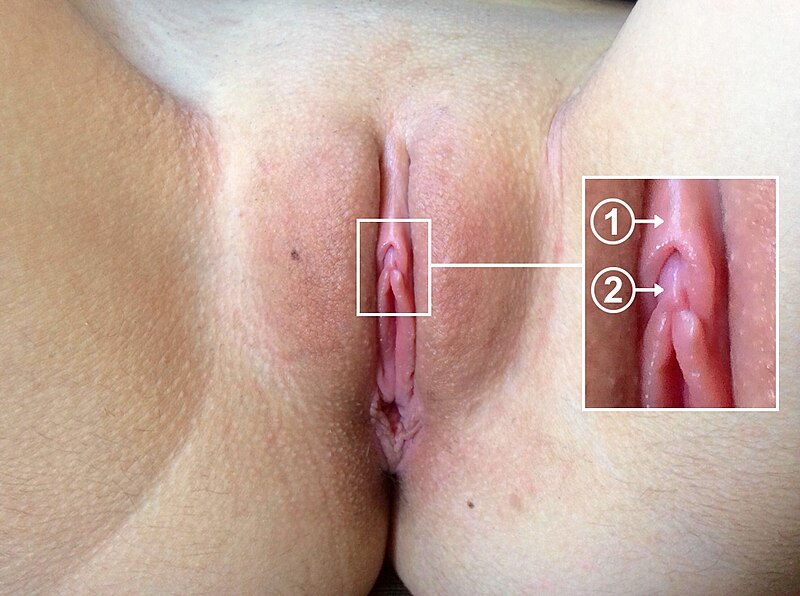
In amniotes, the clitoris ( or ; : clitorises or clitorides) is a female sex organ. In humans, it is the vulva's most erogenous area and generally the primary anatomical source of female sexual pleasure. The clitoris is a complex structure, and its size and sensitivity can vary. The visible portion, the glans, of the clitoris is typically roughly the size and shape of a pea and is estimated to have more than 10,000 nerve endings. Sometimes in common speech, clitoris or clit is used to solely reference the glans.
The clitoris is a female sex organ that is the vulva's most sensitive area and the primary source of female sexual pleasure. It is a complex structure with a visible tip (the glans) about the size of a pea, containing over 10,000 nerve endings, though its overall size and sensitivity can vary.
AI-generated from the Wikipedia summary — may contain errors.
Key facts
- Anatomy.Name
- Body of the clitoris
- Anatomy.Latin
- corpus clitoridis
- Anatomy.Greek
- κλειτορίς
- Anatomy.Image
- Clitoral diagram.jpg
- Anatomy.Caption
- Diagram of clitoris. Body (labeled as "shaft") at the top.
- Anatomy.Precursor
- Genital tubercle
- Anatomy.Part_of
- Vulva
- Anatomy.Artery
- Dorsal arteries of clitoris
- Anatomy.Vein
- Dorsal veins of clitoris
- Anatomy.Nerve
- Dorsal nerve of clitoris
- Anatomy.Alt
- Human clitoris. Pubic hair has been deliberately removed to show anatomical detail.
via Wikipedia infobox
Research
2,885 papers- Anatomy of the clitoris.ReviewThe Journal of urology · 2005O'Connell HE, Sanjeevan KV, Hutson JMDOI: 10.1097/01.ju.0000173639.38898.cd
- Anatomy of the clitoris and the female sexual response.ReviewClinical anatomy (New York, N.Y.) · 2015Pauls RNDOI: 10.1002/ca.22524
- Anatomy and physiology of the clitoris, vestibular bulbs, and labia minora with a review of the female orgasm and the prevention of female sexual dysfunction.ReviewClinical anatomy (New York, N.Y.) · 2013Puppo VDOI: 10.1002/ca.22177
- Colombo and the clitoris.ReviewEuropean journal of obstetrics, gynecology, and reproductive biology · 2010Stringer MD, Becker IDOI: 10.1016/j.ejogrb.2010.04.007
- The Clitoris-An Appraisal of its Reproductive Function During the Fertile Years: Why Was It, and Still Is, Overlooked in Accounts of Female Sexual Arousal.ReviewClinical anatomy (New York, N.Y.) · 2020Levin RJDOI: 10.1002/ca.23498
- Lesions of the clitoris: a review.ReviewJournal of lower genital tract disease · 2015Heller DSDOI: 10.1097/LGT.0000000000000028
- Clitoris color Doppler ultrasound: a 2023 update.The journal of sexual medicine · 2023Maseroli E, Vignozzi L, Reisman YDOI: 10.1093/jsxmed/qdad140
- Glans clitoris innervation: PIEZO2 and sexual mechanosensitivity.Journal of anatomy · 2021García-Mesa Y, Cárcaba L, Coronado C et al.DOI: 10.1111/joa.13317
via PubMed
Wikidata facts
- Part of
- Vulva
- Follows
- genital tubercle
- Image
- Clitoris 3 D - Helen O'Connell.jpg
Show 9 more facts
- Commons category
- Clitoris
- innervated by
- dorsal nerve of the clitoris
- topic's main category
- Category:Clitoris
- venous drainage
- deep dorsal vein of clitoris
- Commons gallery
- Clitoris
- sexually homologous with
- penis
- NCI Thesaurus ID
- C12308
- anatomical location
- vagina
- facet of
- women's health
Sources (7)
via Wikidata · CC0
~67 min read
Encyclopedic overview
31 sectionsContents
- Etymology and terminology
- Structure
- Glans
- Frenulum
- Body
- Root
- Hood
- Size and length
- Development
- Function
- Sexual stimulation and arousal
- Clitoral and vaginal orgasmic factors
- Vestigiality, adaptionist and reproductive views
- Clinical significance
- Modification
- Sexual disorders
- Smegma
- Society and culture
- Ancient Greek–16th century knowledge and vernacular
- 17th century–present day knowledge and vernacular
- Contemporary art
- Influence on female genital mutilation
- Other animals
- Non-human primates
- Spotted hyenas
- See also
- Notes
- References
- Journals
- Bibliography
- External links
In amniotes, the clitoris ( or ; : clitorises or clitorides) is a female sex organ. In humans, it is the vulva's most erogenous area and generally the primary anatomical source of female sexual pleasure. The clitoris is a complex structure, and its size and sensitivity can vary. The visible portion, the glans, of the clitoris is typically roughly the size and shape of a pea and is estimated to have more than 10,000 nerve endings. Sometimes in common speech, clitoris or clit is used to solely reference the glans.
Sexological, medical, and psychological debate has focused on the clitoris, and it has been subject to social constructionist analyses and studies. Such discussions range from anatomical accuracy, gender inequality, female genital mutilation, and orgasmic factors and their physiological explanation for the G-spot. The only known purpose of the human clitoris is to provide sexual pleasure.
Excerpted from Wikipedia’s “clitoris” article, available under the CC BY-SA 4.0 licence.
Gallery (38)
Available in 109 languages
- Español
- Français
- Deutsch
- 中文
- 日本語
- Русский
- Português
- Italiano
- العربية
- हिन्दी
- Achinese
- Afrikaans
- Albanian
- Albanian
- Aragonese
- Asturian
- Azerbaijani
- Bahasa Indonesia
Show 90 more
- Bangla
- Banjar
- Basque
- be_x_old
- Belarusian
- Bhojpuri
- Bikol
- Bosnian
- Breton
- Bulgarian
- Burmese
- Catalan
- Cebuano
- Central Kurdish
- Croatian
- Czech
- Danish
- Divehi
- Esperanto
- Estonian
- Extremaduran
- Filipino
- Finnish
- Galician
- Georgian
- Gilaki
- Greek
- Guarani
- Hebrew
- Hungarian
- Icelandic
- Ido
- Iloko
- Irish
- Javanese
- Kashmiri
- Kazakh
- Kurdish
- Latin
- Latvian
- Lithuanian
- Lombard
- Low German
- Luxembourgish
- Macedonian
- Malay
- Malayalam
- Mazanderani
- Nederlands
- Nepali
- Norwegian
- Norwegian Nynorsk
- Occitan
- Polski
- Quechua
- rki
- Romanian
- Scots
- Scottish Gaelic
- Serbian
- Serbian (Latin)
- Shona
- simple
- Sinhala
- Slovak
- Slovenian
- Somali
- Sundanese
- Svenska
- Swahili
- Tajik
- Tamil
- Telugu
- Tiếng Việt
- Türkçe
- Ukrainian
- Venetian
- Walloon
- Waray
- Welsh
- Western Frisian
- Wu Chinese
- Zaza
- zh_classical
- zh_min_nan
- zh_yue
- Zulu
- فارسی
- ไทย
- 한국어
via Wikidata sitelinks · CC0