Category
page 1Sodium minerals
%20(Billianwala%20Salt%20Member%2C%20Salt%20Range%20Formation%2C%20Ediacaran%20to%20Lower%20Cambrian%3B%20Khewra%20Salt%20Mine%2C%20Salt%20Range%2C%20Pakistan)%2014.jpg)
table salt
thumb|Rock salt (halite)

halite
Halite ( ), commonly known as rock salt, is a type of salt, the mineral (natural) form of sodium chloride (NaCl). Halite forms isometric crystals. The mineral is typically colorless or white, but may also be light blue, dark blue, purple, pink, red, orange, yellow or gray depending on inclusion of other materials, impurities, and structural or isotopic abnormalities in the crystals. It commonly occurs with other evaporite deposit minerals such as several of the sulfates, halides, and borates. The name halite is derived from the Ancient Greek word for "salt", ().

tourmalines
thumb|upright=1.3|Main tourmaline producing countries

sodium nitrate
chemical compound

albite
Albite is a plagioclase feldspar mineral. It is the sodium endmember of the plagioclase solid solution series. It represents a plagioclase with less than 10% anorthite content. The pure albite endmember has the formula . It is a tectosilicate. Its color is usually pure white, hence its name from Latin, . It is a common constituent in felsic rocks.

cryolite
Cryolite (Na3AlF6, sodium hexafluoroaluminate) is a rare mineral identified with the once-large deposit at Ivittuut on the southwest coast of Greenland, mined commercially until 1987.

labradorite
Labradorite ((Ca, Na)(Al, Si)4O8) is a calcium-enriched feldspar mineral first identified in Labrador, Canada, which can display an iridescent effect (schiller).

bentonite
upright=1.3|thumb|Bentonite layers from an ancient deposit of weathering|weathered [[volcanic ash tuff in Wyoming]]
thumb|Gray shale and bentonites (Benton Shale; Colorado Springs, Colorado)

augite
Augite, also known as Augurite, is a common rock-forming pyroxene mineral with formula . The crystals are monoclinic and prismatic. Augite has two prominent cleavages, meeting at angles near 90 degrees.

montmorillonite
Montmorillonite is a very soft phyllosilicate group of minerals that form when they precipitate from water solution as microscopic crystals, known as clay. It is named after Montmorillon in France. Montmorillonite, a member of the smectite group, is a 2:1 clay, meaning that it has two tetrahedral sheets of silica sandwiching a central octahedral sheet of alumina. The particles are plate-shaped with an average diameter around 1 μm and a thickness of 0.96 nm; magnification of about 25,000 times, using an electron microscope, is required to resolve individual clay particles. Members of this group

plagioclase
thumb|Plagioclase displaying cleavage (crystal)|cleavage (unknown scale)
thumb|In volcanic rocks, [[fine-grained plagioclase can display a "microlitic" texture of many small crystals.]]
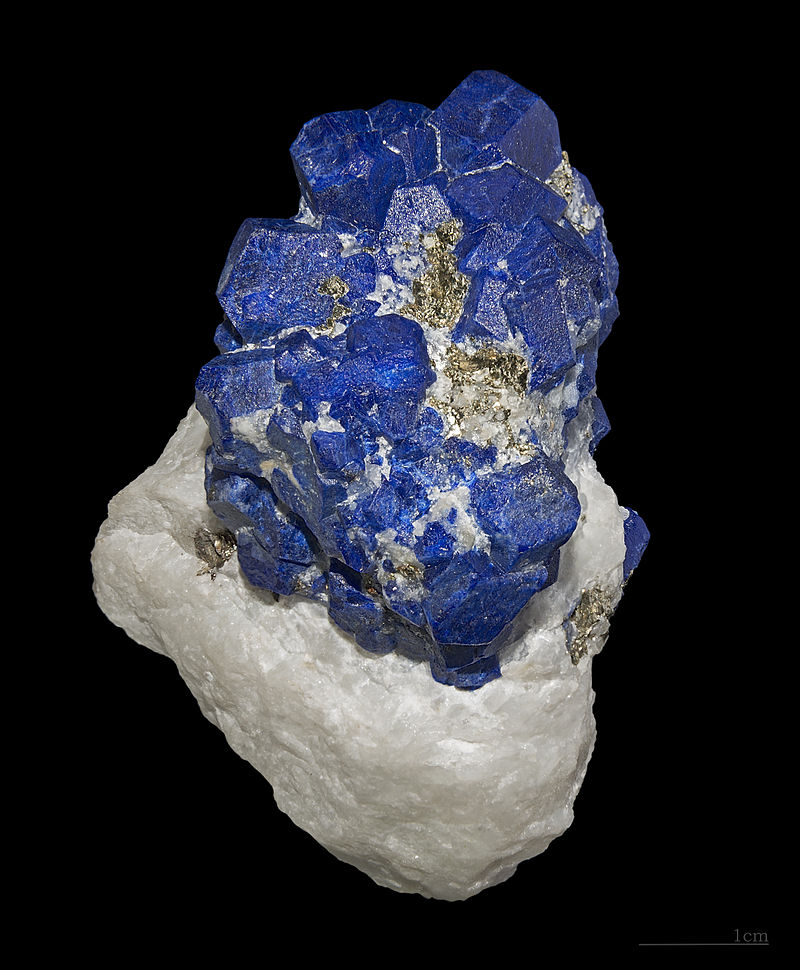
lazurite
Lazurite, old name Azure spar is a tectosilicate mineral with sulfate, sulfur and chloride with formula . It is a feldspathoid and a member of the sodalite group. Lazurite crystallizes in the isometric system although well‐formed crystals are rare. It is usually massive and forms the bulk of the gemstone lapis lazuli.

jadeite
Jadeite is a pyroxene mineral with composition NaAlSi2O6. It is hard (Mohs hardness of about 6.5 to 7.0), very tough, and dense, with a specific gravity of about 3.4. It is found in a wide range of colors, but is most often found in shades of green or white. Jadeite is formed only in the subduction zones of continental margins, where rock undergoes metamorphism at high pressure but relatively low temperature.

nepheline
Nepheline (), also called nephelite, is a rock-forming mineral in the feldspathoid groupa silica-undersaturated aluminosilicate (Na3KAl4Si4O16) that occurs in intrusive and volcanic rocks with low silica, and in their associated pegmatites. It is used in glass and ceramic manufacturing and other industries, and has been investigated as an ore of aluminium.

natron
Natron is a naturally occurring mixture of sodium carbonate decahydrate (Na2CO3·10H2O, a kind of soda ash) and around 17% sodium bicarbonate (also called baking soda, NaHCO3) along with small quantities of sodium chloride and sodium sulfate. Natron is white to colourless when pure, varying to gray or yellow with impurities. Natron deposits are sometimes found in saline lake beds which arose in arid environments. Throughout history natron has had many practical applications that continue today in the wide range of modern uses of its constituent mineral components.
glauconite
Glauconite is an iron potassium phyllosilicate (mica group) mineral of characteristic green color which is very friable and has very low weathering resistance.

aegirine
Aegirine is a mineral. It is a member of the clinopyroxene group of inosilicate minerals. Acmite is a fibrous green-colored variety of aegirine, with the name also used as a synonym. It was first described in 1821, in Kongsberg, Norway.

sodalite
Sodalite ( ) is a tectosilicate mineral with the formula , with royal blue varieties widely used as an ornamental gemstone. Although massive sodalite samples are opaque, crystals are usually transparent to translucent. Sodalite is a member of the sodalite group with hauyne, nosean, lazurite and tugtupite.
analcime
Analcime (; ) or analcite is a white, gray, or colorless tectosilicate mineral. Analcime consists of hydrated sodium aluminium silicate in cubic crystalline form. Its chemical formula is NaAlSi2O6 · H2O. Minor amounts of potassium and calcium substitute for sodium. A silver-bearing synthetic variety also exists (Ag-analcite).
andesine
Andesine is a silicate mineral, a member of the plagioclase feldspar solid solution series. Its chemical formula is (Ca, Na)(Al, Si)4O8, where the ratio of albite to anorthite (Na:Ca) is 50:50 to 70:30. The formula may be written as Na0.5-0.7Ca0.3-0.5Al1.3-1.5Si2.5-2.7O8.

glaucophane
Glaucophane is a mineral and a mineral group belonging to the sodic amphibole supergroup of the double chain inosilicates, with the chemical formula Na2(Mg3Al2)Si8O22(OH)2.
oligoclase
Oligoclase is a rock-forming mineral belonging to the plagioclase feldspars. In chemical composition and in its crystallographic and physical characters it is intermediate between albite (NaAlSi3O8) and anorthite (CaAl2Si2O8). The albite:anorthite molar ratio of oligoclase ranges from 90:10 to 70:30.

ulexite
Ulexite (), sometimes called TV rock or TV stone due to its unusual optical properties, is a hydrous borate hydroxide of sodium and calcium with the chemical formula . The mineral occurs as silky white rounded crystalline masses or in parallel fibers. Ulexite was named for the German chemist Georg Ludwig Ulex (1811–1883), who first discovered it.

bytownite
Bytownite is a calcium rich member of the plagioclase solid solution series of feldspar minerals with composition between anorthite and labradorite. It is usually defined as having between 70 and 90%An (formula: ). Like others of the series, bytownite forms grey to white triclinic crystals commonly exhibiting the typical plagioclase twinning and associated fine striations.

haüyne
Hauyne or haüyne, also called hauynite or haüynite ( ), old name Azure spar, is a rare tectosilicate sulfate mineral with endmember formula . As much as 5 wt % may be present, and also and Cl. It is a feldspathoid and a member of the sodalite group. Hauyne was first described in 1807 from samples discovered in Vesuvian lavas in Monte Somma, Italy, and was named in 1807 by Brunn-Neergard for the French crystallographer René Just Haüy (1743–1822). It is sometimes used as a gemstone.
chabazite
Chabazite () is a tectosilicate mineral series in the zeolite group, closely related to gmelinite, with the chemical formula , where M is one or more metal cations. Recognized minerals in the series include Chabazite-Ca, Chabazite-K, Chabazite-Na, and Chabazite-Sr, depending on the prominence of the indicated cation.

eudialyte
thumb|Pink eudialyte in syenite ([[lujavrite) from Poços de Caldas, Brazil. The white mineral is alkali feldspar, the black is aegirine, and the little brown bits are biotite.]]
apophyllite
The name apophyllite refers to a specific group of phyllosilicates, a class of minerals. Originally, the group name referred to a specific mineral, but was redefined in 1978 to stand for a class of minerals of similar chemical makeup that comprise a solid solution series, and includes the members fluorapophyllite-(K), fluorapophyllite-(Na), hydroxyapophyllite-(K). The name apophyllite is derived from the Greek (), meaning 'it flakes off', a reference to this class's tendency to flake apart when heated, due to water loss. Exfoliation of apophyllite is also possible by treating it with acids or
stilbite
Stilbite is the name of a series of tectosilicate minerals of the zeolite group. Prior to 1997, stilbite was recognized as a mineral species, but a reclassification in 1997 by the International Mineralogical Association changed it to a series name, with the mineral species being named:

amblygonite
Amblygonite () is a fluorophosphate mineral, , composed of lithium, sodium, aluminium, phosphate, fluoride and hydroxide. The mineral occurs in pegmatite deposits and is easily mistaken for albite and other feldspars. Its density, cleavage and flame test for lithium are diagnostic. Amblygonite forms a series with montebrasite, the low fluorine endmember. Geologic occurrence is in granite pegmatites, high-temperature tin veins, and greisens. Amblygonite occurs with spodumene, apatite, lepidolite, tourmaline, and other lithium-bearing minerals in pegmatite veins. It contains about 10% lithium, a
.jpg)
riebeckite
Riebeckite is a sodium-rich member of the amphibole group of silicate minerals, chemical formula Na2(Fe2+3Fe3+2)Si8O22(OH)2. It forms a solid solution series with magnesioriebeckite. It crystallizes in the monoclinic system, usually as long prismatic crystals showing a diamond-shaped cross section, but also in fibrous, bladed, acicular, columnar, and radiating forms. Its Mohs hardness is 5.0–6.0, and its specific gravity is 3.0–3.4. Cleavage is perfect, two directions in the shape of a rhombus; fracture is uneven, splintery. It is often translucent to nearly opaque.
charoite
Charoite ( ) is a rare silicate mineral with the chemical composition , first described in 1978. It is named after the Chara River, despite its being away from the discovery place. When it was discovered, it was thought to be a fake, dyed purple to give it its striking appearance.

natrolite
Natrolite is a tectosilicate mineral species belonging to the zeolite group. It is a hydrated sodium and aluminium silicate with the formula . The type locality is Hohentwiel, Hegau, Germany.

pollucite
Pollucite is a zeolite mineral with the formula with iron, calcium, rubidium and potassium as common substituting elements. It is important as a significant ore of caesium and sometimes rubidium. It forms a solid solution series with analcime. It crystallizes in the isometric-hexoctahedral crystal system as colorless, white, gray, or rarely pink and blue masses. Well-formed crystals are rare. It has a Mohs hardness of 6.5 and a specific gravity of 2.9, with a brittle fracture and no cleavage.
pyrochlore
Pyrochlore () is a mineral group of the niobium end member of the pyrochlore supergroup. Pyrochlore is also a term for the crystal structure Fdm. The name is from the Greek , fire, and , green because it typically turns green on ignition in classic blowpipe analysis.

trona
Trona (trisodium hydrogendicarbonate dihydrate, also sodium sesquicarbonate dihydrate, Na2CO3·NaHCO3·2H2O) is a non-marine evaporite mineral. It is mined as the primary source of sodium carbonate in the United States, where it has replaced the Solvay process used in most of the rest of the world for sodium carbonate production. Turkey is also a major producer.
afghanite
Afghanite, (Na,K)22Ca10[Si24Al24O96](SO4)6Cl6, is a hydrous sodium, calcium, potassium, sulfate, chloride, carbonate alumino-silicate mineral. Afghanite is a feldspathoid of the cancrinite group and typically occurs with sodalite group minerals. It forms blue to colorless, typically massive crystals in the trigonal crystal system. The lowering of the symmetry from typical (for cancrinite group) hexagonal one is due to ordering of Si and Al. It has a Mohs hardness of 5.5 to 6 and a specific gravity of 2.55 to 2.65. It has refractive index values of nω = 1.523 and nε = 1.529. It has one directio

elbaite
Elbaite, a sodium, lithium, aluminium boro-silicate, with the chemical composition Na(Li1.5Al1.5)Al6Si6O18(BO3)3(OH)4, is a mineral species belonging to the six-member ring cyclosilicate tourmaline group.

mirabilite
Mirabilite, also known as Glauber's salt, is a hydrous sodium sulfate mineral with the chemical formula Na2SO4·10H2O. It is a vitreous, colorless to white monoclinic mineral that forms as an evaporite from sodium sulfate-bearing brines. It is found around saline springs and along saline playa lakes. Associated minerals include gypsum, halite, thenardite, trona, glauberite, and epsomite.

heulandite
Heulandite is the name of a series of tectosilicate minerals of the zeolite group. Prior to 1997, heulandite was recognized as a mineral species, but a reclassification in 1997 by the International Mineralogical Association changed it to a series name, with the mineral species being named:
Heulandite-Ca
Heulandite-Na
Heulandite-K
Heulandite-Sr
Heulandite-Ba (described in 2002).
Heulandite-Ca, the most common of these, is a hydrous calcium and aluminium silicate with the formula . Small amounts of sodium and potassium are usually present replacing part of the calcium. Strontium replaces ca
nosean
Nosean, also known as noselite, is a mineral of the feldspathoid group with formula: . It forms isometric crystals of variable color: white, grey, blue, green, to brown. It has a Mohs hardness of 5.5 to 6 and a specific gravity of 2.3 to 2.4. It is fluorescent. It is found in low-silica igneous rocks. There is a solid solution between nosean and hauyne, which contains calcium.

pectolite
Pectolite is a white to gray mineral, NaCa2Si3O8(OH), a sodium calcium hydroxide inosilicate. It crystallizes in the triclinic system typically occurring in radiated or fibrous crystalline masses. It has a Mohs hardness of 4.5 to 5 and a specific gravity of 2.7 to 2.9. A highly sought-after variety known as larimar, is a pale to sky blue. There is also a whitish form of the mineral from Alaska that is sometimes marketed as 'Alaska jade'.

brazilianite
Brazilianite, whose name derives from its country of origin, Brazil, is a typically yellow-green phosphate mineral, most commonly found in phosphate-rich pegmatites.
thénardite
Thénardite is an anhydrous sodium sulfate mineral, Na2SO4 which occurs in arid evaporite environments, specifically lakes and playas. It also occurs in dry caves and old mine workings as an efflorescence and as a crusty sublimate deposit around fumaroles. It occurs in volcanic caves on Mount Etna, Italy. It was first described in 1825 for an occurrence in the Espartinas Saltworks in Ciempozuelos, Spain, by the Spanish chemist José Luis Casaseca (1800 - 1869). Casaseca named the mineral after his master, the French chemist Louis Jacques Thénard (1777–1857).
glauberite
Glauberite is a monoclinic sodium calcium sulfate mineral with the formula Na2Ca(SO4)2.
kernite
Kernite, also known as rasorite, is a hydrated sodium borate hydroxide mineral with formula . It is a colorless to white mineral crystallizing in the monoclinic crystal system typically occurring as prismatic to acicular crystals or granular masses. It is relatively soft with Mohs hardness of 2.5 to 3 and light with a specific gravity of 1.91. It exhibits perfect cleavage and a brittle fracture.
jadarite
Jadarite is a white, earthy monoclinic silicate mineral, sodium lithium boron silicate hydroxide with the chemical formula LiNaSiB3O7(OH).
== Discovery and classification ==
tugtupite
Tugtupite is a beryllium aluminium tectosilicate. It also contains sodium and chlorine and has the formula Na4AlBeSi4O12Cl. Tugtupite is a member of the silica-deficient feldspathoid mineral group. It occurs in high alkali intrusive igneous rocks.
cancrinite
Cancrinite is a complex carbonate and silicate of sodium, calcium and aluminium with the formula Na6Ca2[(CO3)2|Al6Si6O24]·2H2O. It is classed as a member of the feldspathoid group of minerals; the alkali feldspars that are poor in silica. Yellow, orange, pink, white or even blue, it has a vitreous or pearly luster; a hardness of 5–6 and an uneven conchoidal fracture. It is unusual among the silicate minerals in that it will effervesce with hydrochloric acid due to the associated carbonate ions.

arfvedsonite
Arfvedsonite () or soda hornblende (partiellement obsolète) is a sodium amphibole mineral with composition: [Na][Na2][(Fe2+)4Fe3+][(OH)2|Si8O22]. It crystallizes in the monoclinic prismatic crystal system and typically occurs as greenish black to bluish grey fibrous to radiating or stellate prisms.

sugilite
Sugilite ( ) is a relatively rare pink to purple cyclosilicate mineral with the complex chemical formula KNa2(Fe, Mn, Al)2Li3Si12O30. Sugilite crystallizes in the hexagonal system with prismatic crystals. The crystals are rarely found and the form is usually massive. It has a Mohs hardness of 5.5–6.5 and a specific gravity of 2.75–2.80. It is mostly translucent.
Sugilite was first described in 1944 by the Japanese petrologist Ken-ichi Sugi (1901–1948) for an occurrence on Iwagi Islet, Japan, where it is found in an aegirine syenite intrusive stock. It is found in a similar environment at
abenakiite-(Ce)
Abenakiite-(Ce) is a mineral of sodium, cerium, neodymium, lanthanum, praseodymium, thorium, samarium, oxygen, sulfur, carbon, phosphorus, and silicon with a chemical formula Na26Ce6(SiO3)6(PO4)6(CO3)6(S4+O2)O. The silicate groups may be given as the cyclic Si6O18 grouping. The mineral is named after the Abenaki, an Algonquian Indian tribe of New England. Its Mohs scale rating is 4 to 5.

omphacite
Omphacite is a member of the clinopyroxene group of silicate minerals with formula: (Ca, Na)(Mg, Fe2+, Al)Si2O6. It is a variably deep to pale green or nearly colorless variety of clinopyroxene. It normally appears in eclogite, which is the high-pressure metamorphic rock of basalt. Omphacite is the solid solution of Fe-bearing diopside and jadeite. It crystallizes in the monoclinic system with prismatic, typically twinned forms, though usually anhedral. Its space group can be P2/n or C2/c depending on the thermal history. It exhibits the typical near 90° pyroxene cleavage. It is brittle with s
neptunite
Neptunite is a silicate mineral with the formula KNa2Li(Fe2+, Mn2+)2Ti2Si8O24. With increasing manganese it forms a series with mangan-neptunite. is the variety with vanadium replacing the titanium in the formula.
paragonite
Paragonite is a mineral, related to muscovite. Its empirical formula is . A wide solvus separates muscovite from paragonite, such that there is little solid solution along the vector Na+K+ and apparent micas of intermediate composition is most commonly a microscopic (or even sub-microscopic) intergrowth of two distinct micas, one rich in K, and the other in Na. Paragonite is a common mineral in rocks metamorphosed under blueschist facies conditions along with other sodic minerals such as albite, jadeite and glaucophane. During the transition from blueschist to greenschist facies, paragonite an

villiaumite
Villiaumite is a rare halide mineral composed of sodium fluoride, NaF. It is very soluble in water and some specimens fluoresce under long and short wave ultraviolet light. It has a Mohs hardness of 2.5 and is usually red, pink, or orange in color. It is toxic to humans.

blödite
Blödite or bloedite is a hydrated sodium magnesium sulfate mineral with the formula Na2Mg(SO4)2·4H2O. The mineral is clear to yellow in color often darkened by inclusions and forms monoclinic crystals.
mesolite
Mesolite is a tectosilicate mineral with formula . It is a member of the zeolite group and the natrolite subgroup, also resembling natrolite in appearance.
agrellite
Agrellite () is a rare triclinic inosilicate mineral with four-periodic single chains of silica tetrahedra.

anorthoclase
The mineral anorthoclase ((Na,K)AlSi3O8) is a crystalline solid solution in the alkali feldspar series, in which the proportion of the sodium-aluminium silicate member exceeds the potassium-aluminium silicate member. It typically consists of between 64 and 90 percent of NaAlSi3O8 and between 10 and 36 percent of KAlSi3O8.
thumb|left|upright|An anorthoclase crystal from Mount Erebus, Antarctica