Category
page 1Soft tissue
.jpg)
skin
Skin is the layer of usually soft, flexible outer tissue covering the body of a vertebrate animal, with three main functions: protection, regulation, and sensation.

nerve
A nerve is an enclosed, cable-like bundle of nerve fibers (called axons). Nerves have historically been considered the basic units of the peripheral nervous system. A nerve provides a common pathway for the electrochemical nerve impulses called action potentials that are transmitted along each of the axons to peripheral organs or, in the case of sensory nerves, from the periphery back to the central nervous system. Each axon is an extension of an individual neuron, along with other supportive cells such as some Schwann cells that coat the axons in myelin.
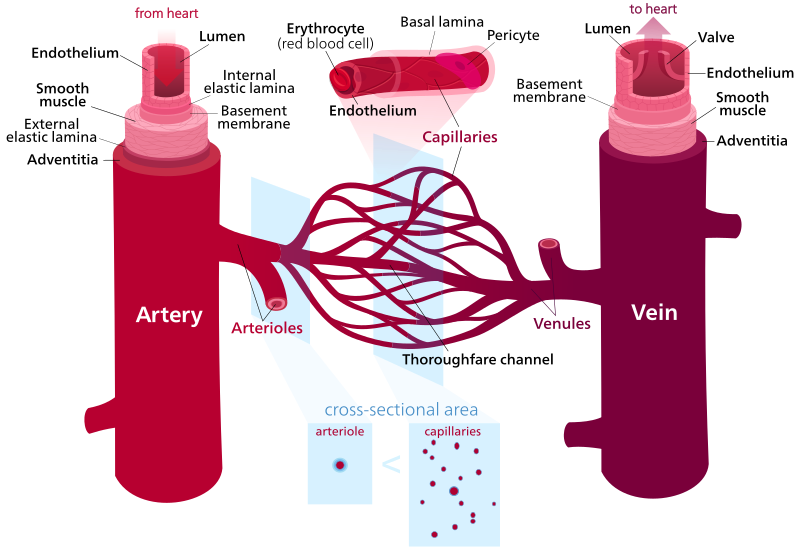
blood vessel
tubular structure which carries blood

tendon
A tendon or sinew is a tough band of dense fibrous connective tissue that connects muscle to bone. It sends the mechanical forces of muscle contraction to the skeletal system, while withstanding tension.

ligament
A ligament is a type of fibrous connective tissue in the body that connects bones to other bones. It also connects flight feathers to bones, in dinosaurs and birds. All 30,000 species of amniotes (land animals with internal bones) have ligaments.

intervertebral disc
cartilage of spine
soft tissue
the tissues that connect, support, or surround other structures and organs of the body, not being hard tissue; tendons, ligaments, fascia, skin, fibrous tissues, fat, and synovial membranes (connective tissue), and muscles, nerves and blood vessels
synovial bursa
small fluid-filled sac lined by synovial membrane with an inner capillary layer of viscous fluid
synovial membrane
inner membrane of a joint capsule surrounding a freely movable joint
endomysium
The endomysium, meaning within the muscle, is a wispy layer of areolar connective tissue that ensheaths each individual muscle fiber, or muscle cell. It also contains capillaries and nerves. It overlies the muscle fiber's cell membrane: the sarcolemma. Endomysium is the deepest and smallest component of muscle connective tissue. This thin layer helps provide an appropriate chemical environment for the exchange of calcium, sodium, and potassium, which is essential for the excitation and subsequent contraction of a muscle fiber.
epimysium
Epimysium (plural epimysia) (Greek epi- for on, upon, or above + Greek mys for muscle) is the fibrous tissue envelope that surrounds muscle. It is a layer of dense irregular connective tissue which ensheaths the entire muscle and protects muscles from friction against other muscles and bones. It also allows a muscle to contract and move powerfully while maintaining its structural integrity.
perimysium
Perimysium is a sheath of dense irregular connective tissue that groups muscle fibers into bundles (anywhere between 10 and 100 or more) or fascicles.
tenotomy
thumb|Tenotomy, 19th century.