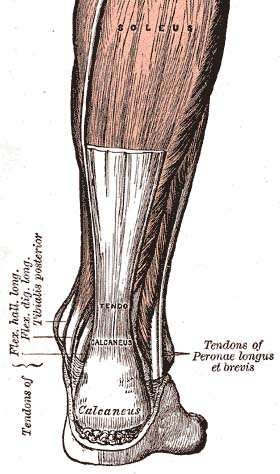
File:Achilles-tendon.jpg · Wikimedia Commons · See Wikimedia Commons
tendon
Sign in to saveAlso known as tendons, sinew
A tendon or sinew is a tough band of dense fibrous connective tissue that connects muscle to bone. It sends the mechanical forces of muscle contraction to the skeletal system, while withstanding tension.
A tendon is a tough, fibrous band of tissue that connects your muscles to your bones and transmits the force of muscle contractions to move your skeleton. This makes tendons essential for movement because they allow your muscles to pull on your bones and create the mechanical actions your body needs to function.
AI-generated from the Wikipedia summary — may contain errors.
Key facts
- Anatomy.Name
- Tendon
- Anatomy.Latin
- tendo
- Anatomy.Image
- achilles-tendon.jpg
- Anatomy.Caption
- The Achilles tendon, one of the tendons in the human body (from ''Gray's Anatomy'', 1st ed., 1858)
- Anatomy.Image2
- Tendon_-_add_-_high_mag.jpg
- Anatomy.Caption2
- Micrograph of a piece of tendon; H&E stain
via Wikipedia infobox
Research
119,223 papers- Tendon Cell Biology: Effect of Mechanical Loading.ReviewCellular physiology and biochemistry : international journal of experimental cellular physiology, biochemistry, and pharmacology · 2024Stańczak M, Kacprzak B, Gawda PDOI: 10.33594/000000743
- Tendon biomechanics and mechanobiology--a minireview of basic concepts and recent advancements.ReviewJournal of hand therapy : official journal of the American Society of Hand Therapists · 2012Wang JH, Guo Q, Li BDOI: 10.1016/j.jht.2011.07.004
- Tendon injury and tendinopathy: healing and repair.ReviewThe Journal of bone and joint surgery. American volume · 2005Sharma P, Maffulli NDOI: 10.2106/JBJS.D.01850
- Using load to improve tendon/ligament tissue engineering and develop novel treatments for tendinopathy.ReviewMatrix biology : journal of the International Society for Matrix Biology · 2025Tam KT, Baar KDOI: 10.1016/j.matbio.2024.12.001
- Tendon injections - upper extremity.ReviewSkeletal radiology · 2023Silva FD, Zorzenoni F, da Silva LNM et al.DOI: 10.1007/s00256-022-04174-7
- [Peroneal tendon pathologies : From the diagnosis to treatment].Der Orthopade · 2021Willegger M, Hirtler L, Schwarz GM et al.DOI: 10.1007/s00132-021-04116-6
- Imaging Tendon Disorders in Athletes.ReviewClinics in podiatric medicine and surgery · 2023Singh K, Hosseini N, Pooyan A et al.DOI: 10.1016/j.cpm.2022.07.015
- Tendon development and diseases.ReviewWiley interdisciplinary reviews. Developmental biology · 2016Gaut L, Duprez DDOI: 10.1002/wdev.201
via PubMed
Wikidata facts
- Part of
- striated muscle tissue
- Has part
- connective tissue
- Image
- Achilo sausgyslė.png
Show 2 more facts
- Commons category
- Tendons
- topic's main category
- Category:Tendons
Sources (8)
via Wikidata · CC0
~28 min read
Encyclopedic overview
16 sectionsContents
- Structure
- Extracellular matrix
- Ultrastructure and collagen synthesis
- Tenocytes
- List of tendons
- Functions
- Mechanics
- Clinical significance
- Injury
- Healing
- Effects of activity on healing
- Society and culture
- Culinary uses
- Other animals
- See also
- References
A tendon or sinew is a tough band of dense fibrous connective tissue that connects muscle to bone. It sends the mechanical forces of muscle contraction to the skeletal system, while withstanding tension.
Tendons, like ligaments, are made of collagen. The difference is that ligaments connect bone to bone, while tendons connect muscle to bone. There are about 4,000 tendons in the adult human body.
Excerpted from Wikipedia’s “tendon” article, available under the CC BY-SA 4.0 licence.
Gallery (8)
Available in 78 languages
- Español
- Français
- Deutsch
- 中文
- 日本語
- Русский
- Português
- Italiano
- العربية
- Albanian
- Avaric
- Azerbaijani
- Bahasa Indonesia
- Balinese
- Bangla
- Basque
- Belarusian
- Betawi
Show 59 more
- Bosnian
- Bulgarian
- Catalan
- Central Kurdish
- Chuvash
- Czech
- Danish
- Erzya
- Esperanto
- Estonian
- Fijian
- Finnish
- Galician
- Greek
- Haitian Creole
- Hebrew
- Icelandic
- Ido
- Irish
- Javanese
- Kazakh
- Kyrgyz
- Latin
- Latvian
- lbe
- Lingua Franca Nova
- Lithuanian
- Luxembourgish
- Macedonian
- Malay
- Mongolian
- Nederlands
- Norwegian
- Norwegian Nynorsk
- Oromo
- Polski
- Quechua
- Romanian
- Scots
- Serbian
- Shona
- simple
- Slovak
- Slovenian
- Sundanese
- Svenska
- Tamil
- Tiếng Việt
- Türkçe
- Ukrainian
- Urdu
- Uzbek
- Walloon
- Welsh
- Wu Chinese
- zh_yue
- فارسی
- ไทย
- 한국어
via Wikidata sitelinks · CC0