Category
page 1Space plasmas

Sun
The Sun is the star located at the centre of the Solar System. It is a massive sphere of hot plasma, heated to incandescence by nuclear fusion reactions in its core, radiating the energy from its surface mainly as visible light and infrared radiation with 10% at ultraviolet energies. It is the main source of energy for life on Earth. The Sun has been an object of veneration in many cultures and a central subject of astronomical research since antiquity.

lightning
thumb|upright=1.5|Strokes of cloud-to-ground lightning strike the Mediterranean Sea off of Port-la-Nouvelle in southern France.

outer space
void between celestial bodies

aurora
An aurora ( aurorae or auroras) is a natural light display in Earth’s upper atmosphere caused by charged particles from the Sun colliding with atoms in the atmosphere. These collisions excite oxygen and nitrogen, which then emit light of different colors such as green, red, and purple. When observed in high-latitude regions they are called polar lights and aurora polaris. In the Arctic they are called northern lights (aurora borealis); in the Antarctic, the terms southern lights (aurora australis) are used. Auroras display dynamic patterns of radiant light that appear as curtains, rays, spiral

nebula
thumb|right|upright=1.5|True color image of the Trifid Nebula, showing complex gas and plasma structure

solar wind
stream of charged particles released from the Sun

interstellar medium
matter and radiation in the space between the star systems in a galaxy
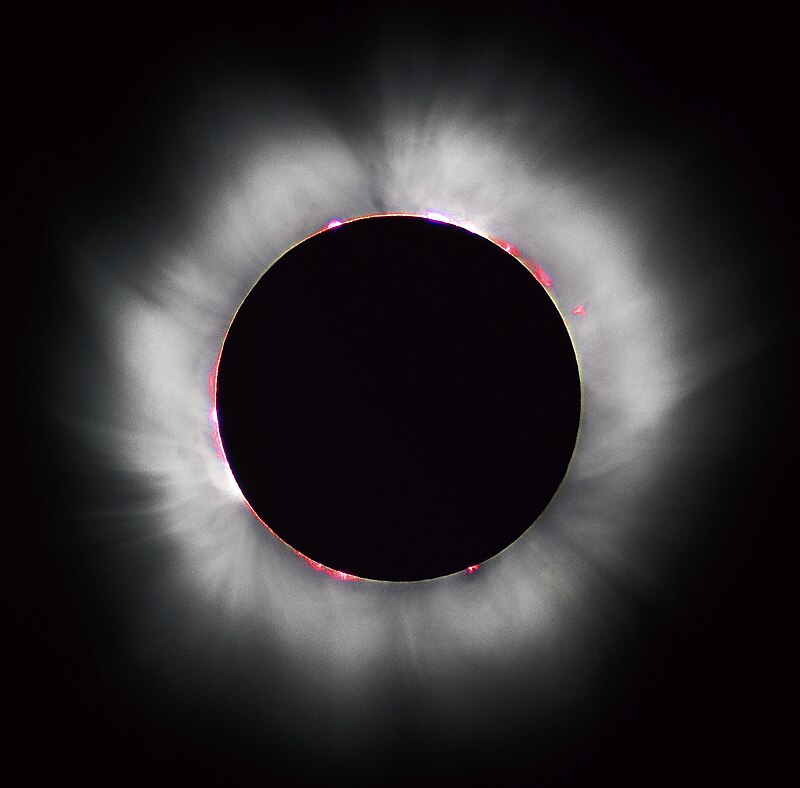
solar corona
plasma "atmosphere" of the Sun

magnetosphere
thumb|300 px|Artist's impression of a magnetosphere

Van Allen radiation belt
zone of energetic charged particles around the planet earth

heliosphere
The heliosphere is the magnetosphere, astrosphere, and outermost atmospheric layer of the Sun. It takes the shape of a vast, tailed bubble-like region of space. In plasma physics terms, it is the cavity formed by the Sun in the surrounding interstellar medium. The "bubble" of the heliosphere is continuously "inflated" by plasma originating from the Sun, known as the solar wind. Outside the heliosphere, this solar plasma gives way to the interstellar plasma permeating the Milky Way. As part of the interplanetary magnetic field, the heliosphere shields the Solar System from significant amounts o

solar flare
sudden flash of increased brightness on the Sun, usually observed near its surface and in close proximity to a sunspot group
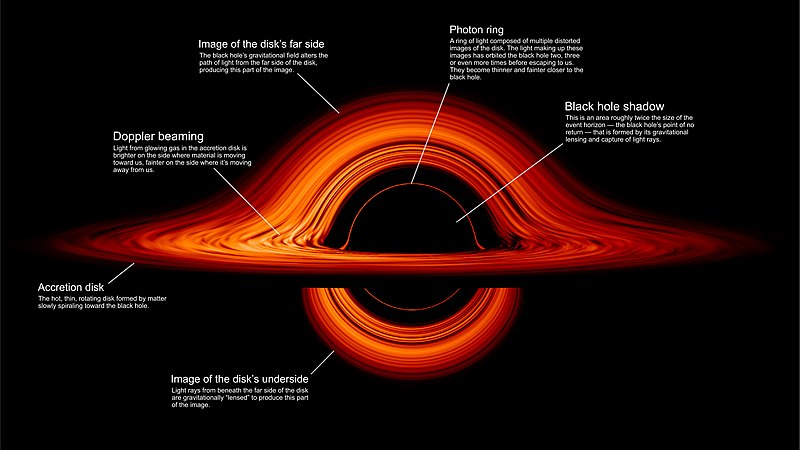
accretion disc
structure formed by diffuse material in orbital motion around a massive central body
X-ray astronomy
branch of astronomy that uses X-ray observation

interplanetary medium
material which fills the Solar System
astrophysical jet
beam of ionized matter flowing along the axis of a rotating astronomical object
South Atlantic Anomaly
area in South Atlantic where the Earth's magnetic field is weakest relative to an idealized dipole, so that the inner Van Allen radiation belt comes closest to the Earth's surface (altitude 200 km), exposing satellites to higher-than-usual radiation

magnetopause
thumb|350px| Artistic rendition of the Earth's magnetopause. The magnetopause is where the pressure from the solar wind and the planet's magnetic field are equal. The position of the Sun would be far to the left in this image.
%20(2023-122).jpg)
reionization
thumb|Phases of the reionization
In the fields of Big Bang theory and cosmology, reionization is the process that caused electrically neutral atoms in the primordial universe to reionize after the lapse of the "dark ages".
Detecting and studying the reionization process is challenging but multiple avenues have been pursued.
This reionization was driven by the formation of the first stars and galaxies.
solar transition region
Section of Sun's atmosphere

heliophysics
thumb|upright=1.5|This image presents various wavelengths of light produced by the Sun.
coronal loop
structure in the lower corona and transition region of the Sun
transient luminous event
short-lived electrical phenomena that occur at high altitudes over lightning storms (sprites, jets, etc.)
intracluster medium
superheated plasma that permeates a galaxy cluster
heliospheric current sheet
surface which separates the heliosphere into positively and negatively charged components

plasmasphere
thumb

Steve
thumb|A STEVE over Little Bow Resort, [[Alberta, in August 2015]]
thumb|A STEVE over Crossfield, Alberta, in March 2018 (around 12:30 a.m.)
stellar corona
outermost layer of a star's atmosphere

Magnetosheath
The magnetosheath is the region of space between the magnetopause and the bow shock of a planet's magnetosphere. The regularly organized magnetic field generated by the planet becomes weak and irregular in the magnetosheath due to interaction with the incoming solar wind, and is incapable of fully deflecting the highly charged particles. The density of the particles in this region is considerably lower than what is found beyond the bow shock, but greater than within the magnetopause, and can be considered a transitory state.

Plasmoid
thumbnail|right|300px|Natural plasmoid produced in the near-Earth magnetotail by magnetic reconnection
A plasmoid is a coherent structure of plasma and magnetic fields. Plasmoids have been proposed to explain natural phenomena such as ball lightning, magnetic bubbles in the magnetosphere, and objects in cometary tails, in the solar wind, solar atmosphere, and in the heliospheric current sheet. Plasmoids produced in the laboratory include the compact toroids (similar to a vortex ring in low temperature fluid dynamics or hydrodynamics) field-reversed configurations, spheromaks, and filamentary v
Ring current
atmospheric effect in a planet's magnetosphere
Polar wind
high-altitude atmospheric effect
Plasma cosmology
Radio atmospheric
broadband electromagnetic impulse
Gunn–Peterson trough
feature of the spectra of quasars
astrophysical plasma
ionized plasma found in astrophysical environments
astrophysical X-ray source
astronomical object emitting X-rays
flux transfer event
short-term magnetic reconnection between magnetic fields of Sun and Earth
sky brightness
visual perception of the sky and how it scatters and diffuses light.
Coronal seismology
Technique of studying the Sun's corona
Cooling flow
cooling of the intracluster medium in galaxy clusters
plasma sheet
sheetlike region of denser (0.3–0.5 cm⁻³) hot plasma and lower magnetic field near the equatorial plane, between the magnetosphere’s north and south lobes