
Steve
Sign in to saveAlso known as strong thermal emission velocity enhancement, proton arc
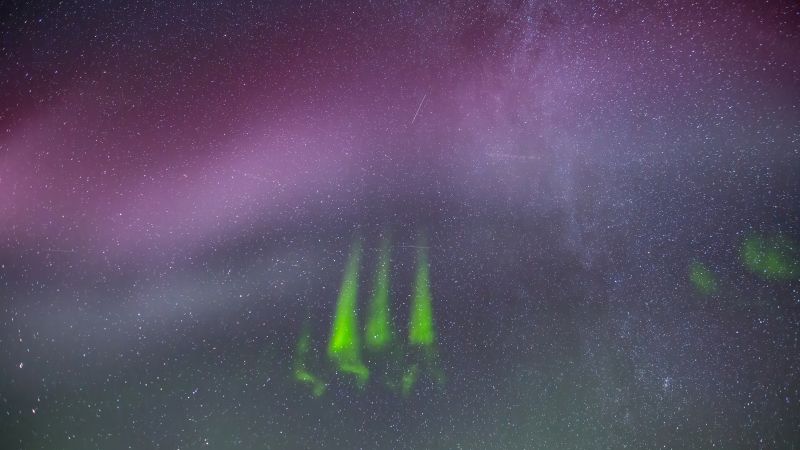
thumb|A STEVE over Little Bow Resort, [[Alberta, in August 2015]] thumb|A STEVE over Crossfield, Alberta, in March 2018 (around 12:30 a.m.)
Described at
Steve: The aurora-like light show you can help research | CNN
Research of the phenomenon called Steve has been driven by citizen photographers. As the solar maximum approaches, there could be even more opportunities to spot it.
edition.cnn.com →An image of the Steve phenomenon captured by Canadian photographer Neil Zeller. Not all science is carried out by folks in white lab coats under the fluorescent lights of academic buildings. Occasionally, the trajectory of the scientific record is forever altered inside a pub over a pint of beer. Such is the case for the sweeping purple and green lights that can hover over the horizon in the Northern Hemisphere. The phenomenon looks like an aurora but is in fact something entirely different. But about eight years ago, when Elizabeth MacDonald, a space physicist at NASA’s Goddard Space Flight Center, was in Calgary, Alberta, for a seminar, she had never seen the phenomenon in person. And it did not yet have a name. In fact, few scientists actively studying auroras and other night-sky phenomenon had witnessed a Steve, which appears closer to the equator than auroras and is characterized by a purple-pink arch accompanied by green, vertical stripes. After MacDonald gave a talk at a nearby university, she met up with some citizen scientists — mostly photographers who spend nights hoping to capture the next stunning image of colors dancing in the Canadian sky — at Kilkenny Irish Pub. “I had already been reaching out to the local Alberta aurora chasers (in) a Facebook group, which was pretty small at the time,” MacDonald said, “but very keen to share their observations and to interact with NASA.” The photographers came with their photos in hand, anxious to show the mysterious light show they had captured. Dr. Eric Donovan, a professor at the University of Calgary who was at the pub with MacDonald that day, assured Zeller he had not have seen a proton arc, which according to a paper Donovan later coauthored is “subvisual, broad, and diffuse,” while a Steve is “visually bright, narrow, and structured.” The Aurora Australis, also known as the Southern Lights, glow on the horizon over waters of Lake Ellesmere on the outskirts of Christchurch on April 24, 2023. (Photo by Sanka VIDANAGAMA / AFP) (Photo by SANKA VIDANAGAMA/AFP via Getty Images) “And the conclusion of that evening was, well, we don’t know what this is,” Zeller said. “But can we stop calling it a proton arc?” It was shortly after that pub meeting that another aurora chaser, Chris Ratzlaff, suggested a name for the mysterious lights on the group’s Facebook page. Members of the group were working to understand the phenomenon better, but “I propose we call it Steve until then,” Ratzlaff wrote in a February 2016 Facebook post. The name stuck. Even after the phenomenon could be better explained. Even after explanations for Steve began to take shape in scientific papers. Scientists later developed an acronym to go with the name: Strong Thermal Emission Velocity Enhancement. And that meeting in a small Canadian pub was a turning point. “That was the in-person meeting that was one of the pieces that gave it more momentum to eventually collect more and more observations in a more and more rigorous way to where we could correlate that with our satellite,” MacDonald said. Eventually, MacDonald said a satellite directly observed a Steve, collecting crucial data and leading to a 2018 study that suggested the lights are a visual manifestation of something called subauroral ion drift, or SAID. Steve can be frustratingly difficult to spot, appearing alongside auroras with little regularity. Sometimes, spotting Steve is a matter of luck, noted Donna Lach, a photographer based in Canada’s Manitoba province. Lach has seen and photographed Steve roughly two dozen times, a rare achievement in the world of sky photography. She said she uses her family farm on a remote plot of land in southern Manitoba, where there’s little to no light pollution. She always checks the space weather before heading out. She’s looking for conditions to be at least a Kp3 — an index of space weather that ranges from Kp0 to Kp9, with higher numbers indicating more activity. It appears, Lach said, tha
Excerpt from a page describing this subject · 13,050 chars · not written by Vinony
Wikidata facts
- Subclass of
- atmospheric optical phenomenon
- Image
- Optical Steve.jpg
Show 3 more facts
- Commons category
- STEVEs (Polar Lights)
- time of discovery or invention
- 2017-04-00
via Wikidata · CC0
~10 min read
Encyclopedic overview
17 sectionsContents
- Discovery and naming
- Occurrence and cause
- Location and timing
- Research into cause
- Association with picket-fence aurora
- Research
- 2017
- 2018
- 2019
- 2020
- 2021
- 2022
- 2023
- 2024
- See also
- References
- External links
thumb|A STEVE over Little Bow Resort, [[Alberta, in August 2015]] thumb|A STEVE over Crossfield, Alberta, in March 2018 (around 12:30 a.m.)
STEVE is an atmospheric optical phenomenon that appears as a purple and green light ribbon in the night sky, named in late 2016 by aurora watchers from Alberta, Canada. The backronym later adopted for the phenomenon is the Strong Thermal Emission Velocity Enhancement. According to analysis of satellite data from the European Space Agency's Swarm mission, the phenomenon is caused by a wide ribbon of hot plasma at an altitude of , with a temperature of and flowing at a speed of (compared to outside the ribbon). The phenomenon is not rare, but had not been investigated and described scientifically prior to that time.
Excerpted from Wikipedia’s “Steve” article, available under the CC BY-SA 4.0 licence.