Category
page 1Stomach

stomach
The stomach is a muscular, hollow organ in the upper gastrointestinal tract of humans and many other animals, including several invertebrates. The Ancient Greek name for the stomach is gaster which is used as gastric in medical terms related to the stomach. The stomach has a dilated structure and functions as a vital organ in the digestive system. The stomach is involved in the gastric phase of digestion, following the cephalic phase in which the sight and smell of food and the act of chewing are stimuli. In the stomach a chemical breakdown of food takes place by means of secreted digestive en

hydrochloric acid
highly corrosive, strong mineral acid in aqueous solution

pepsin
Pepsin is an endopeptidase that breaks down proteins into smaller peptides and amino acids. It is one of the main digestive enzymes in the digestive systems of humans and many other animals, where it helps digest the proteins in food. Pepsin is an aspartic protease, using a catalytic aspartate in its active site.
gastric acid
digestive fluid formed in the stomach
.jpg)
rennet
thumb|right|Animal rennet to be used in the manufacture of cheddar cheese

gastrolith
thumb|Plesiosaur gastroliths from [[Tropic Shale]]
A gastrolith, also called a stomach stone or gizzard stone, is a rock held inside a gastrointestinal tract. Gastroliths in some species are retained in the muscular gizzard and used to grind food in animals lacking suitable grinding teeth. In other species the rocks are ingested and pass through the digestive system and are frequently replaced. The grain size depends upon the size of the animal and the gastrolith's role in digestion. Other species use gastroliths as ballast. Particles ranging in size from sand to cobble have been documented. T

pylorus
The pylorus ( or ) connects the stomach to the duodenum. The pylorus is considered as having two parts, the pyloric antrum (opening to the body of the stomach) and the pyloric canal (opening to the duodenum). The pyloric canal ends as the pyloric orifice, which marks the junction between the stomach and the duodenum. The orifice is surrounded by a sphincter, a band of muscle, called the pyloric sphincter.
The word pylorus comes from Greek πυλωρός, via Latin. The word pylorus in Greek means "gatekeeper", related to "gate" () and is thus linguistically related to the word "pylon".
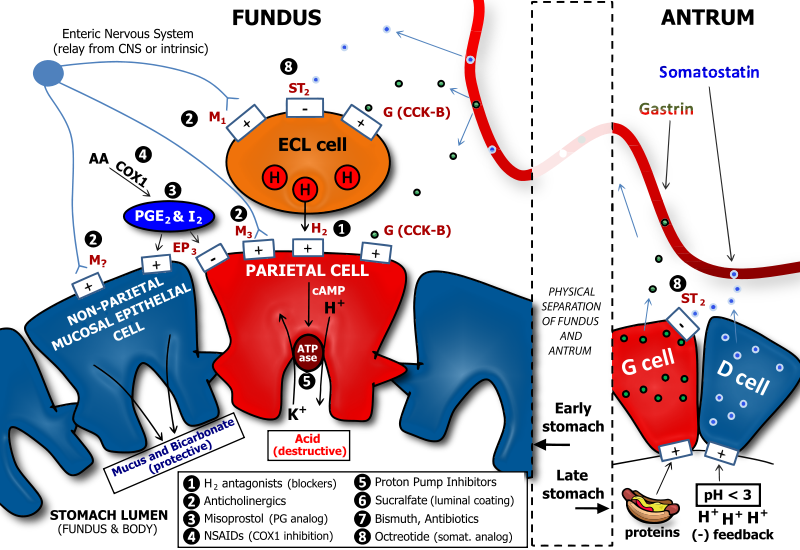
parietal cell
epithelial cell that secrete hydrochloric acid and intrinsic factor
cobalamin binding intrinsic factor
mammalian protein found in Homo sapiens
left gastric artery
gastric chief cell
type of gastric gland cell
delta cell
somatostatin-producing cell
right gastric artery
arises above the pylorus from the proper hepatic artery or less frequently from the common hepatic artery,
right gastroepiploic artery
portal vein
G cell
type of cell in the stomach and duodenum that secretes gastrin
left gastroepiploic artery
blood vessel
gastroduodenal artery
blood vessel
gastric mucosa
lining of the stomach
enteroendocrine cell
specialized cell of the gastrointestinal tract and pancreas with endocrine function
short gastric artery
enterochromaffin-like cell
cell type
left gastric vein
blood vessel
greater curvature of the stomach
lower left or lateral edge of the stomach
gastric pits
Indentations in the stomach
right gastric vein
blood vessel
foveolar cell
mucus-producing cells in stomach lining protective against gastric acid

right gastroepiploic vein
blood vessel
gastrocolic reflex
reflex of the gastrointestinal tract in humans
left gastroepiploic vein
vein of the torso