Category
page 1Television technology

microphone
thumb|upright|Shure Brothers microphone, model 55S, multi-impedance "Small Unidyne" dynamic from 1951

television set
device that combines a tuner, display, and speakers for the purpose of viewing television

pixel
right|upright=0.45|frame|This example shows an image with a portion greatly enlarged so that individual pixels, rendered as small squares, can easily be seen.

John Logie Baird
Scottish inventor, demonstrating the world's first working television (1888–1946)

high-definition television
TV resolution standard

High-Definition Multimedia Interface
digital television
transmission of audio and video by digitally processed and multiplexed signal

modulation
process of encoding information by varying properties of a periodic carrier waveform

cathode ray tube
vacuum tube that can show moving pictures, vector graphics, or lines
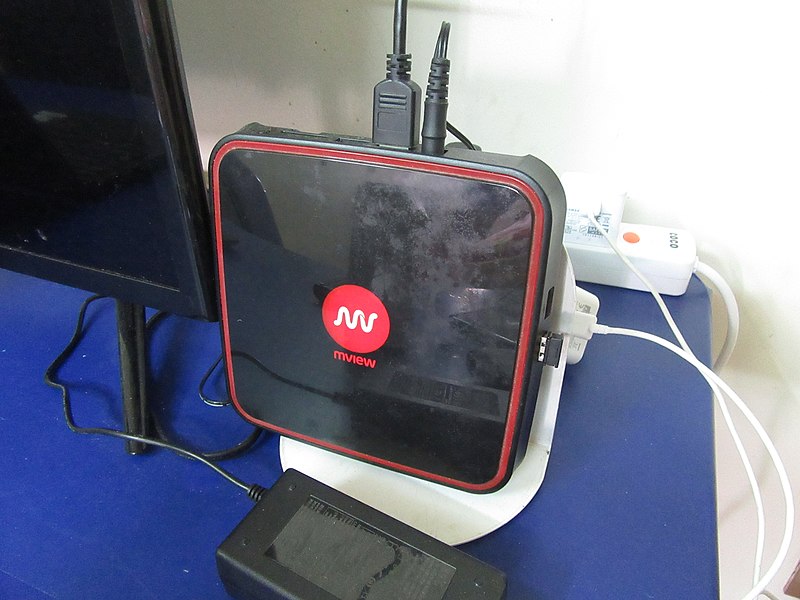
IPTV
system through which television services are delivered using the Internet protocol suite

PAL
Phase Alternating Line (PAL) is a colour encoding system for analogue television. It was one of three major analogue colour television standards, the others being NTSC and SECAM. In most countries it was broadcast at 625 lines, 50 fields (25 frames) per second, and associated with CCIR analogue broadcast television systems B, D, G, H, I and K. The articles on analogue broadcast television systems further describe frame rates, image resolution, and audio modulation.

satellite television
television content transmitted via signals from orbiting satellites

Apple TV
home media receiver device made by Apple

display resolution
number of distinct pixels in each dimension that can be displayed

ultra high frequency
the 300–3000 MHz (or up to 1000 MHz, according to IEEE) range of the electromagnetic spectrum

smart TV
technological convergence of computers, television sets, and set-top boxes

standard-definition television
original analog television systems

SECAM
SECAM, also written SÉCAM (, Système Électronique Couleur Avec Mémoire, French for electronic colour system with memory), is an analogue colour television system that was used in France, Russia, and some other countries or territories of Europe and Africa. It was one of three major analog colour television standards, the others being PAL and NTSC. Similar to PAL, a SECAM picture is made up of 625 interlaced lines and displayed at a rate of 25 frames per second (except SECAM-M). However, because of how SECAM processes colour information, it is not compatible with the PAL video format standard.

Internet television
distribution of television content via the public Internet

Ultra-high-definition television
television formats beyond HDTV

TV tuner card
kind of television tuner that allows television signals to be received by a computer

color depth
range of colors in a display

film frame
one of the many still images which compose the complete moving picture
Digital Visual Interface
standard for transmitting digital video to a display

Digital Video Broadcasting
thumb|400px|right|Countries that use DVB shown in blue.

teleprompter
thumb|300px|Schematic representation: (1) Video camera; (2) Shroud; (3) Video monitor; (4) Clear glass or beam splitter; (5) Image from subject; (6) Image from video monitor
analog television
original television technology that uses analog signals to transmit video and audio; in an analog television broadcast, the brightness, colors and sound are represented by rapid variations of either the amplitude, frequency or phase of the signal
color television
television transmission technology
flat-panel display
electronic display device in a flat form factor
terrestrial television
television content transmitted via signals in the air
3D television
television that conveys depth perception to the viewer
interlaced video
video displaying technique
microwave transmission
technology of transmitting information or energy by the use of microwaves

Windows Media Center
digital video recorder and media player created by Microsoft
progressive scan
format of displaying, storing, or transmitting moving images

Iconoscope
thumb|Zworykin holding the iconoscope tube, in a 1950 magazine article
composite video
analog video signal format, characterised in that the complete video signal information is transferred over one coaxial cable
LED-backlit LCD display
display technology implementation
Nipkow disk
image scanning device
Mobile television
television watched on a cell phone
DV
format for storing digital video
interactive television
form of media convergence

DiSEqC
thumb|2-way DiSEqC switch
thumb|4-way DiSEqC switch with attached coaxial cables.
refresh rate
frequency at which a display hardware displays a new image
audio description
the translation of audiovisual media into narration for blind, partially sighted and visually impaired viewers
HD ready
label
slow-scan television
picture transmission method used mainly by amateur radio operators

scrolling
thumb|Parallax scrolling
In computer displays, filmmaking, television production, video games and other kinetic displays, scrolling is sliding text, images or video across a monitor or display, vertically or horizontally. "Scrolling," as such, does not change the layout of the text or pictures but moves (pans or tilts) the user's view across what is apparently a larger image that is not wholly seen. A common television and movie special effect is to scroll credits, while leaving the background stationary. Scrolling may take place completely without user intervention (as in film credits) or, on

NICAM
Near Instantaneous Companded Audio Multiplex (NICAM) is an early form of lossy compression for digital audio. It was originally developed in the early 1970s for point-to-point links within broadcasting networks. In the 1980s, broadcasters began to use NICAM compression for transmissions of stereo TV sound to the public.
Mobile High-Definition Link
audio/video interface for connecting mobile devices to audio receivers and displays
16K resolution
video or display resolutions with a width of around 16,000 pixels

picture-in-picture
thumb|A picture-in-picture feature of ''L'Arrivée d'un train en gare de La Ciotat'' at the lower right of "picture-in-picture" entry in Wikipedia, screenshoted by [[Mozilla Firefox]]
Picture-in-picture (PiP) is a feature that can be found in television receivers, personal computers, and smartphones. It consists of a video stream playing within an inset window, freeing the rest of the screen for other tasks.
broadcast television system
standard for terrestrial television signals
F connector
coaxial RF connector used for television and cable Internet
Content Scramble System
DVD video copy-protection system
video camera tube
device that captures television images
response time
in technology, the time a system or unit takes to react to a given input
digital media player
device used for playing media such as online video or internet music streaming, built into or for connection to a music system or video device

Trinitron
300px|thumb|A Sony KV-1320UB Mark II Trinitron from the early 1970s
Television channel frequencies
Wikimedia list article