File:Pixel-example.png · Wikimedia Commons · See Wikimedia Commons
pixel
Sign in to saveAlso known as px, picture element
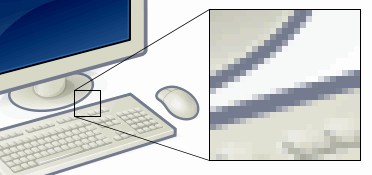
right|upright=0.45|frame|This example shows an image with a portion greatly enlarged so that individual pixels, rendered as small squares, can easily be seen.
A pixel is the smallest unit of a digital image, appearing as a tiny colored square that combines with millions of others to create the pictures you see on screens. Pixels matter because they're the fundamental building blocks that allow computers to display and store images, determining the detail and clarity of everything from photos to videos.
AI-generated from the Wikipedia summary — may contain errors.
Wikidata facts
- Subclass of
- point
Show 4 more facts
- unit symbol
- пкс
- Commons category
- Pixels
- Stack Exchange tag
- stackoverflow.com/tags/pixel
- used by
- raster graphics
Sources (2)
via Wikidata · CC0
~19 min read
Encyclopedic overview
11 sectionsContents
- Etymology
- Technical
- Sampling patterns
- Resolution of computer monitors
- Resolution of telescopes
- Bits per pixel
- Subpixels
- Logical pixel<span class="anchor" id="Logical"></span>
- See also
- References
- External links
right|upright=0.45|frame|This example shows an image with a portion greatly enlarged so that individual pixels, rendered as small squares, can easily be seen.
In digital imaging, a pixel (abbreviated px), pel, or picture element is the smallest addressable physical element of a raster image or the smallest controllable element of a display device or dot matrix printer. Pixels are arranged in a regular, two-dimensional grid, and each pixel serves as a sample of an original image, with a greater number of samples typically providing more accurate representations. Each pixel possesses a specific intensity or color, often composed of three or four component intensities, such as red, green, and blue (RGB), or cyan, magenta, yellow, and black (CMYK). The intensity of each pixel is variable, and in color imaging systems, these components are combined to produce a wide spectrum of colors. The concept of a picture element has existed since the early days of television, appearing as "Bildpunkt" in a 1888 German patent, and the term "pixel" has been used in various U.S. patents since 1911. In most digital display devices, pixels are the smallest element that can be manipulated through software.
Excerpted from Wikipedia’s “pixel” article, available under the CC BY-SA 4.0 licence.
Gallery (27)
Available in 79 languages
- Español
- Français
- Deutsch
- 中文
- 日本語
- Русский
- Português
- Italiano
- العربية
- हिन्दी
- Afrikaans
- Albanian
- Armenian
- Asturian
- Azerbaijani
- Bahasa Indonesia
- Bangla
- Basque
Show 60 more
- be_x_old
- Belarusian
- Bhojpuri
- Bosnian
- Bulgarian
- Catalan
- Central Kurdish
- Croatian
- Czech
- Danish
- Esperanto
- Estonian
- Finnish
- Galician
- Greek
- Hebrew
- Hungarian
- Icelandic
- Ido
- Irish
- Kazakh
- Kyrgyz
- Latin
- Latvian
- Lithuanian
- Macedonian
- Malay
- Malayalam
- Marathi
- Mari
- Nederlands
- Newari
- Norwegian
- Norwegian Nynorsk
- Pashto
- Polski
- Punjabi
- Romanian
- Scottish Gaelic
- Serbian
- Serbian (Latin)
- simple
- Slovak
- Slovenian
- Svenska
- Tamil
- Telugu
- Tiếng Việt
- Türkçe
- Ukrainian
- Urdu
- Uzbek
- Walloon
- Wu Chinese
- zh_min_nan
- zh_yue
- Zulu
- فارسی
- ไทย
- 한국어
via Wikidata sitelinks · CC0