Category
page 1Traditional board games
.jpg)
chess
Chess is a board game for two players, played on a square board consisting of 64 squares arranged in an 8×8 grid. The players, referred to as "White" and "Black", each control sixteen pieces: one king, one queen, two rooks, two bishops, two knights, and eight pawns, with each piece type having a different pattern of movement. An enemy piece may be captured (removed from the board) by moving one's own piece onto the square it occupies. The object of the game is to "checkmate" (threaten with inescapable capture) the enemy king. There are also several ways a game can end in a draw.

go
board game for two players that originated in China more than 2,500 years ago

backgammon
Backgammon is a two-player board game played with counters and dice on tables boards. It is the most widespread Western member of the large family of tables games, whose ancestors date back at least 1,600 years. The earliest record of backgammon itself dates to 17th-century England, being descended from the 16th-century game of Irish (which was apparently of Scottish origin).

checkers
Checkers (North American English), also known as draughts (; British English), is a group of strategy board games for two players which involve forward movements of uniform game pieces and mandatory captures by jumping over opponent pieces. Checkers is developed from alquerque. The term "checkers" derives from the checkered board which the game is played on, whereas "draughts" derives from the verb "to draw" or "to move".

mahjong
Mahjong is a tile-based game that was developed in the 19th century in China and has spread throughout the world since the early 20th century. It is played by four players (with three-player variations found in parts of China, Japan, South Korea, Vietnam, and Southeast Asia). The game and its regional variants are played throughout the Sinosphere in East and Southeast Asia and have also become popular in Western countries. The game has been adapted into a widespread form of online entertainment. Similar to the Western card game rummy, mahjong is a game of skill, strategy, and luck. To distingu

mancala
thumb|Bao (game)|Bao players in [[Mozambique]]

xiangqi
Xiangqi (; ), commonly known as Chinese chess or elephant chess, is a strategy board game for two players. It is the most popular board game in China. Xiangqi is in the same family of games as shogi, janggi, Western chess, chaturanga, and Indian chess. Besides China and areas with significant ethnic Chinese communities, this game is also a popular pastime in Vietnam, where it is known as '''''', literally 'General's chess', in contrast with Western chess or '''', literally 'King's chess'.

shogi
, also known as Japanese chess, is an abstract strategy board game for two players. It is one of the most popular board games in Japan and is in the same family of games as Western chess, chaturanga, xiangqi, Indian chess, Makruk, and janggi. Shōgi means general's (shō ) board game (gi ). The term shōgi is most commonly used to describe hon-shōgi ("standard shogi"), a term used to distinguish the most popular form of the game (with an 81-square board and 40 pieces) from other forms like ko-shogi (ancient shogi variants like chu shogi), modern shogi variants, and related games.

chaturanga
thumb|Chess set from Rajasthan, India
Chaturanga (, , ) is an ancient Indian strategy board game. It is first known from India around the seventh century AD.
snakes and ladders
board game
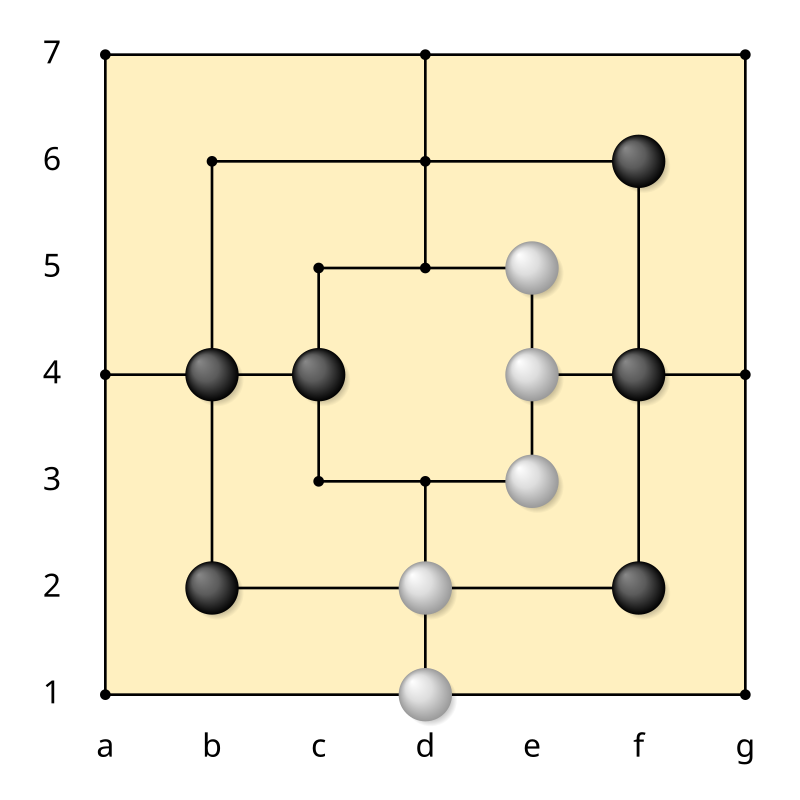
nine men's morris
strategy board game for two players

Senet
Senet or senat (; cf. Coptic , 'passing, afternoon') is a board game from ancient Egypt that consists of ten or more pawns on a 30-square playing board. The earliest representation of senet is dated to 2620 BCE from the Mastaba of Hesy-Re, while similar boards and hieroglyphic signs are found even earlier, including in the Levant in the Early Bronze Age II period. Even though the game has a 2,000-year history in Egypt, there appears to be very little variation in terms of key components. This can be determined by studying the various senet boards that have been found by archaeologists, as well
Royal Game of Ur
ancient Mesopotamian board game

Pachisi
Pachisi (, ) is a cross and circle board game that originated in Ancient India. It is described in the ancient text Mahabharata under the name of "Pasha". It is played on a board shaped like a symmetrical cross. A player's pieces move around the board based upon a throw of six or seven cowrie shells as lots, with the number of shells resting with the aperture upward indicating the number of spaces to move.

Othello
Reversi is an abstract strategy board game for two players, played on an 8×8 uncheckered board. It was invented in 1883. Othello, a variant with a fixed initial setup of the board, was patented in 1971.
Mensch ärgere dich nicht
German board dice-and-pieces game, based on Pachisi (Indian origin)

Gomoku
Gomoku, also called five in a row, is an abstract strategy board game. It is traditionally played with Go pieces (black and white stones) on a 15×15 Go board while in the past a 19×19 board was standard. Because pieces are typically not moved or removed from the board, gomoku may also be played as a paper-and-pencil game. The game is known in several countries under different names.
.svg)
janggi
Janggi (, also romanized as changgi or jangki), sometimes called Korean chess, is a strategy board game popular on the Korean Peninsula. The game was derived from xiangqi (Chinese chess), and is very similar to it, including the starting position of some of the pieces, and the 9×10 gameboard, but without the xiangqi "river" dividing the board horizontally in the middle.
Game of the Goose
board game

Alquerque
Alquerque (also known as al-qirkat from ) is a strategy board game that is thought to have originated in the Middle East. It is considered to be the parent of draughts (US: checkers) and Fanorona and the diagonals of its grid are the predecessor of the checkering of the draughts board.
tafl games
group of asymmetric boardgames
Togyz kumalak

Yut
Yunnori (), also known as yutnori, yut, nyout and yoot, is a traditional board game played in Korea, especially during Korean New Year. The game is also called cheoksa () or sahui ().
Renju
Renju () is a professional variant of the abstract strategy board game gomoku. It was named renju by Japanese journalist Ruikou Kuroiwa (黒岩涙香) on December 6, 1899, in a Japanese newspaper Yorozu chouhou (萬朝報). The name "renju" means "connected pearls" in Japanese. The game is played with black and white stones on a 15×15 gridded go board.

Fanorona
Fanorona () is a strategy board game for two players. The game is indigenous to Madagascar.
Ludus latrunculorum
two-player strategy board game played throughout the Roman Empire

bagh-chal
250px|thumb|Brass playing board and tokens
thumb|Bagh Chal table
Bagh-chal ( bāgh cāl, dhun kasa meaning "tiger game") is a strategic, two-player board game that originated in Nepal. The game is asymmetric in that one player controls four tigers and the other player controls up to twenty goats. The tigers 'hunt' the goats while the goats attempt to block the tigers' movements. This game is also seen in southern India with a different board, but the rules are the same. This game is popular in rural areas of the country.
Hounds and Jackals
ancient Egyptian board game
Mehen
ancient Egyptian board game
Fox games
category of board games for two players, where one player is the fox and tries to eat the geese/sheep
Jungle
traditional Chinese board game

Luzhanqi
Chinese military chess (luzhanqi) () (lit. “Land Battle Chess”) is a two-player Chinese board game . There is also a version for four players. It bears many similarities to dou shou qi, Game of the Generals and the Western board game Stratego. It is a non-perfect abstract strategy game of partial information, since each player has only limited knowledge concerning the disposition of the opposing pieces. Because of the Chinese nature of the game, terms used within the game may vary in translation.

Rithmomachia
thumb|1554 illustration of a Rithmomachy board and pieces by Claude de Boissière
Rithmomachia (also known as rithmomachy, arithmomachia, rythmomachy, rhythmomachy, the '''philosophers' game''', and other variants) is an early European mathematical board game. Its earliest known description dates from the eleventh century. The name comes loosely from Greek and means "The Battle of the Numbers." The game is somewhat like chess except that most methods of capture depend on the numbers inscribed on each piece.
Surakarta
Board Game from Surakarta
nard
tables-style board game for two players
Mū Tōrere
board game
Chaupar
thumb|Fabric chausar board
Chaupar (IAST: caupaṛ), chopad or chaupad is a cross and circle board game very similar to pachisi, played in India. The board is made of wool or cloth, with wooden pawns and seven cowry shells to be used to determine each player's move, although others distinguish chaupur from pachisi by the use of three four-sided long dice. Variations are played throughout India. It is similar in some ways to Pachisi, Parcheesi and Ludo.
Indian chess
chess variant
tables game
class of board games
Tric Trac
Trictrac (also tric trac or tric-trac) is a French board game of skill and chance for two players that is played with dice on a game board similar, but not identical, to that of backgammon (the difference being that the edges of a true trictrac board are perforated for score-marking purposes). It was "the classic tables game" of France in the way that backgammon is in the English-speaking world.
Pallanguzhi
thumb|250px|A fish shaped pallankuli board
Pallanguli, or Pallankuli (, , , , , ), is a traditional ancient mancala game played in South India, especially Tamil Nadu and Kerala. This game was later introduced to Karnataka and Andhra Pradesh in India, as well as Sri Lanka and Malaysia. The game is played by two players, with a wooden board that has fourteen pits in all (hence, it is also called fourteen pits, or pathinālam kuḻi. There have been several variations in the layout of the pits, one among them being seven pits on each player's side. The pits contain cowry shells, seeds or small pebbl
Daldøs
Daldøs [dal'døs] is a running-fight board game only known from a few coastal locations in southern Scandinavia, where its history can be traced back to around 1800. The game is notable for its unusual four-sided dice (stick or long dice). In Denmark it is known as daldøs in Northern and Western Jutland (Mors, Thisted and Fanø), and possibly as daldos on Bornholm. In Norway it is known under the name of daldøsa from Jæren, where, unlike in Denmark, a continuous tradition of the daldøs game exists. Daldøs has much in common with some games in the sáhkku family of Sámi board games. Sáhkku is know
Yota
Yoté is a traditional strategy board game of West Africa, where it is a popular gambling game due to its fast pace and surprising turnarounds. A player wins by capturing all opposing pieces. Yoté is related to the game Choko.
sáhkku
Sáhkku is a board game of the Sami people. The game is traditional among the North Sámi, Skolt Sámi, Inari Sámi and Lule Sámi but may also have been played in other parts of Sápmi.
Gaming board from Knossos
board game
Tâb
Tâb () is the name of a running-fight board game played in several Muslim (mostly Arab) countries, and a family of similar board games played in North Africa (as sîg) and West Asia, from Iran to West Africa and from Turkey to Somalia, where a variant called deleb is played. The rules and boards can vary widely across the region though almost all consist of boards with three or four rows. A reference to "al-tâb wa-l-dukk" (likely a similar game) occurs in a poem of 1310.
Ashta Chamma
Indian Board Game
Shengguan Tu
Chinese Board Game
Ming mang
Tibetan board game
Sho
board game
Ashtapada
thumb|upright=1.4|Carpet with the Ashtapada board (detail). India or Greater Iran|Iran, 15th-century. [[Museum of Islamic Art, Doha]]
Ashtāpada () or Ashtapadi is an Indian board game. Although it is played on a checkered board similar to chess, Ashtāpada predates it and differs in its mechanics and victory conditions. The game was mentioned on the list of games that Gautama Buddha would not play. Chaturanga, which could be played on the same , appeared sometime around the 6th century in India; it could be played by two to four participants.
Pong Hau K'i
ancient Asian (primarily Chinese) children's board game
Manchu chess
variant of xiangqi created during the Qing dynasty by the Bannermen
Ali Guli Mane
abstract strategy board game in India
Heian shogi
predecessor of modern shogi
Alea evangelii
Adugo
Adugo, also known as Jogo da Onça (, ) is a two-player abstract strategy game from the Bororo tribe in the Pantanal region of Brazil.
Shax
traditional board game popular in Horn of Africa