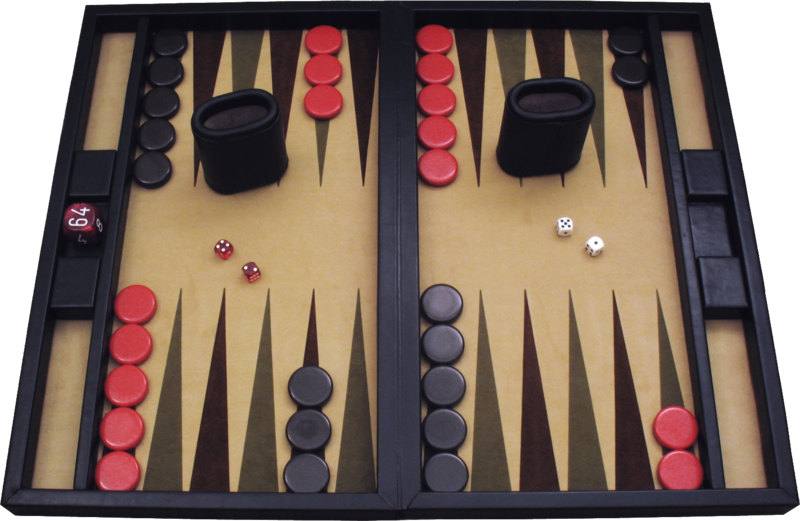
File:Backgammon_lg.png · Wikimedia Commons · See Wikimedia Commons
backgammon
Sign in to saveBackgammon is a two-player board game played with counters and dice on tables boards. It is the most widespread Western member of the large family of tables games, whose ancestors date back at least 1,600 years. The earliest record of backgammon itself dates to 17th-century England, being descended from the 16th-century game of Irish (which was apparently of Scottish origin).
Backgammon is a two-player board game in which players move counters across a board according to dice rolls. It is the most popular Western version of an ancient family of games with roots stretching back at least 1,600 years, with backgammon itself first documented in 17th-century England.
AI-generated from the Wikipedia summary — may contain errors.
Key facts
- Game.italic title
- no
- Game.title
- Backgammon
- Game.image_link
- Backgammon lg.png
- Game.image_caption
- A backgammon set
- Game.years
- 1646 to present
- Game.players
- 2
- Game.setup_time
- 10–30 seconds
- Game.playing_time
- 5–60 minutes
- Game.movement
- Contrary
- Game.random_chance
- Medium (dice rolling)
- Game.ages
- 5+
- Game.related
- Irish, Nard
- Game.footnotes
- Origin: 17th-century EnglandDescended from: Irish
via Wikipedia infobox
Wikidata facts
- Instance of
- hobby
- Subclass of
- mind sport
- Image
- Backgammon lg.jpg
- Has use
- competition
Show 9 more facts
- on focus list of Wikimedia project
- Wikipedia:Vital articles/Level/4
- described by source
- Encyclopædia Britannica 11th edition
- Commons category
- Backgammon
- topic's main category
- Category:Backgammon
- minimum number of players
- 2
- maximum number of players
- 2
- minimum age
- 5
- partially coincident with
- Tric Trac
- maintained by WikiProject
- WikiProject Mathematics
via Wikidata · CC0
~52 min read
Encyclopedic overview
34 sectionsContents
- History
- Tables games
- Ancient history
- Sasanian Empire
- Roman and Byzantine Empires
- Western Europe
- Backgammon
- Early backgammon
- Modern backgammon
- Software
- Rules
- Board
- Setup
- Movement
- Bearing off
- Doubling cube
- Related games
- Strategy and tactics
- Cube handling
- Equity
- Cheating
- Social and competitive play
- Legality
- Club and tournament play
- International competition
- Gambling
- Mediterranean and West Asian cultural significance
- Studies and analysis
- See also
- References
- Notes
- Citations
- Sources
- External links
Backgammon is a two-player board game played with counters and dice on tables boards. It is the most widespread Western member of the large family of tables games, whose ancestors date back at least 1,600 years. The earliest record of backgammon itself dates to 17th-century England, being descended from the 16th-century game of Irish (which was apparently of Scottish origin).
Backgammon is a two-player game of contrary movement in which each player has 15 pieces known traditionally as men (short for "tablemen"), but increasingly known as "checkers" in the United States in recent decades. The backgammon table pieces move along 24 "points" according to the roll of two dice. The objective of the game is to move the 15 pieces around the board and be first to bear off, i.e., remove them from the board. The achievement of this while the opponent is still a long way behind results in a triple win known as a backgammon, hence the name of the game.
Excerpted from Wikipedia’s “backgammon” article, available under the CC BY-SA 4.0 licence.
Gallery (632)
Available in 98 languages
- Español
- Français
- Deutsch
- 中文
- 日本語
- Русский
- Português
- Italiano
- العربية
- हिन्दी
- Afrikaans
- Albanian
- Albanian
- Aragonese
- Armenian
- Assamese
- Asturian
- azb
Show 79 more
- Azerbaijani
- Bahasa Indonesia
- Bangla
- Bashkir
- Basque
- bat_smg
- be_x_old
- Belarusian
- Bosnian
- Breton
- Bulgarian
- Catalan
- Central Kurdish
- Chechen
- Cornish
- Croatian
- Czech
- Danish
- Egyptian Arabic
- Esperanto
- Estonian
- Fiji Hindi
- Filipino
- Finnish
- Galician
- Georgian
- Greek
- Hausa
- Hebrew
- Hungarian
- Icelandic
- Ido
- Interlingua
- Kazakh
- Kurdish
- Latin
- Latvian
- Limburgish
- Lingua Franca Nova
- Lithuanian
- Low German
- Macedonian
- Malay
- Malayalam
- Nederlands
- Norwegian
- Norwegian Nynorsk
- Occitan
- Piedmontese
- Polski
- Punjabi
- Romanian
- Serbian
- Serbian (Latin)
- Sicilian
- simple
- Sindhi
- Slovak
- Slovenian
- Svenska
- Swahili
- Tamil
- Tiếng Việt
- Türkçe
- Ukrainian
- Urdu
- Veps
- Waray
- Welsh
- West Flemish
- Western Frisian
- Western Panjabi
- Wu Chinese
- Yiddish
- zh_min_nan
- zh_yue
- فارسی
- ไทย
- 한국어
via Wikidata sitelinks · CC0