Category
page 1Venus flybys

Cassini−Huygens
Cassini–Huygens ( ), commonly called Cassini, was a space-research mission by NASA, the European Space Agency (ESA), and the Italian Space Agency (ASI) to send a space probe to study the planet Saturn and its system, including its rings and natural satellites. The Flagship-class robotic spacecraft comprised both NASA's Cassini space probe and ESA's Huygens lander, which landed on Saturn's largest moon, Titan. Cassini was the fourth space probe to visit Saturn and the first to enter its orbit, where it stayed from 2004 to 2017. The two craft took their names from the astronomers Giovanni Cassin

Galileo mission
NASA program to send an orbiter to the Jupiter system

Mariner 10
American space probe
MESSENGER
MESSENGER was a NASA robotic space probe that orbited the planet Mercury between 2011 and 2015, studying Mercury's chemical composition, geology, and magnetic field. The name is a backronym for Mercury Surface, Space Environment, Geochemistry, and Ranging, and a reference to the messenger god Mercury from Roman mythology.

Parker Solar Probe
NASA robotic space probe to probe the outer corona of the Sun
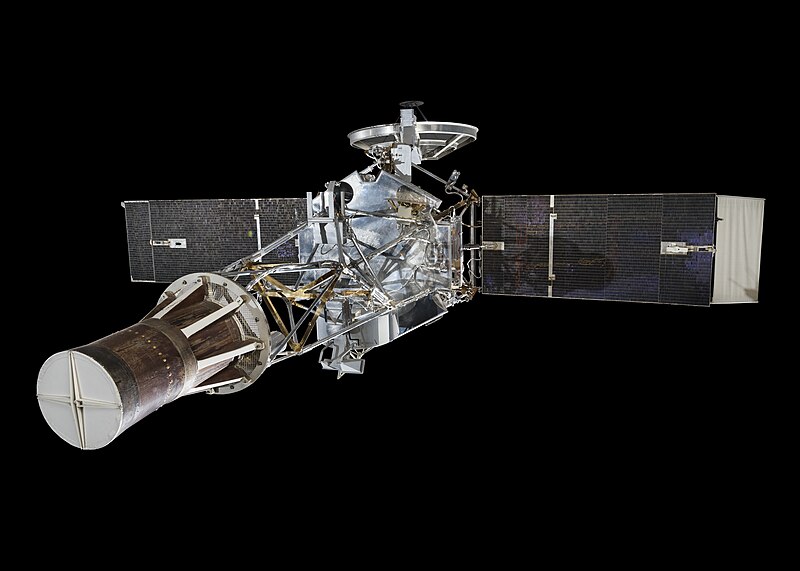
Mariner 2
1962 space probe to Venus

Venera 1
space probe
BepiColombo
BepiColombo is a joint mission of the European Space Agency (ESA) and the Japan Aerospace Exploration Agency (JAXA) to the planet Mercury. The mission comprises two satellites launched together: the Mercury Planetary Orbiter (MPO) and Mio (Mercury Magnetospheric Orbiter, MMO). The mission will perform a comprehensive study of Mercury, including characterization of its magnetic field, magnetosphere, and both interior and surface structure. It was launched on an Ariane 5 rocket on 20 October 2018, with Mercury orbit insertion planned for November 2026, after a flyby of Earth, two flybys of Venus
Jupiter Icy Moons Explorer
mission of the European Space Agency to explore Jupiter’s moons

Mariner 5
uncrewed probe sent by NASA as part of Mariner program in 1967
Venera 2
Soviet spacecraft intended to explore Venus
Solar Orbiter
ESA solar probe
Venera 11
space probe
Venera 12
space mission to Venus
Venera 13
space probe
Venera 14
space probe

IKAROS
IKAROS (Interplanetary Kite-craft Accelerated by Radiation Of the Sun) is a Japan Aerospace Exploration Agency (JAXA) experimental spacecraft. The spacecraft was launched on 20 May 2010, aboard an H-IIA rocket, together with the Akatsuki (Venus Climate Orbiter) probe and four other small spacecraft. IKAROS is the first spacecraft to successfully demonstrate solar sail technology in interplanetary space. The craft's name is an allusion to the legendary Icarus (, Ikaros), who flew close to the Sun on wings made of bird-feathers and wax.
Zond 1
spacecraft of the Soviet Zond program
Vega 1
space probe
Vega 2
space probe
Galileo
NASA robotic space probe that studied the Jupiter system, as well as asteroids Gaspra and Ida
Shin'en
Japanese student spacecraft