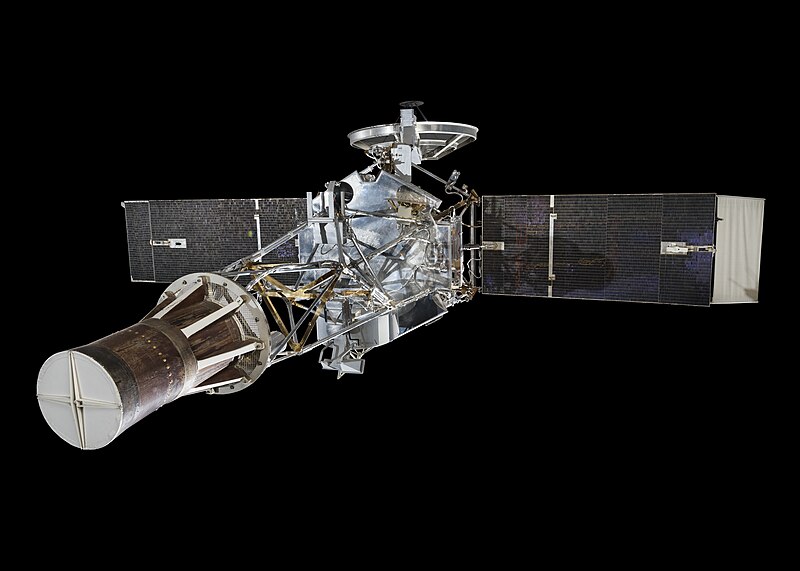
File:Mariner_2_Engineering_Model.jpg · Wikimedia Commons · See Wikimedia Commons
Key facts
- Mission type
- Venus flyby
- Operator
- NASA / JPL
- Harvard designation
- 1962 Alpha Rho 1
- Cospar id
- 1962-041A
- Mission duration
- 4 months and 7 days
- Spacecraft
- Mariner R-2
- Spacecraft type
- Ranger Block I
- Manufacturer
- JPL
- Launch mass
- 203.6 kg (449 lb)
- Power
- 220 watts (at Venus encounter)
- Launch date
- August 27, 1962, 06:53:14 ( 1962-08-27UTC06:53:14Z ) UTC
- Rocket
- Atlas LV-3 Agena-B
- Launch site
- Cape Canaveral LC-12
- Disposal
- Decommissioned
- Last contact
- January 3, 1963 ( 1963-01-04 ) 7:00 UTC
- Reference system
- Heliocentric
- Perihelion altitude
- 0.720 AU (107.7 million km)
- Aphelion altitude
- 1.000 AU (149.6 million km)
via Wikipedia infobox
Wikidata facts
- Part of
- Mariner program
- Operator
- Jet Propulsion Laboratory
- Followed by
- Mariner 3
- Follows
- Mariner 1
- Duration
- 127
- Mass
- 202.8
- Manufacturer
- Jet Propulsion Laboratory
- Image
- Mariner 2.jpg
- Significant event
- planetary flyby
Show 6 more facts
- Commons category
- Mariner 2
- UTC date of spacecraft launch
- 1962-08-27
- Commons gallery
- Mariner 2
- start point
- Cape Canaveral Launch Complex 12
- nominal power output
- 220
- native label
- Mariner 2
Sources (2)
via Wikidata · CC0
~29 min read
Encyclopedic overview
President Kennedy is shown a model of Mariner 2 during a meeting with NASA officials after the successful completion of the mission, 1963 Mariner 2 (Mariner-Venus 1962), an American space probe to Venus, was the first robotic space probe to report successfully from a planetary encounter. The first successful spacecraft in the NASA Mariner program, it was a simplified version of the Block I spacecraft of the Ranger program and an exact copy of Mariner 1. The missions of the Mariner 1 and 2 spacecraft are sometimes known as the Mariner R missions. Original plans called for the probes to be launched on the Atlas-Centaur, but serious developmental problems with that vehicle forced a switch to the much smaller Agena B second stage. As such, the design of the Mariner R vehicles was greatly simplified. Far less instrumentation was carried than on the Soviet Venera probes of this period—for example, forgoing a TV camera—as the Atlas-Agena B had only half as much lift capacity as the Soviet 8K78 booster. The Mariner 2 spacecraft was launched from Cape Canaveral on August 27, 1962, and passed as close as 34,773 km (21,607 mi) to Venus on December 14, 1962.
The Mariner probe consisted of a 100 cm (39 in) diameter hexagonal bus, to which solar panels, instrument booms, and antennas were attached. The scientific instruments on board the Mariner spacecraft were: two radiometers (one each for the microwave and infrared portions of the spectrum), a micrometeorite sensor, a solar plasma sensor, a charged particle sensor, and a magnetometer. These instruments were designed to measure the temperature distribution on the surface of Venus and to make basic measurements of Venus's atmosphere.
Excerpted from Wikipedia’s “Mariner 2” article, available under the CC BY-SA 4.0 licence.