Category
page 1Visual arts genres

graffiti
Graffiti (singular graffiti, or graffito only in graffiti archeology) is writing or drawings made on a wall or other surface, usually without permission and within public view. Graffiti ranges from simple written "monikers" to elaborate wall paintings, and has existed since ancient times, with examples dating back to ancient Egypt, ancient Greece, and the Roman Empire.

portrait
A portrait is a painting, photograph, sculpture, or other artistic representation of a person, in which the face is always predominant. In arts, a portrait may be represented as half body and even full body. If the subject in full body better represents personality and mood, this type of presentation may be chosen. The intent is to display the likeness, personality, and even the mood of the person. For this reason, in photography a portrait is generally not a snapshot, but a composed image of a person in a still position. A portrait often shows a person looking directly at the painter or photo

still life
art genre mostly showing inanimate objects

cartoon
thumb|John Leech (caricaturist)|John Leech, Substance and Shadow (1843), published as Cartoon, No. 1 in Punch, the first use of the word cartoon to refer to a satirical drawing

magic realism
style of literary fiction and art

kitsch
alt=|thumb|A Friend in Need, a 1903 Dogs Playing Poker painting by [[Cassius Marcellus Coolidge, is a common example of kitsch.]]
thumb|Puppy by Jeff Koons (2010) is a self-aware display of kitsch, specifically as a combination of opulence and cuteness.

self-portrait
thumb|Vincent van Gogh, Self-portrait without beard, end September 1889, (F 525), Oil on canvas, 40 × 31 cm., Private collection. This may have been Van Gogh's last self-portrait. Given as a birthday gift to his mother.
thumb|Self-portrait by Judith Leyster, a [[Dutch Golden Age painter, mostly of genre subjects. NGA, 1630. In reality, she probably did not wear expensive clothes like these while painting.]]

arabesque
thumb|340px|Stone relief with arabesques of tendrils, palmettes and half-palmettes in the [[Umayyad Mosque, Damascus, Syria]]
thumb|Part of a 15th-century ceramic panel from Samarkand ([[Uzbekistan) with white calligraphy on a blue arabesque background]]The arabesque is a form of artistic decoration consisting of "surface decorations based on rhythmic linear patterns of scrolling and interlacing foliage, tendrils" or plain lines, often combined with other elements. Another definition is "Foliate ornament, used in the Islamic world, typically using leaves, derived from stylised half-palmettes,

Islamic art
artistic production that developed from the hegira (year 622) to the nineteenth century, from Spain to India among populations of Islamic culture

memento mori
artistic or symbolic reminder of the inevitability of death

grotesque
thumb|upright=0.9|Grotesque studies, Michelangelo.
Grotesque is an adjective often used to describe weird shapes and distorted forms such as Halloween masks. In art, performance, and literature, however, grotesque may also refer to something that simultaneously invokes an audience feeling of uncomfortable bizarreness as well as sympathetic pity.

street art
art that is public and temporary in public spaces

danse macabre
artistic motif on the universality of death

diorama
thumb|Diorama used for the filming of Thomas & Friends television series
new media
forms of media native to computers, computational, relying on computers for redistribution; e.g. telephones, computers, virtual worlds, website games, human-computer interface, computer animation, interactive computer installations
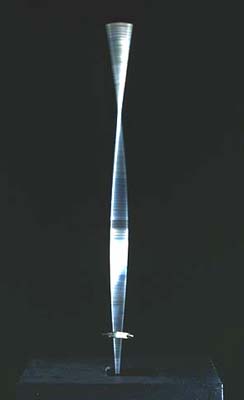
kinetic art
art genre of artworks that contains movement

trompe-l'œil
upright=1.3|thumb|Ceiling of the Treasure Room of the National Archaeological Museum of Ferrara |Archaeological Museum of Ferrara, [[Italy, painted in 1503–1506]]

outsider art
art created outside the boundaries of official culture by those untrained in the arts

silhouette
thumb|A traditional silhouette portrait of the late 18th century
A silhouette (, ) is the image of a person, animal, object or scene represented as a solid shape of a single colour, usually black, with its edges matching the outline of the subject. The interior of a silhouette is featureless, and the silhouette is usually presented on a light background, usually white, or none at all. The silhouette differs from an outline, which depicts the edge of an object in a linear form, while a silhouette appears as a solid shape. Silhouette images may be created in any visual artistic medium, but were
idyll
An idyll (, ; ; occasionally spelled idyl in American English) is a short poem, descriptive of rustic life, written in the style of Theocritus's short pastoral poems, the Idylls (Εἰδύλλια).
genre painting
paintings of scenes or events from everyday life

decorative art
arts or crafts concerned with the design and manufacture of functional, beautiful objects

vanitas
thumb|333px|Vanitas by Antonio de Pereda

vaporwave
folk art
art produced by artisans trained in a relevant skill working within a local client economy
body art
art with the human body

pastoral
right|thumb|Alvan Fisher, Pastoral Landscape, 1854
death mask
wax or plaster cast made of a person’s face following death
fine-art photography
photography genre, created in accordance with the vision of the artist as photographer and with subjective intent
fan art
artwork featuring aspects of a work of fiction created by a fan
new media art
artworks designed and produced by means of electronic media technologies
hardstone carving
art of carving and engraving of stones or gems
environmental art
genre of art engaging nature and ecology

Gesamtkunstwerk
thumb|upright=1.35|Stairway of the Hôtel Tassel, an early example of Gesamtkunstwerk
A Gesamtkunstwerk (, 'total work of art', 'ideal work of art', 'universal artwork', 'synthesis of the arts', 'comprehensive artwork', or 'all-embracing art form') is a work of art that makes use of all or many art forms or strives to do so. The term is a German loanword accepted in English as a term in aesthetics.
marine art
form of figurative art that portrays or draws its main inspiration from the sea
liminal space
Internet aesthetic capturing strange places

zoomorphism
thumb|250px|Fish-shaped door handle from Germany, an example of a zoomorphic artwork
In the context of art, zoomorphism describes art that imagines humans as non-human animals. It can also be defined as art that portrays one species of animal like another species of animal or art that uses animals as a visual motif, sometimes referred to as "animal style". Depicting deities in animal form (theriomorphism) is an example of zoomorphism in a religious context. The word zoomorphism derives from and .

Catalan modernism
Modernisme (, Catalan for "modernism"), also known as Catalan modernism and Catalan art nouveau, is the historiographic denomination given to an art and literature movement associated with the search of a new entitlement of Catalan culture, one of the most predominant cultures within Spain. Nowadays, it is considered a movement based on the cultural revindication of a Catalan identity. Its main form of expression was Modernista architecture, but it also encompassed many other arts, such as painting and sculpture, and especially the design and the decorative arts (cabinetmaking, carpentry, forg
textile art
arts and crafts that use plant, animal, or synthetic fibers and fabrics to construct practical or decorative objects
religious art
genre of art that is religious in theme
generative art
form of art that is created through the use of autonomous systems, often involving algorithms, random processes, or computational techniques to generate artworks
portrait painting
genre of painting; field of work for painters
site-specific art
artwork created for a certain place

tronie
thumb|The Smoker, Joos van Craesbeeck
Tingatinga
contemporary painting style in Tansania
mail art
art movement coined in the 1960s
ero guro
literary and artistic movement originating circa 1930 in Japan
immersion
perception of being physically present in a non-physical world
fine-art nude photography
nude photography for the purposes of fine art
digital painting
type of art
funerary art
grave art
album cover
front of the packaging of a commercially released audio recording product

bodegón
thumb|upright 1.3|A bodegón by an unknown Spanish painter, Kitchen Scene, depicting most of the commonly employed Motif (visual arts)|motifs
Bodegóns are a type of painting from the 17th-century Spanish Baroque period, which are still lifes of food and household objects (mostly culinary) in nondescript or humble surroundings. They sometimes depicts commoners selling food, eating, or drinking. "Bodegón" is Spanish for "still life", yet the style is only one part of what are called "still lifes" in English.
glitch art
practice of using digital or analog errors for aesthetic purposes
genre art
art genre that depicts scenes from everyday life

bioart
thumb|Regenerative Reliquary (2016) by American bioartist Amy Karle. Human [[stem cells were grown to form bone over a preformed hydrogel scaffold in the shape of a hand.]]
Bioart is an art practice where artists work with biology, live tissues, bacteria, living organisms, and life processes. Using scientific processes and practices such as biology and life science practices, microscopy, and biotechnology (including technologies such as genetic engineering, tissue culture, and cloning) the artworks are produced in laboratories, galleries, or artists' studios. The scope of bioart is a range con
yarn bombing
type of graffiti or street art that employs colourful displays of knitted or crocheted yarn or fibre rather than paint or chalk

cityscape
thumb|right|Painting of the Dam Square in Amsterdam, by [[Gerrit Adriaensz Berckheyde, ]]
thumb|right|Photograph of Dresden, Germany, in the 1890s
In the visual arts, a cityscape (urban landscape) is an artistic representation, such as a painting, drawing, print or photograph, of the physical aspects of a city or urban area. It is the urban equivalent of a landscape. Townscape is roughly synonymous with cityscape, though it implies the same difference in urban size and density (and even modernity) implicit in the difference between the words city and town. In urban design the terms refer to th
commercial art
art created for commercial purposes
panoramic painting
massive artwork that reveals a wide, all-encompassing view of a particular subject