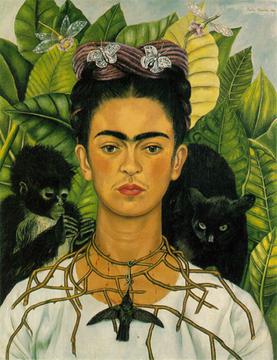
File:Frida_Kahlo_(self_portrait).jpg · Wikimedia Commons · See Wikimedia Commons
self-portrait
Sign in to saveAlso known as selfportrait, auto-portrait, self portrait
thumb|Vincent van Gogh, Self-portrait without beard, end September 1889, (F 525), Oil on canvas, 40 × 31 cm., Private collection. This may have been Van Gogh's last self-portrait. Given as a birthday gift to his mother. thumb|Self-portrait by Judith Leyster, a [[Dutch Golden Age painter, mostly of genre subjects. NGA, 1630. In reality, she probably did not wear expensive clothes like these while painting.]]
A self-portrait is a painting or artwork in which an artist depicts themselves, often used to explore their own identity or appearance. Self-portraits have been created throughout art history by notable artists like Vincent van Gogh and Judith Leyster, and they remain significant because they offer direct insight into how artists viewed themselves and their practice.
AI-generated from the Wikipedia summary — may contain errors.
Wikidata facts
Show 5 more facts
- Commons category
- Self-portraits
- topic's main category
- Category:Self-portraits
- Commons gallery
- Self-portrait
- hashtag
- selfportrait
- P8168
- Lansing
Sources (1)
via Wikidata · CC0
~52 min read
Encyclopedic overview
30 sectionsContents
- Types
- Gallery: Inserted self-portraits
- Women painters
- Antiquity
- Asia
- European art
- Albrecht Dürer, 1471–1528, the first prolific self-portraitist
- Renaissance and Baroque
- Rembrandt and the 17th century in Northern Europe
- After Rembrandt
- Prolific modern self-portraitists
- Self-portraits in general
- Gallery: painters at work
- Classification
- Mirrors and poses
- Gallery: mortality in the self-portrait
- Other meanings, storytelling
- Self-promotion
- Diagnosing the self-portrait
- Collections
- Gallery
- Photo-portraits
- Drawings, prints and engravings
- See also
- Notes and references
- Further reading
- Non-English
- Self-portrait in neurology
- Psychology of self-perception
- External links
thumb|Vincent van Gogh, Self-portrait without beard, end September 1889, (F 525), Oil on canvas, 40 × 31 cm., Private collection. This may have been Van Gogh's last self-portrait. Given as a birthday gift to his mother. thumb|Self-portrait by Judith Leyster, a [[Dutch Golden Age painter, mostly of genre subjects. NGA, 1630. In reality, she probably did not wear expensive clothes like these while painting.]]
Self-portraits are portraits artists make of themselves. Although self-portraits have been made since the earliest times, it is not until the mid-15th century that artists can be frequently identified depicting themselves, as either the main subject or important characters in their work. With better and cheaper mirrors, and the advent of the panel portrait, many painters, sculptors and printmakers tried some form of self-portraiture. Portrait of a Man in a Turban by Jan van Eyck of 1433 may well be the earliest known panel self-portrait. He painted a separate portrait of his wife, and he belonged to the social group that had begun to commission portraits, already more common among wealthy Netherlanders than south of the Alps. The genre is venerable, but not until the Renaissance, with increased wealth and interest in the individual as a subject, did it become truly popular.
Excerpted from Wikipedia’s “self-portrait” article, available under the CC BY-SA 4.0 licence.