Category
page 1Volcanism

volcano
thumb|upright=1.35|Augustine Volcano (Alaska) during its eruptive phase on January 24, 2006

lava
thumb|upright=1.5|Fresh lava from Fagradalsfjall volcano eruption in Iceland, 2023
Lava is molten or partially molten rock (magma) that has been expelled from the interior of a terrestrial planet (such as Earth) or a moon onto its surface. Lava may be erupted at a volcano or through a fracture in the crust, on land or underwater, usually at temperatures from . Lava may be erupted directly onto the land surface or onto the sea floor or it may be ejected into the atmosphere before falling back down. The solid volcanic rock resulting from subsequent cooling of the molten material is often also ca

magma
thumb|350x350px|Magma can be found in the mantle or the crust.
Magma () is the molten or semi-molten natural material from which all igneous rocks are formed. Magma (sometimes colloquially but incorrectly referred to as lava) is found beneath the surface of the Earth, and evidence of magmatism has also been discovered on other terrestrial planets and some natural satellites. Besides molten rock, magma may also contain suspended crystals and gas bubbles.
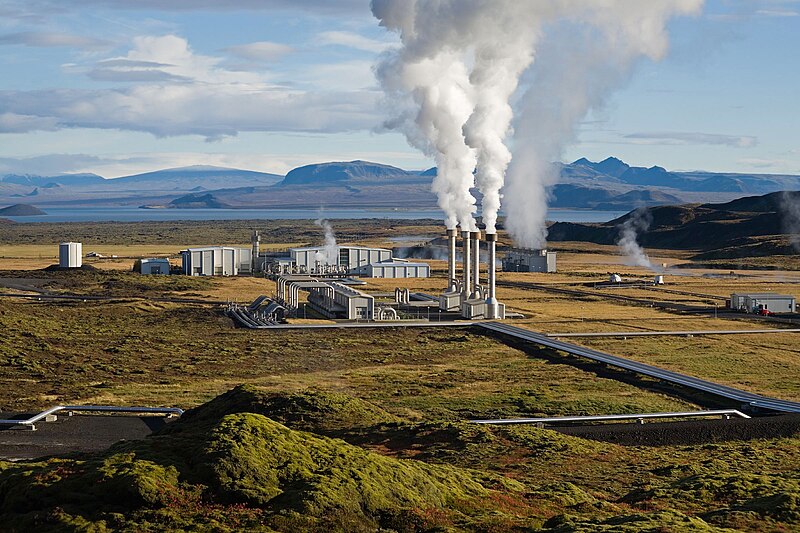
geothermal energy
thermal energy generated and stored in the Earth

caldera
thumb|right|Mount Mazama's eruption timeline, an example of caldera formation

pyroclastic flow
fast-moving concentrated current of hot gas and volcanic matter that moves away from a volcano

volcanism
Volcanism, vulcanism, volcanicity, or volcanic activity is the phenomenon where solids, liquids, gases, and their mixtures erupt to the surface of a solid-surface astronomical body such as a planet or a moon. It is caused by the presence of a heat source, usually internally generated, inside the body; the heat is generated by various processes, such as radioactive decay or tidal heating. This heat partially melts solid material in the body or turns material into gas. The mobilized material rises through the body's interior and may break through the solid surface.

lahar
thumb|A lahar travels down a river valley in Guatemala near the Santa María (volcano)|Santa Maria volcano, 1989
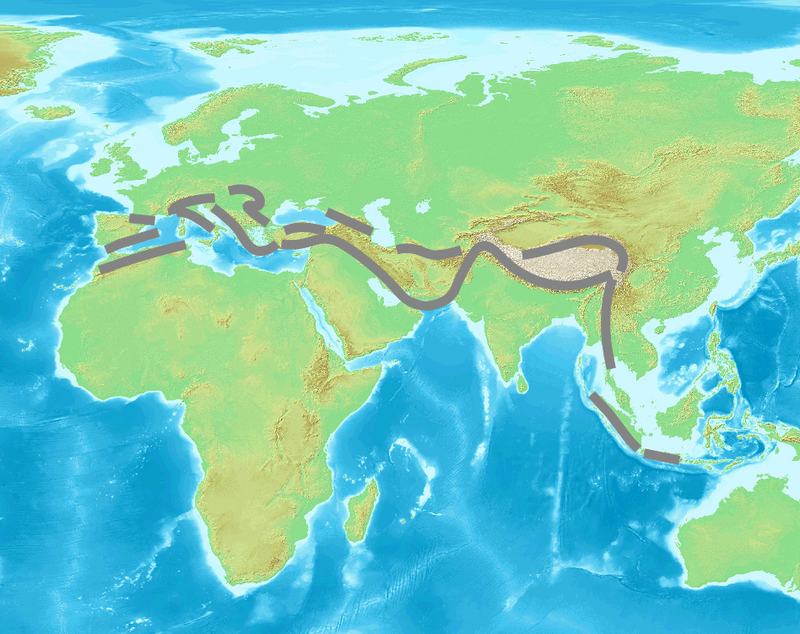
Alpide belt
seismic and orogenic belt that includes an array of mountain ranges extending for more than 15'000 km along the southern margin of Eurasia
flammagenitus
cloud that forms from large fires or explosions
Cretaceous–Paleogene boundary
geological signature, usually a thin band of rock, marking the transition from the end of the Cretaceous Period and the beginning of the Paleogene Period, dated with radiometric methods, at the age of 66.043 ± 0.011 Ma

diatreme
thumb|right|Aerial view of the Moses Rock Dike diatreme in San Juan County, Utah
Pele's hair
form of lava
flood basalt
result of a very large volume eruption of basalt lava
volcano tectonic earthquake
earthquake caused by the movement of magma

Vog
thumb|Dense vog as seen from Hilo Bay, Hawaii
Vog is a form of air pollution that results when sulfur dioxide and other gases and particles emitted by an erupting volcano react with oxygen and moisture in the presence of sunlight. The word is a portmanteau of the words volcanic and smog, the latter itself a portmanteau of smoke and fog. The term is in common use in the Hawaiian Islands, where the Kīlauea volcano, on the Island of Hawaii (the "Big Island"), erupted continuously between 1983 and 2018. Based on June 2008 measurements, Kīlauea emits 2,000–4,000 tons of sulfur dioxide (SO2) every d
mudpot
thumb|Mudpot in Lassen Volcanic National Park
thumb|Mudpots lined up above a volcanic fissure at Krafla|Hverarönd, [[Iceland]]
lava channel
lava flowing through
Bimodal volcanism
eruption of both mafic and felsic lavas from a single volcanic centre
Blue lava
optical phenomenon resulting from burning sulfur
pit crater
depression formed by a sinking or collapse of the surface lying above a void or empty chamber
delamination (geology)
process occurring when lower continental crust and mantle lithosphere break away from the upper continental crust
dike swarm
geological structure consisting of a major group of parallel, linear, or radially oriented dikes intruded within continental crus
New islands
Wikimedia list article