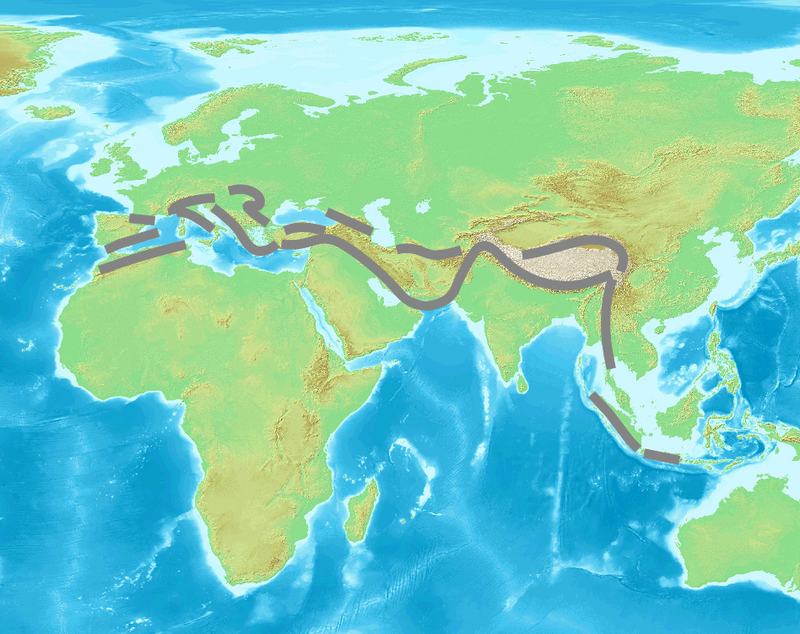
File:Alpiner_Gebirgsgürtel.png · Wikimedia Commons · See Wikimedia Commons
Alpide belt
Sign in to saveAlso known as Alpine-Himalayan orogenic belt
seismic and orogenic belt that includes an array of mountain ranges extending for more than 15'000 km along the southern margin of Eurasia
Key facts
- Peak
- Mount Everest
- Elevation
- 8,848.86 m (29,031.7 ft)
- Length
- 15,000 km (9,300 mi) E–W in the west, N–S in the east
- Etymology
- Derived from Alps
- Mesozoic oceanic platform
- Southern Eurasia, northern Africa, central Asian subcontinent, southeast Asia
- Formed by
- compressive forces at aligned convergent plate boundaries
- Orogenies
- Alpine (in west), Himalayan (in east)
- Mountain type
- Folded mountain ranges
via Wikipedia infobox
Wikidata facts
- Instance of
- orogenic belt
- Has part
- Rif
- Named after
- Himalayas
- Country
- Bulgaria
- Continent
- Africa
- Elevation
- 8848
- Material used
- metamorphic rock
- Image
- Alpiner Gebirgsgürtel.png
Show 5 more facts
- on focus list of Wikimedia project
- WikiProject Ukraine
- Commons category
- Alpide belt
- different from
- Alps
- temporal range start
- Eocene
- temporal range end
- Meghalayan
Sources (3)
via Wikidata · CC0
~7 min read
Encyclopedic overview
The Alpide belt or Alpine-Himalayan orogenic belt or Alpine-Persia–Tibet–Burma orogeny, or more recently and rarely the Tethyan orogenic belt, is a seismic and orogenic belt that includes an array of mountain ranges extending for more than 15,000 kilometres (9,300 mi) along the southern margin of Eurasia, stretching from Java and Sumatra, through the Indochinese Peninsula, the Himalayas and Transhimalayas, the mountains of Iran, Caucasus, Anatolia, the Mediterranean, and out into the Atlantic.
It includes, from west to east, the major ranges of the Atlas Mountains, the Alps, the Caucasus Mountains, Alborz, Hindu Kush, Karakoram, and the Himalayas. It is the second most seismically active region in the world, after the circum-Pacific belt (the Ring of Fire), with 17% of the world's largest earthquakes.
Excerpted from Wikipedia’s “Alpide belt” article, available under the CC BY-SA 4.0 licence.
Gallery (2)
Available in 39 languages
- Español
- Français
- Deutsch
- 中文
- 日本語
- Русский
- العربية
- Albanian
- Armenian
- Azerbaijani
- Bahasa Indonesia
- Basque
- Belarusian
- Croatian
- Czech
- Danish
- Egyptian Arabic
- Esperanto
Show 20 more
via Wikidata sitelinks · CC0