Category
page 1Volcanology

volcano
thumb|upright=1.35|Augustine Volcano (Alaska) during its eruptive phase on January 24, 2006
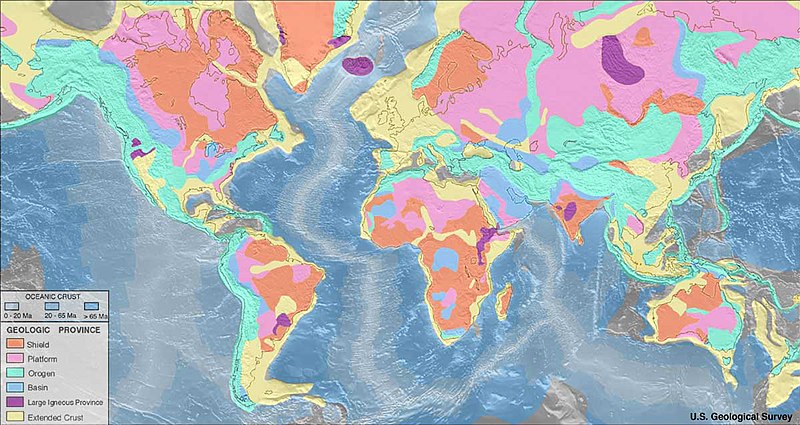
igneous rock
one of the three main rock types; formed through the cooling and solidification of magma or lava

obsidian
Obsidian ( ) is a naturally occurring volcanic glass formed when lava extruded from a volcano cools rapidly with minimal crystal growth. It is an igneous rock. Produced from felsic lava, obsidian is rich in the lighter elements such as silicon, oxygen, aluminium, sodium, and potassium. It is commonly found within the margins of rhyolitic lava flows known as obsidian flows. These flows have a high content of silica, giving them a high viscosity. The high viscosity inhibits the diffusion of atoms through the lava, which inhibits the first step (nucleation) in the formation of mineral crystals. T
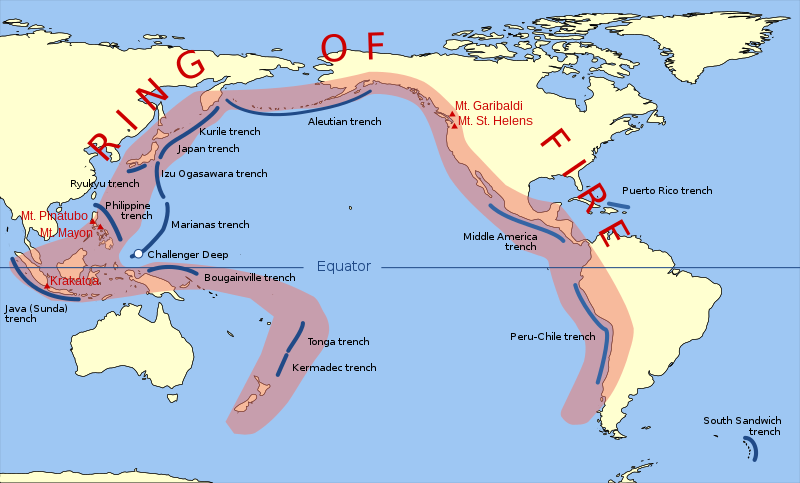
Pacific Ring of Fire
region at edges of Pacific Ocean known for tectonic activity

volcanology
thumb|280px|A volcanologist sampling lava using a rock hammer and a bucket of water
thumb|Eruption of Stromboli (Italy), approximately 100 m (300 ft) vertically. Exposure of several seconds. The dashed trajectories are the result of lava pieces with a bright hot side and a cool dark side rotating in mid-air.

pumice
thumb|Kutkhiny Baty, a pumice rock formation outcrop located 4 km from the source of the Ozyornaya (Sea of Okhotsk)|Ozyornaya River (Lake Kurile), near the southern tip of the [[Kamchatka Peninsula, Russia]]

hotspot
volcanic region

supervolcano
[[File:Supervolcano World Map.png|thumb|upright=1.5|World map of known VEI 7 and VEI 8 volcanoes

trachyte
Trachyte () is an extrusive igneous rock composed mostly of alkali feldspar. It is usually light-colored and aphanitic (fine-grained), with minor amounts of mafic minerals, and is formed by the rapid cooling of lava (or shallow intrusions) enriched with silica and alkali metals. It is the volcanic equivalent of syenite.

cryovolcano
alt=An image of two large cryovolcanoes|thumb|upright=1.5|Leviathan Patera (center) and [[Ruach Planitia (upper left), two large cryovolcanic features on Neptune's moon Triton]]
volcanic rock
rock formed from lava erupted from a volcano
magma chamber
underground accumulation of molten rock
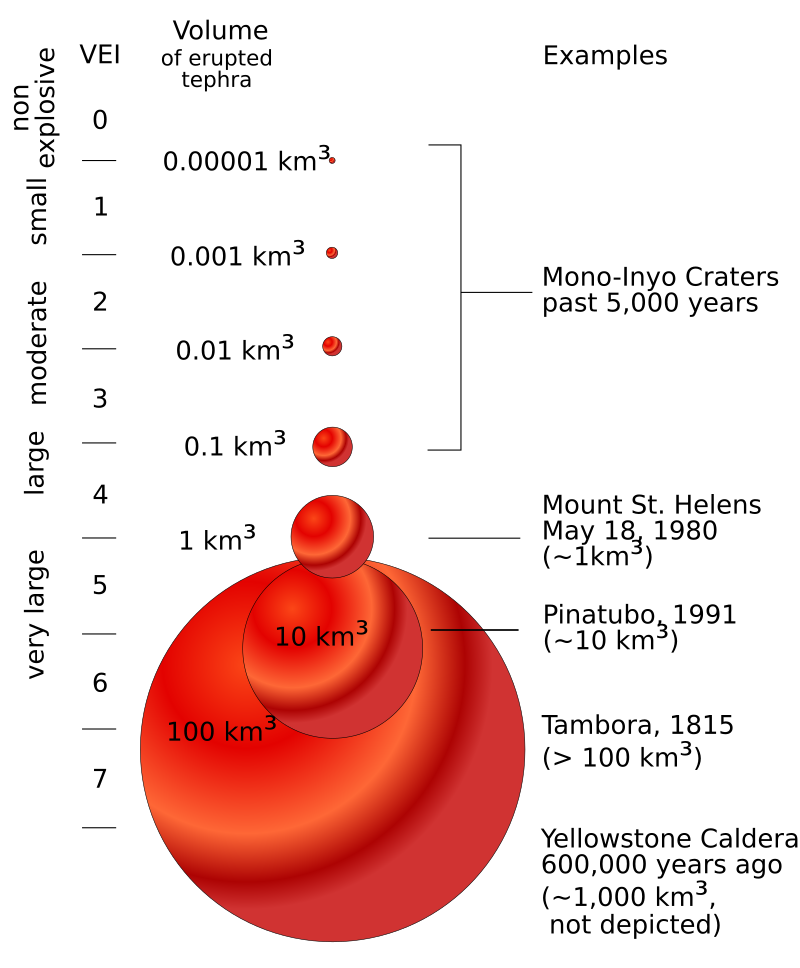
Volcanic Explosivity Index
relative measure of explosive volcanic eruption size (based on product volume, eruption cloud height, etc.), open-ended with the biggest prehistoric eruptions given magnitude 8
pillow lava
lava containing characteristic pillow-shaped structures due to subaqueous extrusion
volcanic glass
material
Wadati–Benioff zone
planar zone of seismicity corresponding with the down-going slab
lava tube
natural conduits through which lava travels beneath the surface of a lava flow

komatiite
thumb|Komatiite lava at the type locality in the Komati Valley, Barberton Mountainland, South Africa, showing the distinctive "spinifex texture" formed by dendritic plates of olivine (scale shown by a hammer on the right edge of photo)
sill
A tabular sheet intrusion that has intruded between older layers of sedimentary rock, beds of volcanic lava or tuff, or along the direction of foliation in metamorphic rock
subvolcanic rock
medium-grained intrusive rock
Bowen's reaction series
Order of crystallization of minerals in magma
volcanic belt
range of volcanically active mountains
large igneous province
massive volcanic formation resulting from flood basalt eruptions
.JPG)
palagonite
right|thumb|250px|Palagonite layers at Moya Beach, Mayotte.
Palagonite is an alteration product from the interaction of water with volcanic glass of chemical composition similar to basalt. Palagonite can also result from the interaction between water and basalt melt. The water flashes to steam on contact with the hot lava and the small fragments of lava react with the steam to form the light-colored palagonite tuff cones common in areas of basaltic eruptions in contact with water. An example is found in the pyroclastic cones of the Galapagos Islands. Charles Darwin recognized the origin of the

hyaloclastite
thumb|Hyaloclastite between Pillow lava|pillows of lava in [[Montana]]
thumb|Pahoehoe|Pahoehoe lava enters the Pacific at [[Hawaii Volcanoes National Park, the Big Island of Hawaii]]
somma volcano
a volcanic caldera that has been partially filled by a new central cone
volatiles
chemical elements or compounds with low boiling points associated with planet’s or moon’s crust or atmosphere
parasitic cone
volcanic cone type
partial melting
process in which only a portion of a solid is melted
phreatomagmatic eruption
type of volcanic eruption
volcanic field
area of the Earth's crust prone to localized volcanic activity

ejecta
thumb|Mt. St Helens eruption plume on 22 July 1980, showing ejecta in the form of pyroclastic material (ash)
Global Volcanism Program
American research program

rhyodacite
right|thumb|A sample of rhyodacite from Slovakia
Rhyodacite is a volcanic rock intermediate in composition between dacite and rhyolite. It is the extrusive equivalent of those plutonic rocks that are intermediate in composition between monzogranite and granodiorite. Rhyodacites form from rapid cooling of lava relatively rich in silica and low in alkali metal oxides.
pseudocrater
volcanic landform which resembles a true volcanic crater, but differs in that it is not an actual vent from which lava has erupted
%20-3.jpg)
Bradyseism
thumb|220px|right|The "Serapium" or Macellum of Pozzuoli demonstrated the effects of bradyseism.
Bradyseism is the gradual uplift (positive bradyseism) or descent (negative bradyseism) of part of the Earth's surface caused by the filling or emptying of an underground magma chamber or hydrothermal activity, particularly in volcanic calderas. It can persist for millennia in between eruptions and each uplift event is normally accompanied by thousands of small to moderate earthquakes. The word derives from the ancient Greek words βραδύς bradús, meaning "slow", and σεισμός seismós meaning "movement
International Association of Volcanology and Chemistry of the Earth's Interior
organization

Fire of Love
2022 film directed by Sara Dosa

glacier lake outburst flood
type of outburst flood that occurs when the dam containing a glacial lake fails

Pele's tears
Small pieces of solidified lava drops

volcanic block
rock mass from solidified lava flows
pyroclastic surge
low-density flow of fluidized mass of turbulent gas and rock fragments which is ejected during some volcanic eruptions
picrobasalt
variety of high-magnesium olivine basalt that is very rich in the mineral olivine
rift zone
part of a volcano where a set of linear cracks form
Limu o Pele
type of volcanic glass which resembles the algae
Macellum of Pozzuoli
market building of the Roman colony of Puteoli, now the city of Pozzuoli in southern Italy
Vulcania
Vulcania, the "European Park of Volcanism", is an educational French amusement park and museum with a volcano theme. Situated in Saint-Ours-les-Roches, Auvergne, 15 km north-west of Clermont-Ferrand, it was officially inaugurated in 2002.
gregoryite
Gregoryite is an anhydrous carbonate mineral that is rich in potassium and sodium with the chemical formula . It is one of the two main ingredients of natrocarbonatite, found naturally in the lava of Ol Doinyo Lengai volcano of Arusha Region, Tanzania, and the other being nyerereite.
dense-rock equivalent
volcanologic calculation
prediction of volcanic activity
interdisciplinary monitoring and research effort to predict the time and severity of a volcano's eruption
Harmonic tremor
tezontle
thumb|One of the Houses of the Mayorazgo de Guerrero showing tezontle walls with cantera accents.
Tezontle () is a porous, highly oxidized, volcanic rock used extensively in construction in Mexico. It is usually reddish in color due to iron oxide.
Tezontle is a well-cemented, agglomeritic and scoriaceous rock.
pyroclastic shield
shield volcano
monogenetic volcanic field
group of small monogenetic volcanoes
pozzolana
thumb|right|Pozzolana from Mount Vesuvius volcano, Italy
Pozzolana or pozzuolana ( , ), also known as pozzolanic ash (), is a natural siliceous or siliceous-aluminous material that reacts with calcium hydroxide in the presence of water at room temperature (cf. pozzolanic reaction). In this reaction insoluble calcium silicate hydrate and calcium aluminate hydrate compounds are formed possessing cementitious properties. The designation pozzolana is derived from one of the primary deposits of volcanic ash used by the Romans in Italy, at Pozzuoli. The modern definition of pozzolana encompasses any
Aso Volcano Museum
Japanese museum near Mount Aso
pumice raft
floating mass of pumice in the ocean
Volcanic Ash Advisory Center
expert group providing information on atmospheric volcanic ash clouds hazardous for airplanes
Tiltmeter
thumb|right|A tiltmeter on Mauna Loa, used to predict eruptions by measuring very small changes in the profile of the mountain.
volcaniclastic rock
thumb|upright=1.35|The Espinaso Formation includes a wide variety of volcaniclastic materials.
Volcaniclastics are geologic materials composed of broken fragments (clasts) of volcanic rock. These encompass all clastic volcanic materials, regardless of what process fragmented the rock, how it was subsequently transported, what environment it was deposited in, or whether nonvolcanic material is mingled with the volcanic clasts. The United States Geological Survey defines volcaniclastics somewhat more narrowly, to include only rock composed of volcanic rock fragments that have been transported so