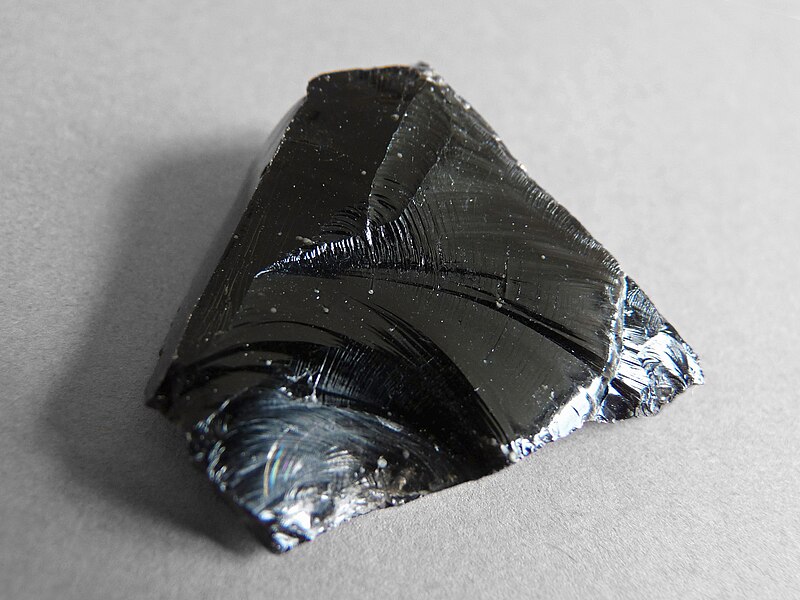
File:Lipari-Obsidienne_(5).jpg · Wikimedia Commons · See Wikimedia Commons
obsidian
Sign in to saveObsidian ( ) is a naturally occurring volcanic glass formed when lava extruded from a volcano cools rapidly with minimal crystal growth. It is an igneous rock. Produced from felsic lava, obsidian is rich in the lighter elements such as silicon, oxygen, aluminium, sodium, and potassium. It is commonly found within the margins of rhyolitic lava flows known as obsidian flows. These flows have a high content of silica, giving them a high viscosity. The high viscosity inhibits the diffusion of atoms through the lava, which inhibits the first step (nucleation) in the formation of mineral crystals. T
Obsidian is a naturally occurring volcanic glass created when lava from a volcano cools very quickly without forming crystals, resulting in a smooth, glassy igneous rock. Because the lava cools so rapidly, atoms cannot move around enough to form mineral crystals, which is what gives obsidian its distinctive glass-like properties.
AI-generated from the Wikipedia summary — may contain errors.
Key facts
- Mineral.name
- Obsidian
- Mineral.category
- Volcanic glass
- Mineral.boxbgcolor
- dddddd
- Mineral.image
- Lipari-Obsidienne (5).jpg
- Mineral.color
- usually black; sometimes green or brown; rarely yellow, orange, red or blue
- Mineral.fracture
- Conchoidal
- Mineral.mohs
- 5–6
- Mineral.luster
- Vitreous
- Mineral.other
- Texture: Smooth; glassy
- Mineral.opticalprop
- Translucent
- Mineral.gravity
- c. 2.4
via Wikipedia infobox
Wikidata facts
- Subclass of
- volcanic glass
- Material used
- feldspar
- Image
- A2613-Museum Geologi-Obsidian.jpg
Show 8 more facts
- Commons category
- Obsidian
- mineral fracture
- conchoidal fracture
- Commons gallery
- Obsidian
- topic's main category
- Category:Obsidian
- described by source
- Encyclopædia Britannica 11th edition
- Mohs' hardness
- 5.5
- color
- red
- on focus list of Wikimedia project
- Wikipedia:Vital articles/Level/4
via Wikidata · CC0
~15 min read
Encyclopedic overview
11 sectionsContents
- Origin and properties
- Occurrence
- Prehistoric and historical use
- Europe
- Middle East and Asia
- Americas
- Oceania
- Current use
- See also
- References
- External links
Obsidian ( ) is a naturally occurring volcanic glass formed when lava extruded from a volcano cools rapidly with minimal crystal growth. It is an igneous rock. Produced from felsic lava, obsidian is rich in the lighter elements such as silicon, oxygen, aluminium, sodium, and potassium. It is commonly found within the margins of rhyolitic lava flows known as obsidian flows. These flows have a high content of silica, giving them a high viscosity. The high viscosity inhibits the diffusion of atoms through the lava, which inhibits the first step (nucleation) in the formation of mineral crystals. Together with rapid cooling, this results in a natural glass forming from the lava.
Obsidian is hard, brittle, and amorphous; it therefore fractures with sharp edges. In the past, it was used to manufacture cutting and piercing tools, and it has been used experimentally as surgical scalpel blades.
Excerpted from Wikipedia’s “obsidian” article, available under the CC BY-SA 4.0 licence.
Gallery (27)
Available in 75 languages
- Español
- Français
- Deutsch
- 中文
- 日本語
- Русский
- Português
- Italiano
- العربية
- हिन्दी
- Armenian
- Asturian
- Azerbaijani
- Bahasa Indonesia
- Basque
- be_x_old
- Belarusian
- Bulgarian
Show 56 more
- Catalan
- Central Kurdish
- Corsican
- Croatian
- Czech
- Danish
- Egyptian Arabic
- Esperanto
- Estonian
- Fijian
- Filipino
- Finnish
- Galician
- Georgian
- Greek
- Hebrew
- Hungarian
- Icelandic
- Ido
- Irish
- kge
- Kyrgyz
- Latin
- Latvian
- Lithuanian
- Low German
- Macedonian
- Malay
- Nederlands
- Norwegian
- Norwegian Nynorsk
- Occitan
- Pashto
- Polski
- ppl
- Quechua
- Romanian
- Scots
- Serbian
- Serbian (Latin)
- simple
- Slovak
- Slovenian
- Svenska
- Tiếng Việt
- Türkçe
- Ukrainian
- Uzbek
- Waray
- Western Frisian
- Western Panjabi
- Wu Chinese
- zh_yue
- فارسی
- ไทย
- 한국어
via Wikidata sitelinks · CC0