Category
page 1Weather hazards

snow
Snow consists of individual ice crystals that grow while suspended in the atmosphere—usually within clouds—and then fall, accumulating on the ground where they undergo further changes. It consists of frozen crystalline water throughout its life cycle, starting when, under suitable conditions, the ice crystals form in the atmosphere, increase to millimeter size, precipitate and accumulate on surfaces, then metamorphose in place, and ultimately melt, slide, or sublimate away.

flood
thumb|Urban flooding in a street in Morpeth, England, 2008

lightning
thumb|upright=1.5|Strokes of cloud-to-ground lightning strike the Mediterranean Sea off of Port-la-Nouvelle in southern France.

tornado
A tornado, also known as a twister, is a rapidly rotating column of air that extends vertically from the surface of the Earth to the base of a cumulonimbus or cumulus cloud. Tornadoes are often (but not always) visible in the form of a condensation funnel originating from the cloud base, with a cloud of rotating debris and dust close to the ground. Most tornadoes have wind speeds less than , are about across, and travel several kilometers (a few miles) before dissipating. The most extreme tornadoes can attain wind speeds of more than , can be more than in diameter, and can stay on the ground f

tropical cyclone
rapidly rotating storm system that forms in the tropics

hail
thumb|A large hailstone, about in diameter
.jpg)
storm
thumb|A storm seen at the Baltic Sea near the island of [[Öland, Sweden.]]

avalanche
thumb|upright=1.25|A powder snow avalanche in the Himalayas near [[Mount Everest]]
An avalanche is a rapid flow of snow down a slope, such as a hill or mountain. Avalanches can be triggered spontaneously, by factors such as increased precipitation or snowpack weakening, or by external means such as humans, other animals, and earthquakes. Primarily composed of flowing snow and air, large avalanches have the capability to capture and move ice, rocks, and trees.

drought
A drought is a period of drier-than-normal conditions. A drought can last for days, months or years. Drought often has large impacts on the ecosystems and agriculture of affected regions, and causes harm to the local economy. Annual dry seasons in the tropics significantly increase the chances of a drought developing, with subsequent increased wildfire risks. Heat waves can significantly worsen drought conditions by increasing evapotranspiration. This dries out forests and other vegetation, and increases the amount of fuel for wildfires.

monsoon
thumb|upright=1.2|Advancing monsoon clouds and showers in Aralvaimozhy, near Nagercoil, [[Tamil Nadu, India]]
thumb|upright=1.2|Monsoon clouds arriving at Port Blair, Andaman, India

cyclone
thumb|upright=1.3|An extratropical cyclone near Iceland
.jpg)
thunderstorm
upright=1.35|thumb|Lightning from a thunderstorm near Pritzerbe, Germany

blizzard
A blizzard is a severe snowstorm characterized by strong sustained winds and low visibility, lasting for a prolonged period of time—typically at least three or four hours. A ground blizzard is a weather condition where snow that has already fallen is being blown by wind. Blizzards can have an immense size and usually stretch to hundreds or thousands of kilometres.
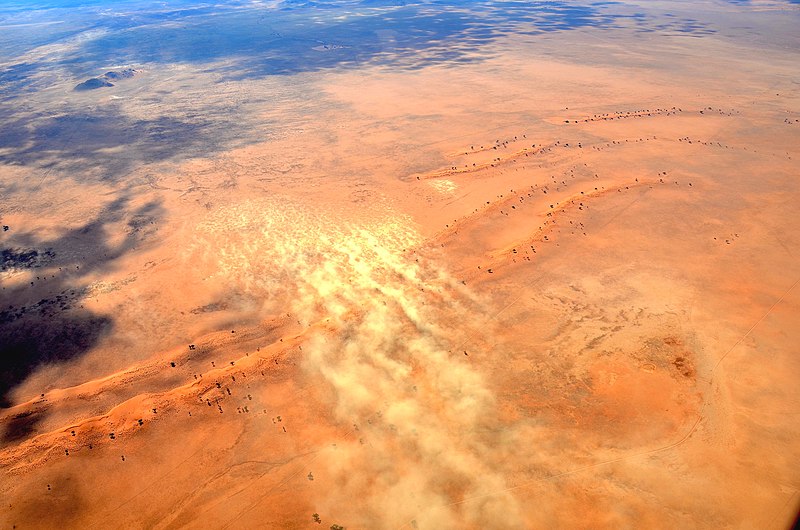
dust storm
meteorological phenomenon common in arid and semi-arid regions

heat wave
prolonged period of excessively hot weather

volcanic ash
volcanic material formed during explosive eruptions with the diameter of the grains less than 2 mm

freezing rain
rain, whose water is supercooled

mudflow
thumb|Mailboxes caught in a mudflow following the May 1980 Mount St. Helens volcanic eruption.
.jpg)
waterspout
thumb|upright=1.3|A waterspout near Thailand in 2016

black ice
transparent coating of glazed ice on a surface

cloud burst
thumb|upright=1.35|Cloudburst in Iceland

winter storm
event in which the varieties of precipitation are formed that only occur at low temperatures
El Niño southern oscillation
irregularly periodic variation in winds and sea surface temperatures over the tropical eastern Pacific Ocean
rogue wave
relatively large and spontaneous ocean surface waves that occur far out at sea
Asian Dust
meteorological phenomenon
extreme weather
unusual, severe or unseasonal weather
fire whirl
whirlwind induced by a fire and often partially composed of flame or ash

haboob
thumb|right|A haboob moves across the Llano Estacado toward [[Yellow House Canyon, near the residential community of Ransom Canyon, Texas (2009)]]
severe weather
any dangerous meteorological phenomena with the potential to cause damage, serious social disruption, or loss of human life
shower
sudden and brief rain or snowfall of variable intensities

zud
thumb|250px|Goats that died as result of a "black" zud. Gobi Desert, March 2010.
A zud, dzud (), dzhut, zhut, djut, or jut (, , ) is a periodic disaster in steppe, semi-desert and desert regions in Mongolia and Central Asia (including Kazakhstan, Uzbekistan, Kyrgyzstan) in which large numbers of livestock die, primarily due to starvation, being unable to graze due to particular severe climatic conditions. Various kinds of zud are recognized, depending on the particular type of climatic conditions. In winter it may be caused by an impenetrable ice crust, and in summer it may happen due to droug
whiteout
meterological phenomena
ice congestion
accumulation of ice on a river caused by ice break-up forming a barrier that in turn can cause floods
Aleutian Low
semi-permanent low pressure center located near the Aleutian Islands
transient luminous event
short-lived electrical phenomena that occur at high altitudes over lightning storms (sprites, jets, etc.)
meteotsunami
A meteotsunami or meteorological tsunami is a tsunami-like sea wave of meteorological origin. Meteotsunamis are generated when rapid changes in barometric pressure cause the displacement of a body of water. In contrast to impulse-type tsunami sources, a traveling atmospheric disturbance normally interacts with the ocean over a limited period of time (from several minutes to several hours). Tsunamis and meteotsunamis are otherwise similar enough that it can be difficult to distinguish one from the other, as in cases where there is a tsunami wave but there are no records of an earthquake, landsl
European windstorm
type of storm

thundersnow
derecho
thumb|right|Timelapse video of a derecho approaching and eventually passing over an airport in South Dakota, United States
A derecho (, from , 'straight') is a widespread, long-lived, straight-line wind storm that is associated with a fast-moving complex of severe thunderstorms referred to as a mesoscale convective system.
Air travel disruption after the 2010 Eyjafjallajökull eruption
disruption of air travel due to volcanic ash

hypercane
A hypercane is a hypothetical class of extreme tropical cyclone that could form if sea surface temperatures reached approximately , which is warmer than the warmest ocean temperature ever recorded. Such an increase could be caused by a large asteroid or comet impact, a large supervolcanic eruption, a large submarine flood basalt, or "incredible" global warming. There is some speculation that a series of hypercanes resulting from the impact of a large asteroid or comet contributed to the demise of the non-avian dinosaurs. The hypothesis was developed by Kerry Emanuel of MIT, who also coined the
microburst
REDIRECT Downburst

cryoseism
A cryoseism, ice quake or frost quake, is a seismic event caused by a sudden cracking action in frozen soil or rock saturated with water or ice, or by stresses generated at frozen lakes.
freezing drizzle
drizzle, whose water is supercooled
Rapid intensification
Sudden, violent increase in a tropical cyclone's severity
washout
sudden erosion (usually by water) of either natural terrain or man-made objects (such as roads and railroads)
Bow echo
mesoscale convective system shaped like a ancher's bow
Genoa low
type of low pressure area
perfect storm
megadrought
thumb|300px|A typical dry lakebed is seen in droughts in California|California, which experienced its worst megadrought in 1,200 years in 2022. The drought was precipitated by [[climate change. California rationed water in response.]]
A megadrought is an exceptionally severe drought, lasting for many years and covering a wide area.
Rainband
thumb|right|Band of thunderstorms seen on a weather radar display
A rainband is a cloud and precipitation structure associated with an area of rainfall which is significantly elongated. Rainbands in tropical cyclones can be either stratiform or convective and are curved in shape. They consist of showers and thunderstorms, and along with the eyewall and the eye, they make up a tropical cyclone. The extent of rainbands around a tropical cyclone can help determine the cyclone's intensity.
snowsquall
localized heavy snowfall accompanied with strong winds and blowing snow
air-mass thunderstorm
thunderstorm that is generally weak and usually not severe.
post-tropical cyclone
former tropical cyclone
training
repeated area of rain that moves over the same region in a relatively short period of time
tree well
void or area of loose snow around the trunk of a tree enveloped in deep snow
Central dense overcast
large central area of thunderstorms surrounding its circulation center