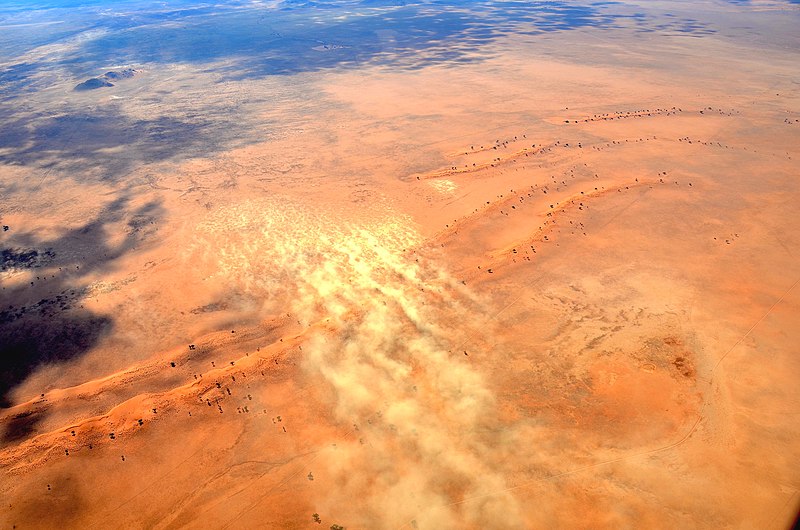
File:Sandsturm_in_der_Namib_(2017).jpg · Wikimedia Commons · See Wikimedia Commons
dust storm
Sign in to saveAlso known as sandstorm
meteorological phenomenon common in arid and semi-arid regions
A dust storm is a massive wall of dust and sand that sweeps across arid and semi-arid regions, kicked up by strong winds. These storms matter because they can reduce visibility to dangerous levels, damage crops and infrastructure, and spread dust across large distances that can affect air quality and human health.
AI-generated from the Wikipedia summary — may contain errors.
Wikidata facts
- Instance of
- meteorological phenomenon
- Subclass of
- lithometeor
- Has part
- dust
- Image
- Sandstorm in Al Asad, Iraq.jpg
Show 4 more facts
- Commons category
- Dust storms
- Commons gallery
- Dust storm
- topic's main category
- Category:Dust storms
- on focus list of Wikimedia project
- Wikipedia:Vital articles/Level/4
Sources (3)
via Wikidata · CC0
~9 min read
Encyclopedic overview
An aerial view of a sandstorm over the Namib Desert A dust storm, also called a sandstorm, is a meteorological phenomenon common in arid and semi-arid regions. Dust storms arise when a gust front or other strong wind blows loose sand and dirt from a dry surface. Fine particles are transported by saltation and suspension, a process that moves soil from one place and deposits it in another. These storms can reduce visibility, disrupt transportation, and pose serious health risks. Over time, repeated dust storms can reduce agricultural productivity and contribute to desertification.
The arid regions of North Africa, the Middle East, Central Asia and China are the main terrestrial sources of airborne dust. It has been argued that poor management of Earth's drylands, such as neglecting the fallow system, are increasing the size and frequency of dust storms from desert margins and changing both the local and global climate, as well as impacting local economies.
Excerpted from Wikipedia’s “dust storm” article, available under the CC BY-SA 4.0 licence.
Gallery (5)
Available in 71 languages
- Español
- Français
- Deutsch
- 中文
- 日本語
- Русский
- Português
- Italiano
- العربية
- हिन्दी
- Afrikaans
- Albanian
- Armenian
- Asturian
- Azerbaijani
- Bahasa Indonesia
- Basque
- Belarusian
Show 52 more
- Bulgarian
- Burmese
- Catalan
- Chuvash
- Croatian
- Czech
- Danish
- Esperanto
- Estonian
- Finnish
- Galician
- Greek
- Hausa
- Hebrew
- Hungarian
- Irish
- Javanese
- Kazakh
- Latin
- Latvian
- Lithuanian
- Macedonian
- Malay
- Malayalam
- Mongolian
- Nederlands
- Norwegian
- Norwegian Nynorsk
- Obolo
- Occitan
- Polski
- Romanian
- Serbian
- Serbian (Latin)
- simple
- Sindhi
- Slovak
- Slovenian
- Svenska
- Tajik
- Tamil
- Tibetan
- Tiếng Việt
- Türkçe
- Ukrainian
- Urdu
- Western Panjabi
- Wu Chinese
- zh_yue
- فارسی
- ไทย
- 한국어
via Wikidata sitelinks · CC0