File:Avalanche_on_Everest.JPG · Wikimedia Commons · See Wikimedia Commons
avalanche
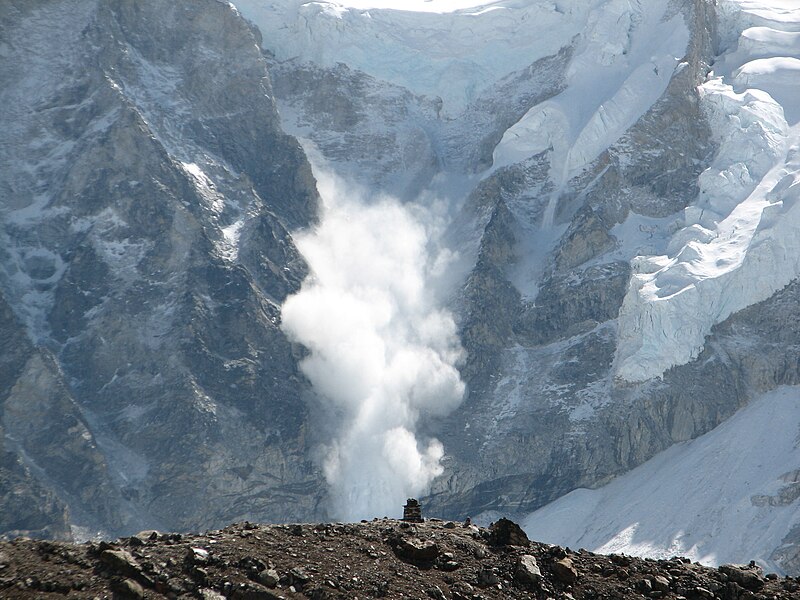
Sign in to savethumb|upright=1.25|A powder snow avalanche in the Himalayas near [[Mount Everest]] An avalanche is a rapid flow of snow down a slope, such as a hill or mountain. Avalanches can be triggered spontaneously, by factors such as increased precipitation or snowpack weakening, or by external means such as humans, other animals, and earthquakes. Primarily composed of flowing snow and air, large avalanches have the capability to capture and move ice, rocks, and trees.
An avalanche is a rapid flow of snow down a slope such as a hill or mountain, which can be triggered by natural factors like heavy precipitation or snowpack weakening, or by external causes like humans, animals, and earthquakes. Large avalanches matter because they can capture and move not just snow and air, but also ice, rocks, and trees, making them potentially destructive events.
AI-generated from the Wikipedia summary — may contain errors.
Research
4,965 papers- [Avalanche rescue 2024-Current recommendations].Die Anaesthesiologie · 2025
- Avalanche burial pathophysiology - a unique combination of hypoxia, hypercapnia and hypothermia.The Journal of physiology · 2024
- Single Photon Avalanche Diode Arrays for Time-Resolved Raman Spectroscopy.Sensors (Basel, Switzerland) · 2021
- On-Site Medical Management of Avalanche Victims-A Narrative Review.International journal of environmental research and public health · 2021
- Effectiveness and use of avalanche airbags in mortality reduction among winter-recreationists.Journal of travel medicine · 2023
via PubMed
Wikidata facts
- Image
- Laviin MAL-Pamir 85 02.jpg
Show 7 more facts
- topic's main category
- Category:Avalanches
- Commons gallery
- Avalanche
- on focus list of Wikimedia project
- Wikipedia:Vital articles/Level/4
- facet of
- gravity
- different from
- Avalanche
- Commons category
- Avalanches
- exact match
- purl.obolibrary.org/obo/ENVO_01000691
Sources (5)
via Wikidata · CC0
~44 min read
Encyclopedic overview
39 sectionsContents
- Formation
- Slab avalanches
- Powder snow avalanches
- Wet snow avalanches
- Ice avalanche
- Avalanche pathway
- Injuries and deaths
- Terrain, snowpack, weather
- Terrain
- Snowpack structure and characteristics
- Weather
- Dynamics
- Modeling
- Human involvement
- How to prevent avalanches
- Mitigation
- Early warning systems
- Alarm systems
- Survival, rescue, and recovery
- Notable avalanches
- Classification of avalanches
- European avalanche risk
- European avalanche size table
- North American Avalanche Danger Scale
- Avalanche problems
- Canadian classification for avalanche size
- United States classification for avalanche size
- Rutschblock Test
- Avalanches and climate change
- Impacts on avalanche type and frequency
- Impacts on burial survival rate
- Avalanches of dust on Mars
- See also
- Related flows
- Avalanche disasters
- References
- Bibliography
- Notes
- External links
thumb|upright=1.25|A powder snow avalanche in the Himalayas near [[Mount Everest]] An avalanche is a rapid flow of snow down a slope, such as a hill or mountain. Avalanches can be triggered spontaneously, by factors such as increased precipitation or snowpack weakening, or by external means such as humans, other animals, and earthquakes. Primarily composed of flowing snow and air, large avalanches have the capability to capture and move ice, rocks, and trees.
Avalanches occur in two general forms, or combinations thereof: slab avalanches made of tightly packed snow, triggered by a collapse of an underlying weak snow layer, and loose snow avalanches made of looser snow. After being set off, avalanches usually accelerate rapidly and grow in mass and volume as they capture more snow. If an avalanche moves fast enough, some of the snow may mix with the air, forming a powder snow avalanche.
Excerpted from Wikipedia’s “avalanche” article, available under the CC BY-SA 4.0 licence.
Gallery (50)
Available in 120 languages
- Español
- Français
- Deutsch
- 中文
- 日本語
- Русский
- Português
- Italiano
- العربية
- हिन्दी
- abstract
- Afrikaans
- Albanian
- Albanian
- Angika
- Aragonese
- Armenian
- Arpitan
Show 101 more
- Assamese
- Asturian
- azb
- Azerbaijani
- Bahasa Indonesia
- Bangla
- Bashkir
- Basque
- bat_smg
- Bavarian
- be_x_old
- Belarusian
- Bosnian
- Bulgarian
- Burmese
- Catalan
- Central Kurdish
- Chechen
- Chuvash
- Croatian
- Czech
- Danish
- dty
- Egyptian Arabic
- Esperanto
- Estonian
- Fiji Hindi
- Filipino
- Finnish
- fiu_vro
- Galician
- Georgian
- Greek
- Hebrew
- Hungarian
- Icelandic
- Ido
- Ingush
- Interlingua
- Irish
- Karachay-Balkar
- Kazakh
- kbp
- Kikuyu
- Kurdish
- Kyrgyz
- Latin
- Latvian
- Limburgish
- Lithuanian
- Macedonian
- Malay
- Malayalam
- Marathi
- Mingrelian
- Mirandese
- nds_nl
- Nederlands
- Nepali
- Newari
- Northern Frisian
- Norwegian
- Norwegian Nynorsk
- Occitan
- Pashto
- Piedmontese
- Polski
- Punjabi
- Romanian
- Rusyn
- Sanskrit
- Scottish Gaelic
- Serbian
- Serbian (Latin)
- Sicilian
- simple
- Slovak
- Slovenian
- Svenska
- Swahili
- Tajik
- Tamil
- Tatar
- Telugu
- Tiếng Việt
- Türkçe
- Ukrainian
- Urdu
- Uzbek
- Venetian
- Waray
- Welsh
- Western Panjabi
- Wu Chinese
- Yiddish
- Zaza
- zh_min_nan
- zh_yue
- فارسی
- ไทย
- 한국어
via Wikidata sitelinks · CC0