Category
page 1Web 2.0 neologisms

AJAX
group of interrelated Web development techniques
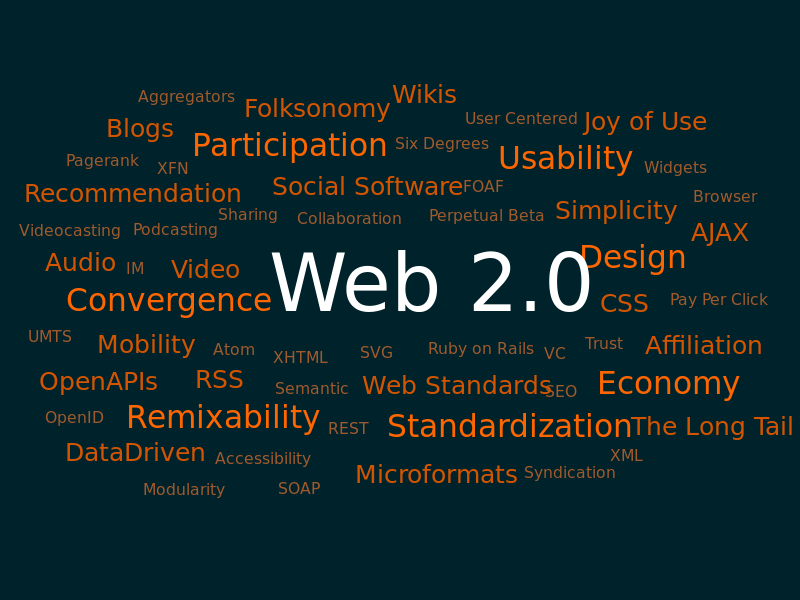
Web 2.0
World Wide Web sites that use technology beyond the static pages of earlier Web sites
tag cloud
type of visual representation for text data

Representational State Transfer
REST (Representational State Transfer) is a software architectural style that was created to describe the design and guide the development of the architecture for the World Wide Web. REST defines a set of constraints for how the architecture of a distributed, Internet-scale hypermedia system, such as the Web, should behave. The REST architectural style emphasizes uniform interfaces, independent deployment of components, the scalability of interactions between them, and creating a layered architecture to promote caching to reduce user-perceived latency, enforce security, and encapsulate legacy
folksonomy
Folksonomy is a classification system in which end users apply public tags to online items, typically to make those items easier for themselves or others to find later. Over time, this can give rise to a classification system based on those tags and how often they are applied or searched for, in contrast to a taxonomic classification designed by the owners of the content and specified when it is published. This practice is also known as collaborative tagging, social classification, social indexing, and social tagging. Folksonomy was originally "the result of personal free tagging of informatio
1% rule
hypothesis that more people will lurk in a virtual community than will participate
mashup
web application that combines content from more than one source in a single graphical interface
slashdot effect
effect that occurs when a popular website links to a smaller website, causing a massive increase in traffic
Comet
web application model
social web
set relations linking people through the WWW
HATEOAS
Hypermedia as the engine of application state (HATEOAS) is a constraint of the REST software architectural style that distinguishes it from other network architectural styles.

deplatforming
thumb|A bust of MIT president Francis Amasa Walker separated from its pedestal at the [[MIT Museum]]
Deplatforming, also known as no-platforming, is a boycott on an individual or group by removing the platforms used to share their information or ideas. The term is commonly associated with social media.
Identicon
thumb|right|An arbitrary Identicon
An Identicon is a visual representation of a hash value, usually of an IP address, that serves to identify a user of a computer system as an effectively random form of avatar while protecting the user's privacy. The original Identicon was a 9-block graphic, and the representation has been extended to other graphic forms by third parties.
Learning Tools Interoperability
education technology specification by IMS Global Learning Consortium
comments section
feature of online news, blogs, or social media platforms in which readers discuss the posted content