Category
page 1Wisdom goddesses

Athena

Muse
thumb|Muse, perhaps Clio, reading a scroll (Attic red-figure [[lekythos, Boeotia, )]]
In ancient Greek religion and mythology, the Muses (, ; singular: , Moúsa, ; , ) were the inspirational goddesses of literature, science, and the arts. They were considered the source of the knowledge embodied in the poetry, lyric songs, and myths that were related orally for centuries in ancient Greek culture.

Saraswati
Saraswati (, ), also spelled as Sarasvati, is one of the principal goddesses in Hinduism, revered as the goddess of knowledge, education, learning, arts, speech, poetry, music, creativity, purification, language and culture. Together with the goddesses Lakshmi and Parvati, she forms the trinity of chief goddesses, known as the Tridevi. Saraswati is a pan-Indian deity, venerated not only in Hinduism but also in Jainism and Buddhism.

Isis
thumb|Isis wall painting in the tomb of Seti I (KV17)

Minerva
thumb|upright|Mosaic of the Minerva of Peace in the Library of Congress

Frigg
thumb|Frigg sits enthroned and facing the spear-wielding goddess Gná, flanked by two goddesses, one of whom ([[Fulla) carries her eski, a wooden box. Illustrated (1882) by Carl Emil Doepler.]]
Frigg (, , , Old Swedish: Frigg, genitive: Friggiar, etc, Early Modern Swedish: etc; ; ; ; ; ) is a goddess, one of the Æsir, in Germanic mythology. In Norse mythology, the source of most surviving information about her, she is associated with marriage, prophecy, clairvoyance and motherhood, and dwells in the wetland halls of Fensalir. The names ultimately stem from the Proto-Germanic theonym *Frijjō. Ne

Neith
thumb|Neith wearing the Deshret|Red Crown of Lower Egypt.

Metis
Oceanid of Greek mythology, goddess of wisdom, daughter of Oceanid and Tethys

Seshat
Seshat (, under various spellings) was the ancient Egyptian goddess of writing, wisdom, and knowledge. She was seen as a scribe and record keeper. She was also credited with inventing writing. She became identified as the goddess of measurement, accounting, architecture, science, astronomy, mathematics, geometry, history and surveying. She was variously depicted as the wife, daughter, or feminine counterpart of Thoth, who was also associated with knowledge, astronomy, measurement, and writing.''''''
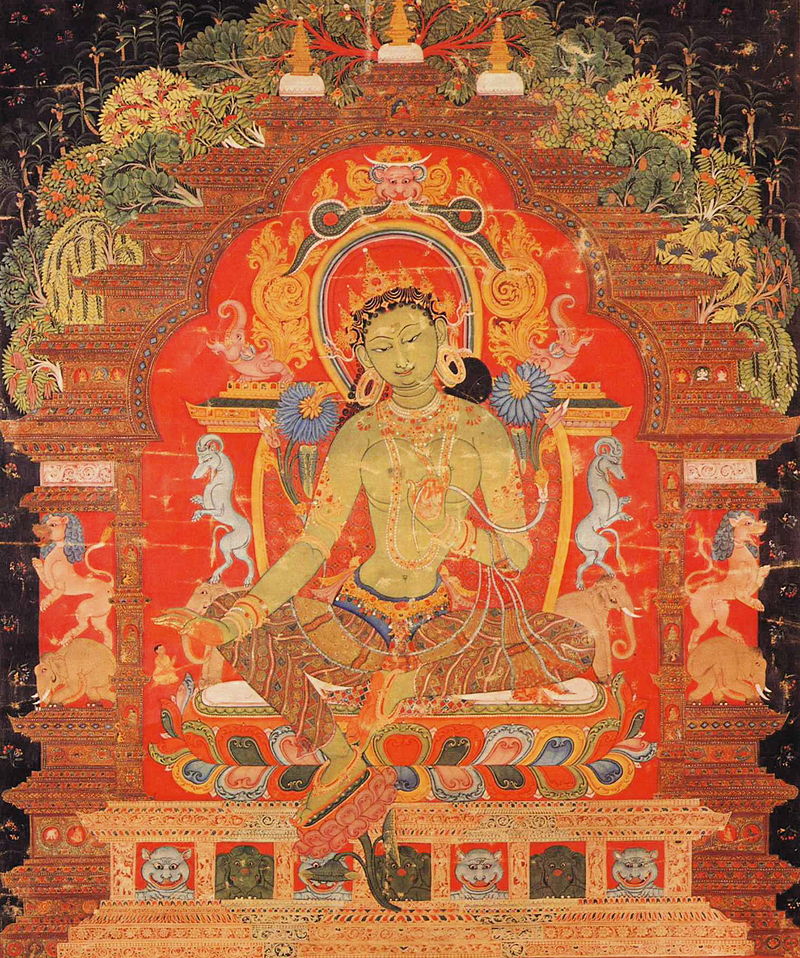
Tārā
female Bodhisattva
Egeria
legendary wife of Roman king Numa and minor goddess
Brigid
Brigid or Brigit ( , ; meaning 'exalted one'), also Bríg, is a goddess of pre-Christian Ireland. She appears in Irish mythology as a member of the Tuatha Dé Danann, the daughter of the Dagda and wife of Bres, with whom she had a son named Ruadán.

Gefjon
thumb|300px|Detail of the Gefion Fountain (1908) by [[Anders Bundgaard]]
In Norse mythology, Gefjon (Old Norse: ; alternatively spelled Gefion, or Gefjun , pronounced without secondary syllable stress) is a goddess associated with ploughing, the Danish island of Zealand, the legendary Swedish king Gylfi, the legendary Danish king Skjöldr, foreknowledge, her oxen children, and virginity. Gefjon is attested in the Poetic Edda, compiled in the 13th century from earlier traditional sources; the Prose Edda and Heimskringla, written in the 13th century by Snorri Sturluson; in the works of skalds; an

Benzaiten
or simply Benten is an East Asian Buddhist goddess who originated from the Hindu Saraswati, the patroness of speech, the arts, and learning.

Snotra
In Norse mythology, Snotra (Old Norse: , "clever") is a goddess associated with wisdom. Snotra is attested in the Prose Edda, written in the 13th century by Snorri Sturluson. Scholars have proposed theories about the implications of the goddess.
Anahit
Anahit () was the goddess of fertility and healing, wisdom and water in Armenian mythology. In the early periods, she was the goddess of war. By the 5th century BCE, she was the main deity in Armenia along with Aramazd. The Armenian goddess Anahit is related to the similar Iranian goddess Anahita. Artaxias I erected statues of Anahit, and promulgated orders to worship them.
Menrva
Menrva (also spelled Menerva or Menfra) was an Etruscan goddess of war, art, wisdom, and medicine. She contributed much of her character to the Roman Minerva. She was the child of Uni and Tinia.
Vör
In Norse mythology, Vör (Old Norse: Vǫr, possibly "the careful one," or "aware, careful") is a goddess associated with wisdom. Vör is attested in the Prose Edda, written in the 13th century by Snorri Sturluson; and twice in kennings employed in skaldic poetry. Scholars have proposed theories about the implications of the goddess.

Nisaba
Nisaba was the Mesopotamian goddess of writing and grain. She is one of the oldest Sumerian deities attested in writing, and remained prominent through many periods of Mesopotamian history. She was commonly worshiped by scribes, and numerous Sumerian texts end with the doxology "praise to Nisaba" as a result. She declined after the Old Babylonian period due to the rise of the new scribe god, Nabu, though she did not fully vanish from Mesopotamian religion and attestations from as late as the neo-Babylonian period are known.
Sophia
personification of wisdom in Hellenistic philosophy

Geshtinanna
Geshtinanna was a Mesopotamian goddess best known due to her role in myths about the death of Dumuzi, her brother. It is not certain what functions she fulfilled in the Mesopotamian pantheon, though her association with the scribal arts and dream interpretation is well attested. She could serve as a scribe in the underworld, where according to the myth ''Inanna's Descent'' she had to reside for a half of each year in place of her brother.
Triple Goddess
concept in Neopaganism
Eidyia
In Greek mythology, Idyia () or Eidyia (; ) was a daughter of the Titans Oceanus and Tethys, and queen to Aeëtes, king of Colchis. She was the mother of Medea, Chalciope and Absyrtus. According to Apollonius of Rhodes, she was the youngest of the Oceanides. Her name means "the fair-faced" or "the knowing one" derived from the Greek word () meaning "to see" or "to know".

Ninshubur
Ninshubur (,; Ninšubur, "Lady of Subartu" or "Lady of servants"), also spelled Ninšubura, was a Mesopotamian goddess regarded as the sukkal (divine attendant) of the goddess Inanna. While it is agreed that in this context Ninshubur was regarded as female, in other cases the deity was considered male, possibly due to syncretism with other divine messengers, such as Ilabrat. No certain information about her genealogy is present in any known sources, and she was typically regarded as unmarried. As a sukkal, she functioned both as a messenger deity and as an intercessor between other members of th
Siduri
Siduri, or more accurately Šiduri (pronounced Shiduri), is a character in the Epic of Gilgamesh. She is described as an alewife. The oldest preserved version of the composition to contain the episode involving her leaves her nameless, and in the later standard edition compiled by Sîn-lēqi-unninni her name only appears in a single line. She is named Naḫmazulel or Naḫmizulen in the preserved fragments of Hurrian and Hittite translations. It has been proposed that her name in the standard edition is derived from an epithet applied to her by the Hurrian translator, šiduri, "young woman." An altern
.jpg)
Kurukullā
Kurukullā (; also (i.e. 'knowledge' or 'magic woman') or ) is a female, peaceful to semi-wrathful Yidam in Tibetan Buddhism particularly associated with rites of magnetization or enchantment. Her Sanskrit name is of unclear origin. She is related to Shri Yantra in Hinduism, occupying the centre of the mystic diagram with varahi, together with whom the fifteen signs of moon phases () were born from. She is identified with Tripura Sundari and Tara in some sources of Hinduism.

Providentia
thumb|300px|Roman aureus struck under the rule of [[Pertinax. Inscription: IMP. CAES. P. HELV. PERTIN. AVG. / PROVIDentia DEORum COnSul II]]
In ancient Roman religion, Providentia is a divine personification of the ability to foresee and make provision. She was among the embodiments of virtues that were part of the Imperial cult of ancient Rome. Providentia thus figures in art, cult, and literature, but has little or no mythology as such.

Vajrayogini
right|thumb|280px|Painting of Vajrayoginī in the form of Nāropa's Ḍākinī
Nane
Armenian goddess of war
Sunthareevani
Phra Sunthariwani, also known as Nang Sunthariwani, is a goddess in the Thai Buddhist tradition, regarded as the protector of the Dhamma and the Tripiṭaka. She is venerated especially at Wat Suthat Thepwararam Ratchaworamahawihan. Depicted with a pure white body, she is adorned in royal Thai attire, dressed in white, with two arms. Her right hand is in a beckoning gesture (later changed to the vitarka mudrā), and her left hand holds a crystal ball in her lap.
Sophia
feminine figure in Gnosticism
Barbelo
Barbēlō (Greek: Βαρβηλώ) refers to the first emanation of God in several forms of Gnostic cosmogony. Barbēlō is often depicted as a supreme female principle, the single passive antecedent of creation in its manifold. This figure is also variously referred to as 'Mother-Father' (hinting at her apparent androgyny), 'The Triple Androgynous Name', or 'Eternal Aeon'. So prominent was her place amongst some Gnostics that some schools were designated as Barbeliotae, Barbēlō worshippers or Barbēlō gnostics.
Vajravarahi
thumb|right|Buddha Vajravārāhī
Prajñāpāramitā Devī
Buddhist goddess that symbolizes and embodies Prajñāpāramitā, the perfection of transcendent wisdom
Ihi
Mythological Tahitian goddess
Simhamukha
thumb|260px|Fierce lion-headed dakini Simhamukha crowned with Padmasambhava
In Tibetan Buddhism, Siṃhamukhā (Tib. Senge Dongma) or Siṃhavaktra, also known as the Lion Face Dakini or Lion-headed Dakini, is a wisdom dakini of the Dzogchen tradition. She is represented as a fierce dakini with the head of a snow lion. Her mouth is depicted with a roar, symbolizing untamed fury and jubilant laughter. Her roar disperses discursive thoughts. She is naked, symbolizing that she herself is completely free of discursive thought.
Ninimma
Ninimma was a Mesopotamian goddess best known as a courtier of Enlil. She is well attested as a deity associated with scribal arts, and is variously described as a divine scholar, scribe or librarian by modern Assyriologists. She could also serve as an assistant of the birth goddess Ninmah, and a hymn describes her partaking in cutting of umbilical cords and determination of fates. It has also been suggested that she was associated with vegetation. In the Middle Babylonian period she additionally came to be viewed as a healing deity.
Vegoia
Vegoia (Etruscan: Vecu) is a sibyl, prophet, or nymph within the Etruscan religious framework. She is identified as the author of parts of their large and complex set of sacred books, detailing the religiously correct methods of founding cities and shrines, draining fields, formulating laws and ordinances, measuring space and dividing time; she initiated the Etruscan people to the arts, as originating the rules and rituals of land marking, and as presiding over the observance, respect, and preservation of boundaries.