
310 Margarita
Also known as (310) Margarita, Margarita
main-belt asteroid
Picture of the Day · NASA
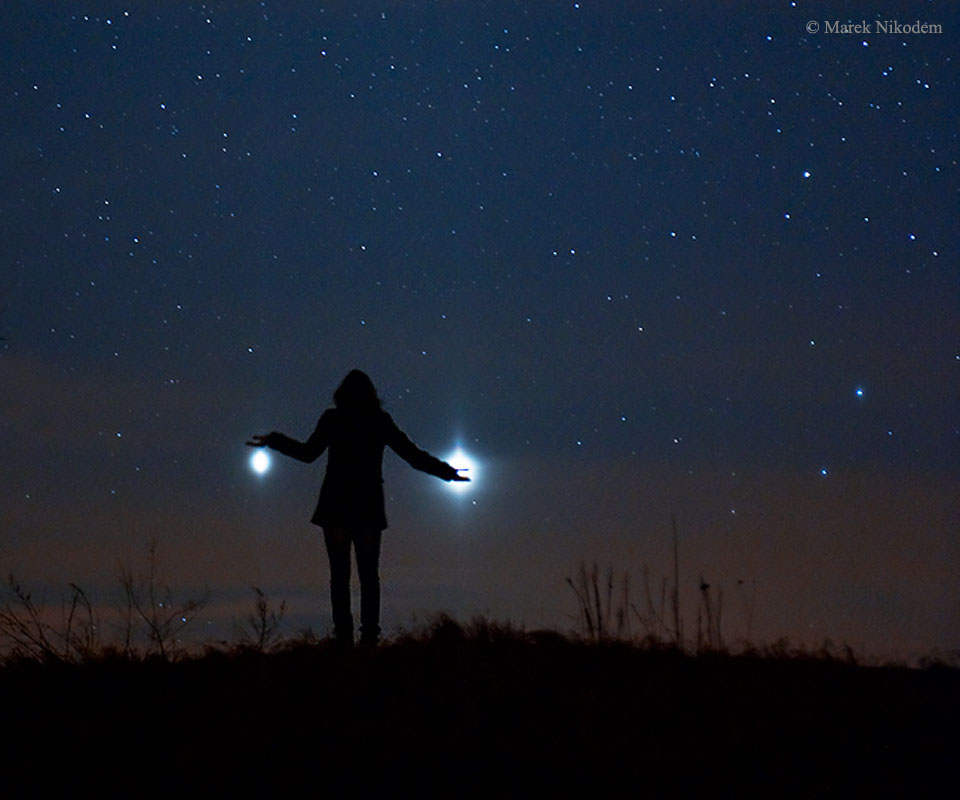
Jupiter and Venus from Earth
2026-06-07
It was visible around the world. The sunset conjunction of Jupiter (left) and Venus (right) in 2012 was visible almost no matter where you lived on Earth. Anyone on our planet with a clear western horizon at sunset could see them. That year, a creative photographer traveled away from the town lights of Szubin, Poland to photograph a near closest approach of the two planets. The bright planets were then separated by only three degrees and his daughter struck a humorous pose. A faint red sunset still glowed in the background. Jupiter and Venus are together again this week after sunset, passing within a degree of each other about two days from today.
© Marek Nikodem (PPSAE) · via NASA APOD
Key facts
- Discovered by
- Auguste Charlois
- Discovery date
- 16 May 1891
- Minor planet category
- Main belt
- Observation arc
- 95.51 yr (34884 d)
- Aphelion
- 3.07625 AU (460.200 Gm )
- Perihelion
- 2.44950 AU (366.440 Gm)
Article
310 Margarita is a typical Main belt asteroid. It was discovered by the French astronomer Auguste Charlois on 16 May 1891 in Nice. The intended meaning of the asteroid's name is unknown. This minor planet is orbiting the Sun at a distance of 2.76 AU with a period of 4.592 years and an orbital eccentricity of 0.113. The orbital plane is inclined at an angle of 3.17° to the plane of the ecliptic.
Photometric observations of 310 Margarita made during 2010 showed a synodic rotation period of 12.069±0.001 h with a brightness variation of 0.15±0.02 in magnitude. This rotation rate is nearly Earth commensurable, making observations from widely different longitudes particularly useful when studying the light curve of this object. 310 Margarita is a stony S-type asteroid with an estimated diameter of 33 km.