
349 Dembowska
Also known as (349) Dembowska, Dembowska
main-belt asteroid
Picture of the Day · NASA
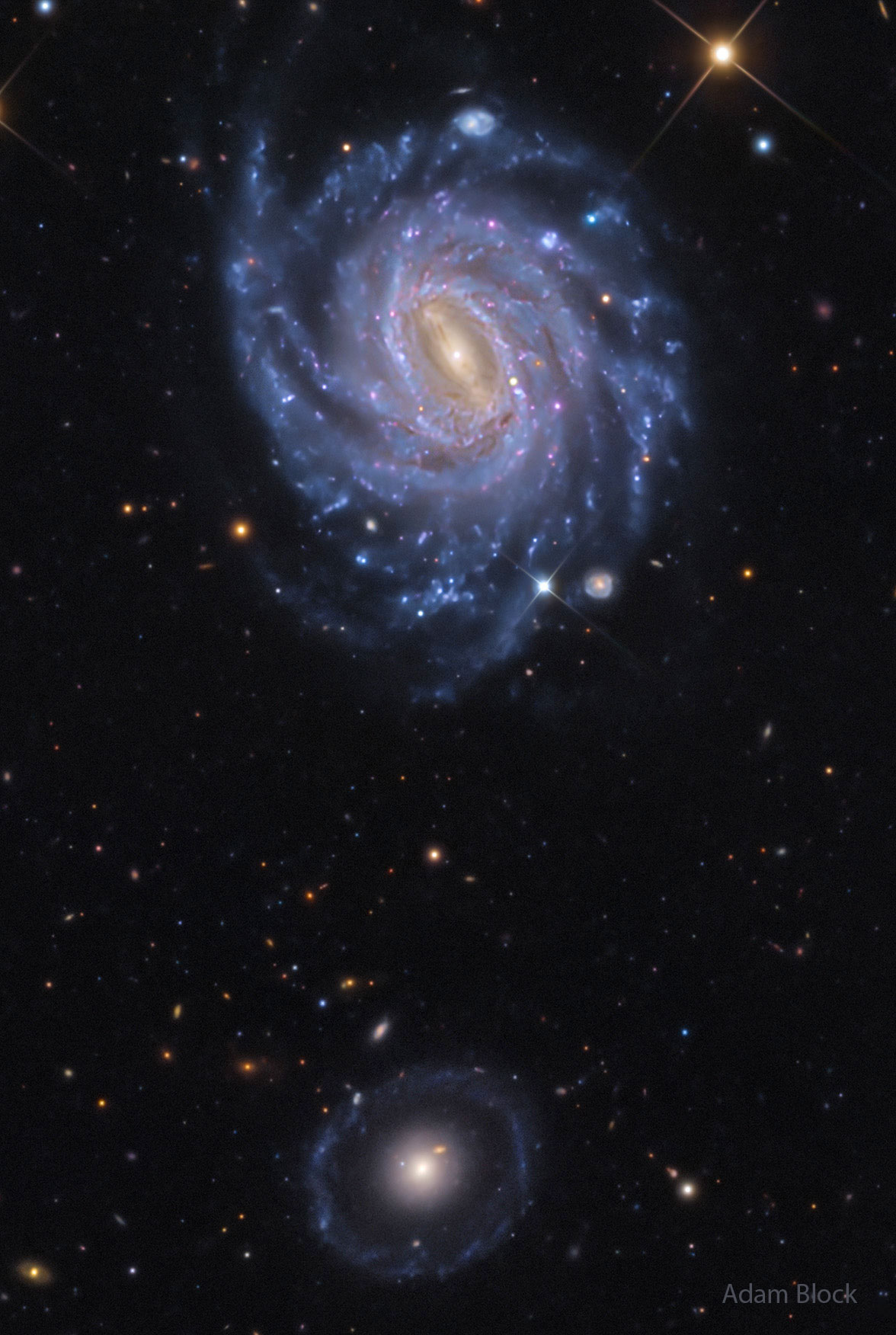
NGC 3660 and Burçin's Galaxy
2026-05-26
The upper galaxy might be more photogenic, but the lower galaxy is more unusual. The galaxy up top is NGC 3660, a spiral galaxy similar to our own Milky Way galaxy in that it has several bright blue spiral arms and a central bar of stars, dust, and gas. Captured by chance in the featured deep and colorful image, surprisingly, is SN 2026cff, a supernova found just to the right of the central bar. Farther in the distance is the bottom galaxy, known informally as Burçin’s galaxy, but formally cataloged as LEDA 1000714. The center of this galaxy appears to be an old elliptical galaxy, but it is strangely surrounded by not one but two rings of stars. What created Burçin's galaxy is a mystery and remains a continuing topic of research, but it likely involves the accretion of one or more smaller galaxies.
via NASA APOD
Key facts
- Discovered by
- Auguste Charlois
- Discovery date
- 9 December 1892
- Pronunciation
- / d ɛ m ˈ b aʊ s k ə /
- Named after
- Ercole Dembowski
- Alternative designations
- 1892 T
- Minor planet category
Article
349 Dembowska is a large asteroid of the main belt, discovered on 9 December 1892, by the French astronomer Auguste Charlois while working at the observatory in Nice, France. It is named in honor of the Baron Hercules Dembowski, an Italian astronomer who made significant contributions to research on double and multiple stars.
Orbiting just inside the prominent 7:3 resonance with Jupiter, 349 Dembowska is among the largest asteroids in the main belt with an estimated diameter of ~140 km. It has a rotational period of 4.7012 hours, and is classified as an R-type asteroid for the presence of strong absorption lines in olivine and pyroxene with little or no metals. It may have undergone partial melting/differentiation. 349 Dembowska has an unusually high albedo of 0.384. Of the asteroids with a diameter greater than 75 km, only 4 Vesta has a higher known albedo.