859 Bouzaréah
Also known as (859) Bouzaréah, Bouzaréah, Bouzareah
outer main-belt asteroid
Picture of the Day · NASA
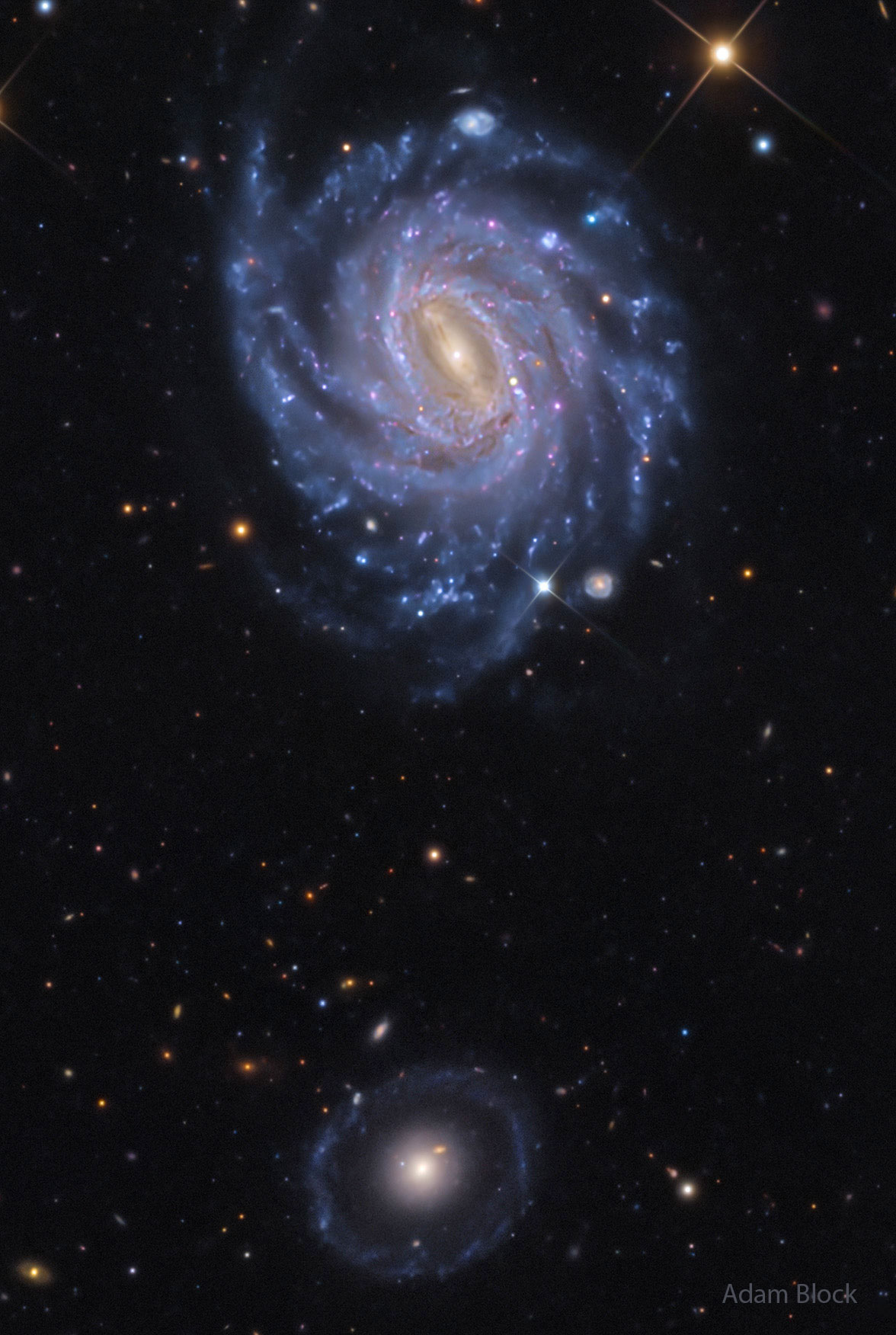
NGC 3660 and Burçin's Galaxy
2026-05-26
The upper galaxy might be more photogenic, but the lower galaxy is more unusual. The galaxy up top is NGC 3660, a spiral galaxy similar to our own Milky Way galaxy in that it has several bright blue spiral arms and a central bar of stars, dust, and gas. Captured by chance in the featured deep and colorful image, surprisingly, is SN 2026cff, a supernova found just to the right of the central bar. Farther in the distance is the bottom galaxy, known informally as Burçin’s galaxy, but formally cataloged as LEDA 1000714. The center of this galaxy appears to be an old elliptical galaxy, but it is strangely surrounded by not one but two rings of stars. What created Burçin's galaxy is a mystery and remains a continuing topic of research, but it likely involves the accretion of one or more smaller galaxies.
via NASA APOD
Key facts
- Discovered by
- F. Sy
- Discovery site
- Algiers Observatory
- Discovery date
- 2 October 1916
- Named after
- Bouzaréah
- Alternative designations
- 1916 c · 1928 YA, A916 UN
- Minor planet category
Article
859 Bouzaréah, provisional designation 1916 c, is a dark asteroid from the asteroid belt about 74 kilometers in diameter. It was discovered by French astronomer Frédéric Sy at the Algiers Observatory in Algeria, North Africa, on 2 October 1916.
The asteroid orbits the Sun at a distance of 2.9–3.6 AU about once every 6 years (2,117 days) and rotates around its axis in 23 hours. Its low geometric albedo of 0.047 has been measured by the Infrared Astronomical Satellite, IRAS.