Encyclopedia of Life · EOL (see source)
Corynebacterium
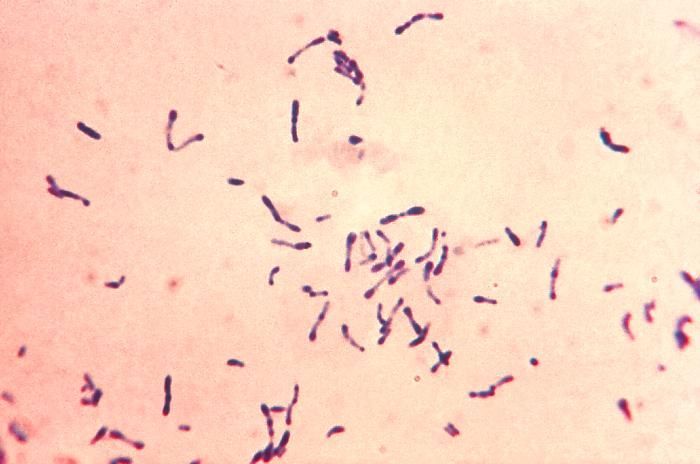
Sign in to saveCorynebacterium () is a genus of Gram-positive bacteria and most are aerobic. They are bacilli (rod-shaped), and in some phases of life they are, more specifically, club-shaped, which inspired the genus name (coryneform means "club-shaped").
Species
コリネバクテリウム属
GENUS
- KingdomBacteria
- PhylumActinobacteriota
- ClassActinomycetia
- OrderMycobacteriales
- FamilyMycobacteriaceae
Corynebacterium (von griechisch κορύνη korýnē, deutsch ‚Keule‘) ist eine Gattung aerob bis fakultativ anaerob lebender, grampositiver Bakterien mit hohem GC-Gehalt. Die Vertreter sind zwischen 3 und 5 μm lang, bilden keine Sporen und sind unbeweglich. Corynebakterien gehören in die CMNR-Gruppe, wie auch Mycobakterium, Nocardia und Rhodococcus. Diese Gruppe zeichnet ein hoher G+C Gehalt im Genom aus, sowie Mykolsäuren, Arabinogalactan und Peptidoglycan in ihrer Zellmembran. Die Gattung ist vielfältig; einige Vertreter sind für den Menschen oder Tiere pathogen. Andere sind Saprophyten und leben auf verfaulenden Pflanzenresten. Einige Arten kommen häufig in der Schleimhautflora und auf der Haut des Menschen vor.
via GBIF
Research
18,395 papers- An underestimated pathogen: Corynebacterium species.Journal of clinical microbiology · 2025
- Corynebacterium durum and possibilities of its identification.Epidemiologie, mikrobiologie, imunologie : casopis Spolecnosti pro epidemiologii a mikrobiologii Ceske lekarske spolecnosti J.E. Purkyne · 2025
- Corynebacterium ulcerans, an emerging human pathogen.Future microbiology · 2016
- [CORYNEBACTERIUM: FEATURES OF THE STRUCTURE OF THE BACTERIAL CELL].Zhurnal mikrobiologii, epidemiologii i immunobiologii · 2017
- Corynebacterium diphtheriae and its relatives.Bacteriological reviews · 1970
via PubMed
Wikidata facts
- Instance of
- taxon
- Parent taxon
- Corynebacteriaceae
- Image
- Corynebacterium.jpg
Show 8 more facts
- taxon name
- Corynebacterium
- Commons category
- Corynebacterium
- taxon rank
- genus
- topic's main category
- Category:Corynebacterium
- taxon common name
- Korünebakterid
- Gram staining
- gram-positive bacteria
- taxonomic type
- Corynebacterium diphtheriae
Sources (2)
via Wikidata · CC0
~20 min read
Encyclopedic overview
11 sectionsContents
- Taxonomy
- Genomics
- Characteristics
- Cell wall
- Culture
- Habitat
- Role in disease
- Industrial uses
- Species
- References
- Further reading
Corynebacterium () is a genus of Gram-positive bacteria and most are aerobic. They are bacilli (rod-shaped), and in some phases of life they are, more specifically, club-shaped, which inspired the genus name (coryneform means "club-shaped").
They are widely distributed in nature in the microbiota of animals (including the human microbiota) and are mostly innocuous, most commonly existing in commensal relationships with their hosts. Some, such as C. glutamicum, are commercially and industrially useful. Others can cause human disease, including, most notably, diphtheria, which is caused by C. diphtheriae. Like various species of microbiota (including their relatives in the genera Arcanobacterium and Trueperella), they are usually not pathogenic, but can occasionally capitalize opportunistically on atypical access to tissues (via wounds) or weakened host defenses.
Excerpted from Wikipedia’s “Corynebacterium” article, available under the CC BY-SA 4.0 licence.