File:Aerogel_hand.jpg · Wikimedia Commons · See Wikimedia Commons
Aerogel is an extremely lightweight, porous solid material made by removing liquid from a gel while preserving its structure, leaving behind a substance that is mostly air. It matters because its combination of low weight, low density, and insulating properties makes it useful for applications ranging from spacecraft insulation to scientific research.
AI-generated from the Wikipedia summary — may contain errors.
Research
6,969 papers- Aerogel-Based Biomaterials for Biomedical Applications: From Fabrication Methods to Disease-Targeting Applications.ReviewAdvanced science (Weinheim, Baden-Wurttemberg, Germany) · 2023Karamikamkar S, Yalcintas EP, Haghniaz R et al.DOI: 10.1002/advs.202204681
- Biopolymer-Based Biomimetic Aerogel for Biomedical Applications.ReviewBiomimetics (Basel, Switzerland) · 2024Jeong Y, Patel R, Patel MDOI: 10.3390/biomimetics9070397
- Advancements in Aerogel Technology for Antimicrobial Therapy: A Review.ReviewNanomaterials (Basel, Switzerland) · 2024Croitoru GA, Pîrvulescu DC, Niculescu AG et al.DOI: 10.3390/nano14131110
- Emerging Trends in Nanotechnology: Aerogel-Based Materials for Biomedical Applications.ReviewNanomaterials (Basel, Switzerland) · 2023Bakhori NM, Ismail Z, Hassan MZ et al.DOI: 10.3390/nano13061063
- Flexible Aerogel Materials: A Review on Revolutionary Flexibility Strategies and the Multifunctional Applications.ReviewACS nano · 2024Hou X, Chen J, Chen Z et al.DOI: 10.1021/acsnano.4c00347
- Trends on Aerogel-Based Biosensors for Medical Applications: An Overview.ReviewInternational journal of molecular sciences · 2024Almeida CMR, Merillas B, Pontinha ADRDOI: 10.3390/ijms25021309
- Aerogel-Based Materials in Bone and Cartilage Tissue Engineering-A Review with Future Implications.ReviewGels (Basel, Switzerland) · 2023Lázár I, Čelko L, Menelaou MDOI: 10.3390/gels9090746
- Nanocellulose-based aerogel electrodes for supercapacitors: A review.ReviewCarbohydrate polymers · 2022Nargatti KI, Subhedar AR, Ahankari SS et al.DOI: 10.1016/j.carbpol.2022.120039
via PubMed
Wikidata facts
- Subclass of
- gel
- Image
- Aerogel hand.jpg
Show 4 more facts
- discoverer or inventor
- Steven Kistler
- Commons category
- Aerogel
- topic's main category
- Category:Aerogels
- time of discovery or invention
- 1931-00-00
Sources (3)
via Wikidata · CC0
~28 min read
Encyclopedic overview
23 sectionsContents
- History
- Properties
- Structure
- Porosity of aerogel
- Knudsen effect
- Waterproofing
- Production
- Gelation
- Drying
- Supercritical drying
- Freeze-drying
- Preparation of non-silica aerogels
- Materials
- Silica aerogel
- Carbon
- Metal oxide
- Other
- Applications
- Safety
- See also
- References
- Sources
- External links
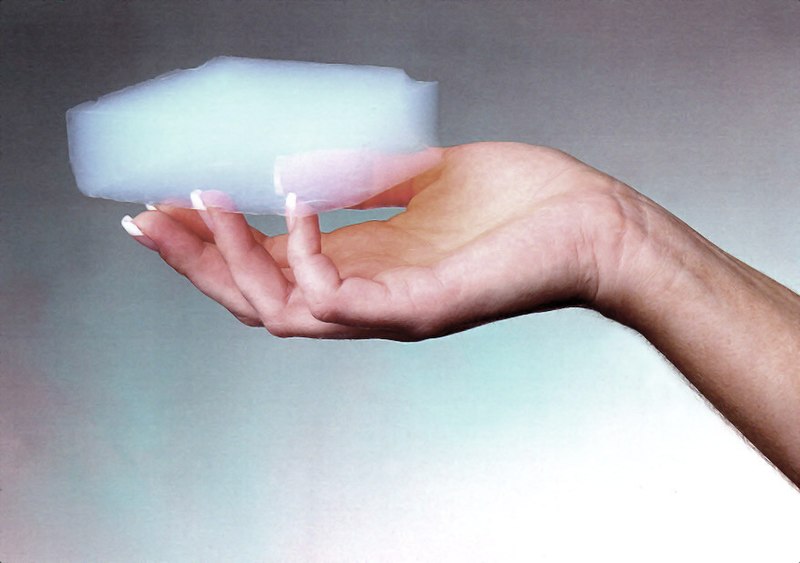
right|thumb|A block of silica aerogel in a hand.
Aerogels are a class of synthetic porous ultralight material derived from a gel, in which the liquid component for the gel has been replaced with a gas, without significant collapse of the gel structure. The result is a solid with extremely low density and extremely low thermal conductivity. Aerogels can be made from a variety of chemical compounds. Silica aerogels feel like fragile styrofoam to the touch, while some polymer-based aerogels feel like rigid foams. thumb|Aerogel crystals produced in ScCO2 drying Aerogels are produced by extracting the liquid component of a gel through supercritical drying or freeze-drying. This allows the liquid to be slowly dried off without causing the solid matrix in the gel to collapse from capillary action, as would happen with conventional evaporation. The first aerogels were produced from silica gels. Kistler's later work involved aerogels based on alumina, chromia, and tin dioxide. Carbon aerogels were first developed in the late 1980s.
Excerpted from Wikipedia’s “aerogel” article, available under the CC BY-SA 4.0 licence.