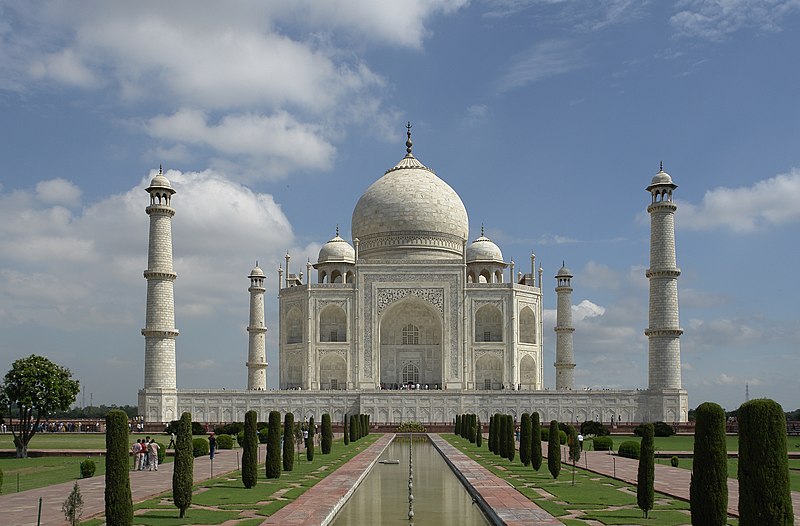
File:Taj_Mahal,_Agra,_India.jpg · Wikimedia Commons · See Wikimedia Commons
Agra
Sign in to saveAlso known as Agrah, Agra, India
Agra (; ) is a city on the banks of the Yamuna river in the Indian state of Uttar Pradesh, about south-east of the national capital Delhi and 330 km west of the state capital Lucknow. It is also the part of Braj region. With a population of roughly 1.6 million, Agra is the fourth-most populous city in Uttar Pradesh and twenty-third most populous city in India.
OverviewAI-generated
Agra is a big city and the capital of Agra district and Agra division in India. It has at various times been the capital of the Mughal Empire, the British Raj, and the Delhi Sultanate. The city is located in the administrative territorial entity of Agra district within the state of Uttar Pradesh. It operates under a municipal corporation form of government and is situated in the Asia/Kolkata time zone, which corresponds to UTC+05:30.
The population of Agra is recorded as 1585705, with another source listing 1430055. Its area is 188.40, and it sits at an elevation above sea level ranging from 166 to 183 meters. The native label for the city is आगरा. Agra is described by sources including Nordisk familjebok and The Nuttall Encyclopædia. Notable features within the city include the Agra Fort, located on SH62 in the Taj Ganj area. The city uses the postal code 282001, the local dialing code 562, and the licence plate code UP-80.
Synthesized by Vinony from 51 facts across 7 sources: Wikidata, Open Meteo, Openweathermap, OpenStreetMap, GeoNames, Vinony graph, Geo. Generated from structured data (not the Wikipedia text) and checked against those facts — may still contain errors.
Weather now
7-day forecast
via Open-Meteo
Place details
- Locality
- Agra
- Region
- Uttar Pradesh
- Country
- India
- Population
- 1,430,055
- Timezone
- Asia/Kolkata
via OpenStreetMap · GeoNames
Key facts
- Settlement.settlement_type
- Metropolis
- Settlement.nickname
- The Taj City (Taj Nagari)
- Settlement.pushpin_map
- India Uttar Pradesh#India#Asia
- Settlement.pushpin_label_position
- right
- Settlement.pushpin_relief
- yes
- Settlement.subdivision_type
- Country
- Settlement.subdivision_type1
- State
- Settlement.subdivision_type2
- Division
- Settlement.subdivision_type3
- District
- Settlement.subdivision_name1
- Uttar Pradesh
- Settlement.subdivision_name2
- Agra
- Settlement.subdivision_name3
- Agra
- Settlement.founder
- Sikandar II
- Settlement.government_type
- Municipal Corporation
- Settlement.governing_body
- Agra Municipal Corporation
- Settlement.leader_title
- Mayor
- Settlement.leader_name
- Hemlata Divakar
- Settlement.leader_party
- BJP
via Wikipedia infobox
Wikidata facts
- Instance of
- big city
- Official name
- आगरा
- Country
- Delhi Sultanate
- Located in
- Agra district
- Continent
- Asia
- Population
- 1585705
- Area
- 188.40
- Elevation
- 171
- Time zone
- UTC+05:30
- Form of government
- municipal corporation
- Capital of
- Mughal Empire
- Official website
- agra.nic.in
- Image
- Aks The Reflection Taj Mahal.jpg
- Dialing code
- 562
- Licence plate code
- UP-80
Show 11 more facts
- category for people who died here
- Category:Deaths in Agra
- Commons category
- Agra
- postal code
- 282001
- topic's main category
- Category:Agra
- category for people born here
- Category:Births in Agra
- category of associated people
- Category:People from Agra
- Commons gallery
- आगरा
- native label
- आगरा
- P8168
- Przywory Duże
- urban population
- 1760285
- P12749
- Sternschanze
Sources (8)
via Wikidata · CC0
Travel guide
Understand
thumb|300px|The Taj Mahal as seen from Mehtab Bagh, across the Yamuna River.
Get in
thumb|300px|The walls of the Agra Fort Agra is 200 km southeast of Delhi and is one of the points of the tourist's Golden Triangle of Agra-Delhi-Jaipur. Agra is also very well connected via rail and road with other nearby cities and tourist destinations, and thus suitable for a day trip from Delhi or as a part of a larger itinerary.
Get around
Metro, electric buses, tongas (horse-drawn carriages) and e-rickshaws are readily available and the best way to get to the Taj Mahal. As polluting vehicles are banned around the Taj, you need to use a tonga or an electric auto while travelling in the vicinity. Camels are also available.
See
Agra's top two sights by far are the incomparable Taj Mahal and Agra Fort.
Do
City Walks: Other than the monuments visits, one can also stroll in the local markets in old city area. It's a nice experience to have a walk in one of the oldest parts of the city.
Buy
Agra has many shops selling stone products, from jewellery to small boxes and plaques with inlay work resembling that on the Taj. The best of these are wonderful, and even the run-of-the-mill ones are rather pretty. Agra is also famous for its leather goods. Consider spending time in Sadar Bazaar for some shopping and cheap food. These markets have gemstones, both precious and semi-precious, cut and polished but unset, and finished jewellery. You can also find chic boutiques, classy leather goods, culturally-designed clothing, and marble markets.
Beware of being overcharged. Do not let anyone lead you to a shop, lest the price go up to cover their commission, typically 50%. Be very wary of the promises these people make. Bargain hard. Be prepared to walk away, you can nearly always get the same items in another shop or order items you liked during your visit over the Internet after you return. Expect to encounter petty and greedy shopowners who will resort to every lie in the book to make a sale (with initial markups of 1,000-10,000%).
There are many local markets: Sadar Bazar. a sophisticated market, Raja ki Mandi market, Sanjay Place for all the offices, Shah Market for electronics. All of these markets are situated along the M G Road. Hospital Road Market and Subhash Bazar for clothes situated near Agra Fort railway station. Rawatpara market is for spices. Besides these there are many branded shops along the M G Road.
Many wholesale marble products are available at Goku…
Eat
Agra specialities are petha, a type of very sweet candy, and Dal Moth, a spicy lentil mix. Both are also popular souvenirs.
Chaat - Agra is a heaven for any Chaat lover. Chaat can be of various types but there is one thing common among them all is that they are spicy and you will find crowd outside virtually every chaat stall, especially popular places like Double Phatak (near Sikandra) for Mangores. You'll find quality Bhallas and Panipuri at Sadar and Belangunj. Samosa and Kachori are found at every sweet shop that flood the city. Some typical chaat items are Aloo Tikki (made by roasting mess made out of boiled potatoes), paneer tikka (cubes of cottage cheese baked in a tandoor with spices), pani puri or golguppa (small round hollow shells filled with a potato-based filling and a spicy sweet blend of sauces), mangores, Samosaes, Chachori, etc. If you want to savour the typical Agra breakfast have a bite of one of those spicy Berahi and round it off with sweet Jalebies. Sweets - There are quite a few good sweets shops. The best for the famous petha of Agra are at Hari Parwat, a short distance from Agra Fort. Amongst the well-known shops are Panchi's, Bhimsain BaidyaNath and The Pracheen Petha store. There are many types of petha available but, for the authentic experience, try either the plain one (ivory white) or Angoori flavoured (rectangular and yellow pieces soaked in sugar syrup). Other shops in Agra include: Bikanervala, Deviram, Munnalal Petha, Gopaldas, and Ajanta S…
Drink
A bottle of Indian beer costs around ₹70-100 in a hotel, but there is virtually no nightlife in Agra outside of cultural shows at some of the larger hotels and restaurants. After getting off the streets of Agra and into your hotel, you will not want to go back anyway.
Stay safe
Don't leave cash or any valuables in the hotel room. Cross check all hotel, restaurant and lounge bills for errors. Never pay anyone for anything upfront, including taxi drivers. Beware of pickpockets. If you decide to purchase anything, beware that most items are cheap replicas of original items and not likely to last long. The toys are really poorly put together so do not buy them! During the winter season, the weather of Agra is unpredictable and temperature may go as low as freezing; be well prepared. Some unscrupulous dealers of carpets use the classic 'bait and switch'. If you buy something, insist on carrying it yourself else what arrives in the post might not be what you bargained for. A carpet shop named 'Kanu carpets' is particularly infamous for this. It is prudent to steer clear of shady looking establishments.
Connect
There are several Internet cafés for sending email or uploading digital photos. Sify Iway also offers broadband connectivity at different locations spread all over the city.
Many cheap cafés, such as the Taj Café, offer free Wi-Fi.
Travel guide from Wikivoyage (CC BY-SA 4.0)
~53 min read
Encyclopedic overview
46 sectionsContents
- Pre-Mughal era
- Mughal era
- Later periods
- Post Independence and Mughal legacy
- Geography and climate
- Geography<!--This entire subsection is fully referenced and relatively high quality. Other sections should follow suit.-->
- Climate
- Environment
- Demographics
- Administration and politics
- Administration
- Police administration
- Infrastructure and civic administration
- Politics
- Utilities
- Economy
- Monuments and architecture
- Taj Mahal
- Agra Fort
- I'timād-ud-Daulah's tomb
- Akbar's Tomb, Sikandra
- Other places of Interest
- City
- Around
- Culture
- Cuisine
- Taj Mahotsav
- Transport
- Air
- Rail
- Road
- Agra Metro
- Yellow Line (Line 1)
- Blue Line (Line 2)
- Recent developments
- Education
- Universities and colleges
- Schools
- Media
- Notable people
- Movies filmed in Agra
- Sister cities
- See also
- References
- Further reading
- External links
Agra (; ) is a city on the banks of the Yamuna river in the Indian state of Uttar Pradesh, about south-east of the national capital Delhi and 330 km west of the state capital Lucknow. It is also the part of Braj region. With a population of roughly 1.6 million, Agra is the fourth-most populous city in Uttar Pradesh and twenty-third most populous city in India.
Agra's notable historical period began during Sikandar Khan Lodi's reign, but the golden age of the city began with the Mughals in the early 16th century. Agra was the foremost city of the Indian subcontinent and the capital of the Mughal Empire under Mughal emperors Babur, Humayun, Akbar, Jahangir and Shah Jahan. Under Mughal rule, Agra became a centre for learning, arts, commerce, and religion, and saw the construction of the Agra Fort, Sikandra and Agra's most prized monument, the Taj Mahal, constructed between 1632 and 1648 by Shah Jahan in remembrance of his wife Mumtaz Mahal. With the decline of the Mughal empire in the late 18th century, the city fell first to Marathas and later to the East India Company. After Independence, Agra has developed into an industrial town, with a booming tourism industry, along with footwear, leather and other manufacturing. The Taj Mahal and the Agra Fort are UNESCO World Heritage Sites. The city features mild winters, hot and dry summers and a monsoon season, and is famous for its Mughlai cuisine. Agra is part of the Golden Triangle tourist circuit, along with Delhi and Jaipur; and the Uttar Pradesh Heritage Arc, a tourist circuit of Uttar Pradesh, along with Lucknow and Varanasi.
Excerpted from Wikipedia’s “Agra” article, available under the CC BY-SA 4.0 licence.
Gallery (44)
On the map
3 mapped locations
Available in 120 languages
- Español
- Français
- Deutsch
- 中文
- 日本語
- Русский
- Português
- Italiano
- العربية
- हिन्दी
- Afrikaans
- Akan
- Albanian
- Aragonese
- Armenian
- Assamese
- Asturian
- Awadhi
Show 101 more
- azb
- Azerbaijani
- Bahasa Indonesia
- Bangla
- Basque
- be_x_old
- Belarusian
- Bhojpuri
- Bishnupriya
- Bulgarian
- Burmese
- Catalan
- Cebuano
- Central Kurdish
- Chechen
- Croatian
- Czech
- Danish
- dty
- Egyptian Arabic
- Esperanto
- Estonian
- Fiji Hindi
- Filipino
- Finnish
- Galician
- Georgian
- Goan Konkani
- Greek
- Guarani
- Gujarati
- Hausa
- Hebrew
- Hungarian
- hyw
- Irish
- Kannada
- Kashmiri
- Kazakh
- kge
- Kyrgyz
- Latin
- Latvian
- Lithuanian
- Lombard
- Maithili
- Malay
- Malayalam
- Marathi
- Mazanderani
- Minangkabau
- Mingrelian
- Mongolian
- Nederlands
- Nepali
- Newari
- Northern Frisian
- Norwegian
- Norwegian Nynorsk
- Odia
- Ossetic
- Pampanga
- Pashto
- Piedmontese
- Polski
- Punjabi
- Romanian
- Sanskrit
- Santali
- Scots
- Serbian
- Serbian (Latin)
- Silesian
- simple
- Sindhi
- skr
- Slovak
- Slovenian
- Svenska
- Swahili
- Tajik
- Talysh
- Tamil
- Tatar
- Telugu
- Tiếng Việt
- Türkçe
- Ukrainian
- Urdu
- Uzbek
- Waray
- Welsh
- Western Panjabi
- Wu Chinese
- Yakut
- Zaza
- zh_min_nan
- zh_yue
- فارسی
- ไทย
- 한국어
via Wikidata sitelinks · CC0